Why the October 17 Protests in France Are Not Yet the Revolution
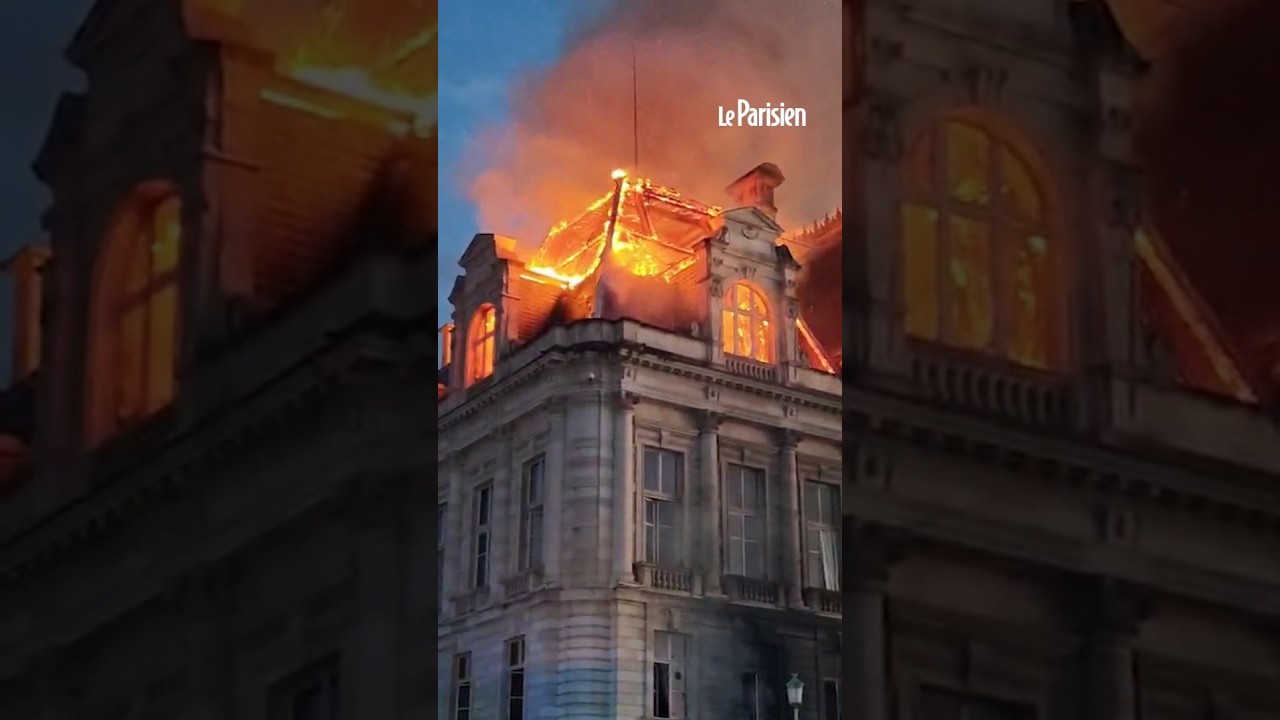
On Saturday, October 17, 550,000 people by the interior minister’s count, 800,000 by the organizers’, marched across France. Limoges city hall burned, and the prefect describes it as largely destroyed. City halls in Marseille and Lille were stormed, and shops were looted in Marseille, Lille, Caen, Nantes, and Valence. By evening the prime minister was reporting 1,200 arrests and 150 police officers and gendarmes injured. In the crowds: high school students who have been in the streets for a month, yellow vests, union members, all under a slogan that says it all, « jaunes et jeunes », the yellow and the young. The president saw nothing but “sowers of chaos,” the prime minister swore he would not be intimidated, and nobody answered the question the day was asking.
What happened on Saturday was not a riot that came out of nowhere. It was the meeting point of two mechanisms political theory has known for more than a century, either of which would be enough on its own to destabilize a regime. The first comes from the nature of democracy itself; Tocqueville described it. The second comes from the nature of capitalism; Schumpeter described it. Both need the same fuel to stay harmless: growth, which France has lacked for seventeen years. If Limoges is not 1789, it is because a third of the electorate has an absolute interest in nothing changing, and because debt has paid for its peace of mind. The first condition still holds. The second is giving way, faster than I was writing even this summer, and the budget presented on October 1 is its first admission.
Tocqueville: equality makes inequality unbearable
In Democracy in America, Tocqueville observes that aristocratic societies tolerate immense gaps without flinching, because inequality is simply the order of things, whereas when everything is nearly on the same level, the slightest are marked enough to hurt it. The further equality advances, the more intolerable the remaining inequalities become, and the more insatiable the desire for equality grows.
I draw from this a consequence he does not state himself but which follows from his premises. In a society of estates, your neighbor’s success is explained by his birth; there is nothing to think about it. In a democracy, only two explanations remain for why someone does better than you: he is more deserving, or he is more dishonest. Human psychology, unsurprisingly, picks the second. Democracy therefore manufactures armies of the discontented as a matter of structure, not because it fails, but because it succeeds at leveling conditions.
There is a release valve, and the economist Albert Hirschman described it in 1973 as the tunnel effect. Stuck in a two-lane tunnel, you are initially pleased to see the other lane start moving: it is a sign that yours will follow. Growth plays exactly this role. As long as it is strong, you tolerate watching others get ahead, because you can reasonably tell yourself that in a few years you will be at the same level. Hirschman adds a detail that always gets forgotten: the longer the tolerance has lasted, the more brutal the reversal when the other lane keeps moving and yours stays put.
Seventeen years without growth: what’s true and what isn’t
Saying that France has had no growth since 2008 is false in the strict sense, and the first contrarian to come along will prove it with a chart: total GDP has grown by roughly 1 percent a year. But Tocqueville’s mechanism does not look at total GDP; it looks at each person’s own trajectory. And there, the INSEE series is unambiguous: real GDP per capita has gained barely 10 percent in seventeen years, half a point a year on average, and in 2024 it fell below the European Union average. At half a point a year, doubling your standard of living takes a hundred and forty years. No tunnel effect survives that arithmetic.
I have written it before: the finite world is an illusion, and growth is a question of choices, not of resources. What France has been missing since 2008 is not raw material. It is a decision.
A generation with no children, no walls, and no patience
The consequence is measurable. According to Ipsos, 64 percent of the French expect their working lives to be worse than their parents’, 58 percent expect weaker purchasing power, and France ranks among the most pessimistic countries in the world about its young people’s future. A generation that no longer believes it will catch up with the privileged has little interest left in keeping the system alive.
Nor is it held back by any of the traditional conservative forces. Having children and owning a roof are the two attachments that make a person cautious, and this generation lacks both. Fertility fell to 1.56 children per woman in 2025, the lowest since the end of the First World War, and the natural balance turned negative for the first time since 1945; I have detailed elsewhere what that does to a social model now in its terminal phase. As for property, 17 percent of households headed by someone under 30 own their primary residence, against 71 percent of those over 70. I argued recently that abundance will have owners or it will have masters. French youth has nothing to conserve, and therefore nothing to make it conservative. A city hall is not its house.
Schumpeter, Turchin, and the overproduction of graduates
The second mechanism comes from Schumpeter. In Capitalism, Socialism and Democracy (1942), he explains that capitalism, by the very logic of its civilization, creates, educates, and subsidizes the people who will come to hate it. Its prosperity funds the expansion of higher education, which produces more intellectuals than the economy has places for. And the man who has been through a university, he writes, becomes “psychically unemployable” in manual occupations without necessarily becoming employable anywhere else. These cohorts see themselves as an enlightened elite facing a system that has no room for them, and they turn structurally hostile.
I add an engine Schumpeter could not see in 1942. Capitalism has pushed industrial and agricultural productivity so far that manual trades have shrunk to a sliver, and society has responded by training enormous cohorts for intellectual work that the economy cannot absorb at that level. However many bullshit jobs we multiply, those positions whose own holders cannot justify their existence, we still produce a great many educated people who are unemployable at the level they were promised.
Peter Turchin gave the phenomenon a name, elite overproduction, and measured it across centuries of data. When the number of aspirants to positions of power massively exceeds the number of positions, the game of musical chairs produces frustrated rejects, and those rejects become counter-elites who channel popular resentment against the established order. Combined with the immiseration of the majority, this overproduction precedes, by his account, nearly every violent political rupture.
France checks every box. Fifty-three percent of 25-to-34-year-olds hold a higher education degree, 26 percent of them a master’s, against an OECD average of 16 percent; roughly eight jobs in ten are in services. The market has found its answer to this surplus, and I have described it: “we’re hiring an intern”, at 4.50 euros an hour, replaceable every six months. And the machine is seizing up at the intake: the movement that ended in city halls on Saturday started on September 18 at a high school in Créteil, over absent teachers who are never replaced and overcrowded classrooms, in a country that has just posted the worst PISA results in its history.
And it is going to get worse, because artificial intelligence is going after precisely the intellectual jobs these cohorts were trained for. I have documented the great dispossession of developers and the freeze on junior hiring that is producing a ghost generation. Turchin locates the danger among the rejected aspirants; AI will produce them faster than universities can graduate them.
What these two mechanisms don’t explain
I am staying here within the classic frame, democracy and capitalism, and it does not tell the whole story of the young people who marched on Saturday. At least three factors shorten the fuses without appearing in Tocqueville or Schumpeter.
The first, Hirschman flagged himself: the tunnel effect assumes you recognize yourself in the people moving ahead in the other lane, and it is weak in societies segmented along ethnic or religious lines, where the other group’s progress signals nothing about your own. I have written that democracy requires a “we” and that diversity lowers trust, including among people who resemble each other, as Putnam measured despite himself. A country that no longer has a shared sky also has less of a shared tunnel: everyone looks at the next lane as a foreign lane. I will be told the problem is not diversity as such but the failure to integrate. That is true, and it worsens the diagnosis rather than softening it: you integrate into a lane that is moving, not one that has stopped. Growth integrated the Italians, the Poles, and the Portuguese. Stagnation will integrate no one.
The second is trust in institutions, meaning trust in the idea that voice still accomplishes anything. Sixty-five percent of the French believe the government is not listening enough to the high school students, and that figure is the endpoint of a long series: a referendum circumvented in 2008, parliamentary inquiries that bury what they find, a stock of trust evaporating one shoe at a time. A youth that believes neither in catching up economically nor in the usefulness of voting has only the street left, and the street is all the more violent for how long voice has been useless.
The third is the most damning for the state: France manufactures the very gaps that wound. Low-emission zones that bar 40 percent of vehicles from major cities, an energy certificate that dispossesses modest homeowners, a society of estates in which the protected are shielded and the exposed pay: each measure draws a new line between those who can pay and those who cannot, and presents it as a virtue. Add paid parking whose revenues have jumped 84 percent since 2018, free-flow tolls that turn six euros into 375, a property tax up 35 percent in five years and 31,000 euros of renovations for the right to rent out a home, an E85 fuel first encouraged and then taxed. Taken one by one, these measures are anecdotal; taken together, they are the daily life of peripheral France, the France that owns a car because it has no subway and a house rated F because it does not have 31,000 euros. Tocqueville describes a democracy in which the slightest gaps wound; ours invents new ones by decree, and sends the bill.
None of these factors contradicts the diagnosis. They do not change the fuses; they shorten them. Short fuses, zero growth, a generation with no attachments: everything is in place for the explosion. And yet something is missing, and that something votes.
Why it hasn’t blown up yet
So, kaboom? Limoges city hall would say yes. I say not yet, for a reason of arithmetic. There is one segment of society with an absolute interest in keeping the system exactly as it is: retirees. There are 17.3 million of them according to DREES, the statistics office of the social ministries, a little more than a third of the roughly 49 million registered voters. And they vote. In the 2022 legislative elections, a third of retirees stayed home, compared with more than 60 percent of employed workers and 71 percent of 18-to-24-year-olds. At the ballot box they carry something like four votes in ten; in party primaries they can make up half of all voters. On Saturday, they were not the ones forcing the doors of city halls.
I have explained that degrees don’t vote, but wallets do: the real variable is who signs your paycheck. For seventeen million people, it is the state, every month, indexed to inflation. The electorate most dependent on public spending is also the most mobilized, and in the France of estates it forms by far the largest of the protected orders.
Their role is ambivalent. They prevent the destructive revolution, because they would lose everything in it. But they also prevent any reform capable of making the system viable, because every reform of the system is a reform of their income: the dead end of pay-as-you-go pensions comes down to that single equation. We had the demonstration ten months ago, when the pension freeze written into the 2026 budget was abandoned in December before it ever existed. The country is frozen at the exact point where it can neither explode nor heal.
The objections
October 17 already is the revolution. No. A revolution is not a city hall on fire; it is a breaker that trips: the day seventeen million retirees stop defending the status quo, or the day the state can no longer pay them. Neither happened on Saturday. What happened was the end of a convenient illusion, that of a youth that abstains instead of rebelling. For years, abstention was what Hirschman called exit rather than loyalty, and 71 percent of 18-to-24-year-olds were exiting. On October 17, voice came back through the only door left open to it: 86 percent of the 6,800 people taken into custody during the high school movement are minors. The other door was shut in 2023, when months in the streets against the pension reform ended in a bill passed without a vote, under Article 49.3, the device by which a government’s “responsibility” now commits it to nothing. I have described how the state and Big Tech methodically disarmed our anger; a dam that holds because it was raised is not a river that has run dry, and on Saturday the water went over the top. Tocqueville himself, in The Old Regime and the Revolution, noted that 1789 did not come at the depth of misery but at the moment things began to improve: that is Hirschman’s reversal. So the real danger is not this Saturday of stagnation; it is the first recovery that benefits some and not others. Concretely: wages picking up in AI, defense, and energy, for those already working there; real estate climbing again on the first rate cut, for those who already own; portfolios swelling, for those who have one. Three lanes moving while a fourth stands still, and nobody to explain to that fourth lane why it should keep waiting.
Graduates vote for the state; they aren’t revolutionaries. My piece on the sociology of the vote shows as much, and that is precisely the problem: the graduate surplus is currently absorbed by the public and parapublic sphere, starting with the 50 billion euros a year paid out to nonprofits. In other words, by debt. Turchin’s counter-elites are not the median graduate; they are the rejects of the musical chairs. And when the shock absorber gives out, the parapublic chairs will be the first to go.
Retirees aren’t a selfish bloc; they help their children. Correct, and INSEE finds that family help has become common in getting onto the property ladder. But this privatized solidarity works only for the children of retirees who own property. It reproduces inequality inside the younger generation itself, which brings us back to the first mechanism: in a democracy, it is the smallest gaps that wound. I return to this below, because it is also the key to the solution.
The end of the shock absorber
What paid for peace on both sides, indexed pensions for one and subsidized patience for the other, was debt. It now stands at 119 percent of GDP, or 3,595 billion euros, a record. On October 1, France borrowed for ten years at 4.92 percent, its highest rate since 2002 and higher than Italy’s, after a rise of 1.13 points between July and October, and the spread against Germany reached 1.3 points, its widest since 2012. I proposed in the aftermath a national bond reserved for private savers rather than paying that price to the markets. Interest payments will climb from 79 billion euros in 2026 to 91 billion in 2027, and they have become the state’s largest line item, ahead of defense and education.
The speed matters, because it changed this summer. The Senate notes that each additional point of interest costs roughly 30 billion euros a year in debt service after nine years, and that the state’s debt burden could reach 100 billion around 2030, or 2.7 percent of GDP. We have just absorbed more than a point in a single quarter. Twelve billion more in one year for creditors is twelve billion that will be in neither pensions nor paychecks, and the next step is already financed. The shock absorber does not snap all at once; it stiffens. But it now stiffens at the speed of interest rates.
The 2027 budget was presented the same October 1, under pressure from the markets, with 54 billion euros of consolidation. And for the first time, it touches the breaker: 5.5 billion euros asked of retirees, either by partially de-indexing pensions from inflation or by scrapping the 10 percent tax allowance on them, with parliament to decide and with Sébastien Lecornu’s promise that “no pension will go down”. The freeze abandoned in December is back ten months and a full point of interest later, not out of courage but out of necessity. And the same text freezes housing benefits and family allowances: it hits both ends at once, which is exactly what a shock absorber does when it no longer absorbs. The high school students and the yellow vests, with diesel at 2.34 euros a liter for reasons I have explained trace back to Hormuz, read that budget before the commentators did.
Each point of interest answers the fundamental question before any politician gets around to asking it: whom does the French economic machine serve? Its creditors, first. I had set out a timeline; the autumn of 2026 is running ahead of it.
My take
The political task comes down to three moves, and the order matters.
Restart growth first, because it is the only known release valve for both mechanisms, and because without it everything else is a zero-sum game. This is a problem of decision, not of resources, and France’s levers have names and numbers. Labor: full-time French employees work 1,664 hours a year, against 1,786 in Germany and a European average of 1,784. Taxation: 43.6 percent of GDP, including production taxes at 4.4 percent of GDP against 2.4 percent in the EU and 1.0 percent in Germany, which is to say a tax on the act of producing before a single euro is earned. Energy: the one structural advantage we have left, electricity half the price of Germany’s thanks to a fully depreciated nuclear fleet, and we are letting it slip away, since the ARENH regulated-price mechanism expired on December 31, 2025, its replacement only kicks in above 78 euros per megawatt-hour, and 2026 industrial contracts are being signed 35 to 80 percent higher; I have written that electricity was the only truly national lever, and the one never pulled. Housing: 264,800 housing starts in 2025, a pace 20 percent below the average of the previous five years, while regulations pull small landlords’ homes off the rental market. Four levers, four decisions, none of them dependent on Brussels or Beijing. A country that prefers to regulate its decline rather than build its future has chosen stagnation, and can therefore choose otherwise.
Then redirect wealth toward working people, and not through a check in the mail: I have said enough about universal basic income as a leash. Through lower taxes on labor, which I have proposed capping at 35 percent in total, and through ownership: funded pensions for the young, access to productive capital, access to housing. The conservative force French youth is missing is not the police. It is something to defend.
Finally, get around the retirees, and here honesty requires two admissions. There is no electoral majority to be had against a third of the electorate that votes at twice the rate of everyone else. And many retirees already help their children and grandchildren: their resentment does not come from selfishness; it comes from the sense that the effort being asked of them is lopsided, and captured by the state or by creditors rather than by their own descendants. The government, cornered by interest rates, is attempting a partial de-indexing, but with no contract attached: every euro taken from pensions flows into the deficit, and nothing reaches working people. That is the worst of all combinations, angering the breaker without cooling the fuse, and Saturday showed it.
The contract I propose has two clauses, both verifiable. First clause: the partial de-indexing is earmarked by law, euro for euro, to lower the pension contributions of working people, printed on the payslip, and never routed through the general budget; the retiree sees where the effort goes, the worker sees where the gain comes from. Second clause: private transfers are made cheaper than public capture, by raising substantially the tax exemptions on gifts to grandchildren, currently a 31,865-euro allowance plus a 31,865-euro family cash gift every fifteen years, on condition that the money goes toward a down payment on a home or into a stock savings plan. The government is talking about raising the family gift to 50,000 euros, which is the right direction and the wrong order of magnitude. Pensions guaranteed in nominal terms, effort made visible, descendants served before creditors: that is the only version of de-indexing a retiree could vote for, because it is the only one that does not rob him. I have already made, to fund the next-generation Rafale, a fiscal choice I stand behind. None of the seven chairs in the 2027 casting call will say any of this, because all seven are counting on the same third of the electorate.
Limoges burned, and it is not yet kaboom. Both fuses are lit, the breaker is holding, and the debt that kept it cool is starting to heat up. The question “whom does it serve?” was asked on Saturday neither by any candidate nor by a president who saw only chaos. It will be asked by an undersubscribed bond auction, and on that day the answer will have to come fast.