Society No society has endured without the sacred, and France has let its own die out. The republican mystique held the country together for a century, then nothing replaced it, while forty thousand churches crumble in the care of a Republic that owns them but has walked away. I argue for a laïcité that owns who we are: complete freedom of worship for all, but public upkeep of Christian buildings and Christian visibility protected by law. This is not an anthropological necessity; it is an identity choice, and I own it. The state oversees the stone, never the faith.
History Along the Bourne gorges, a single drop of water can spin turbines twice over. Upstream, the Bournillon plant turbines it under 314 meters of head, at the foot of one of the tallest cave porches in Europe; downstream, the Choranche dam catches it again and sends it through a 5,756-meter underground tunnel to the Pont-en-Royans power station for a second pass. From the pioneers of 1893 to the great postwar construction sites, by way of a wonderfully detailed technical report from 1905, postcards and archives tell the story of a plant that grew from 4,500 horsepower to 26.6 megawatts. The chronicle of a discreet piece of engineering, carved into the karst of the Vercors, with a few construction secrets still visible in the cliff face.
Artificial Intelligence Napoleon, Cleopatra, or Josephine Baker telling you their life story to camera in thirty seconds: these AI-generated videos are everywhere on Instagram and TikTok, and as entertainment they work rather well. The trouble lies elsewhere. AI doesn’t know history; it assembles likely patterns, which is why historians keep flagging one anachronism after another. Watch them as fiction and there’s no harm done. The risk starts when the testimony format passes itself off as a source, especially on sensitive subjects. And when a synthetic Josephine Baker signs off with a question about which country we belong to, that isn’t history anymore, it’s ventriloquism.
Culture 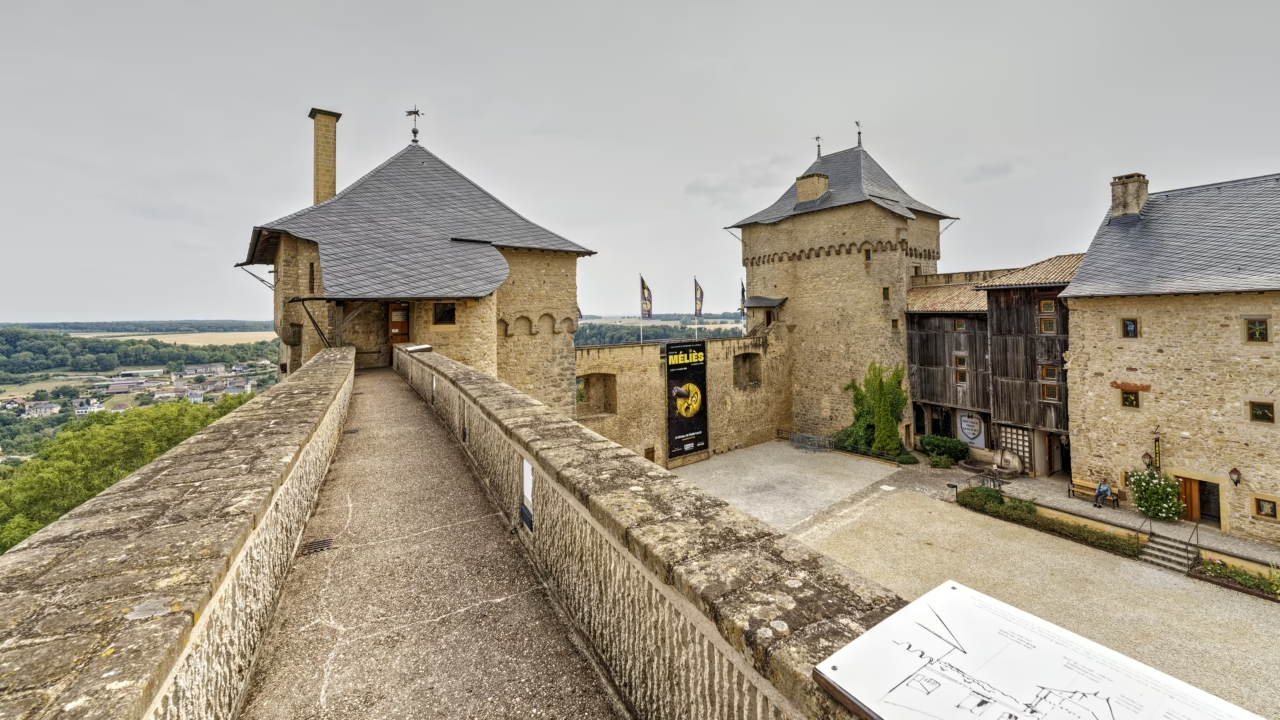
On July 31, 2026, as an extension of a trip through Lorraine, I drove up to Manderen-Ritzing to visit the Château de Malbrouck, a fifteenth-century fortress planted on its rocky spur in the heart of the Three Borders country. I came for the stone, the wall-walks, and the oak framing, with no idea that the castle was hosting an exhibition devoted to Georges Méliès this season, mounted with the Cinémathèque française. A fine surprise for anyone with a long-standing interest in the pioneer of the trick shot: magic lanterns, phenakistiscope discs, hand-cranked cameras, and the plans of the Montreuil glass studio tell the story of a moving image built first from mechanics and stubborn tinkering. A visit recounted, a reflection on what Méliès still has to say about illusion in the age of generated images, and a good place to eat a short walk from the site.
History 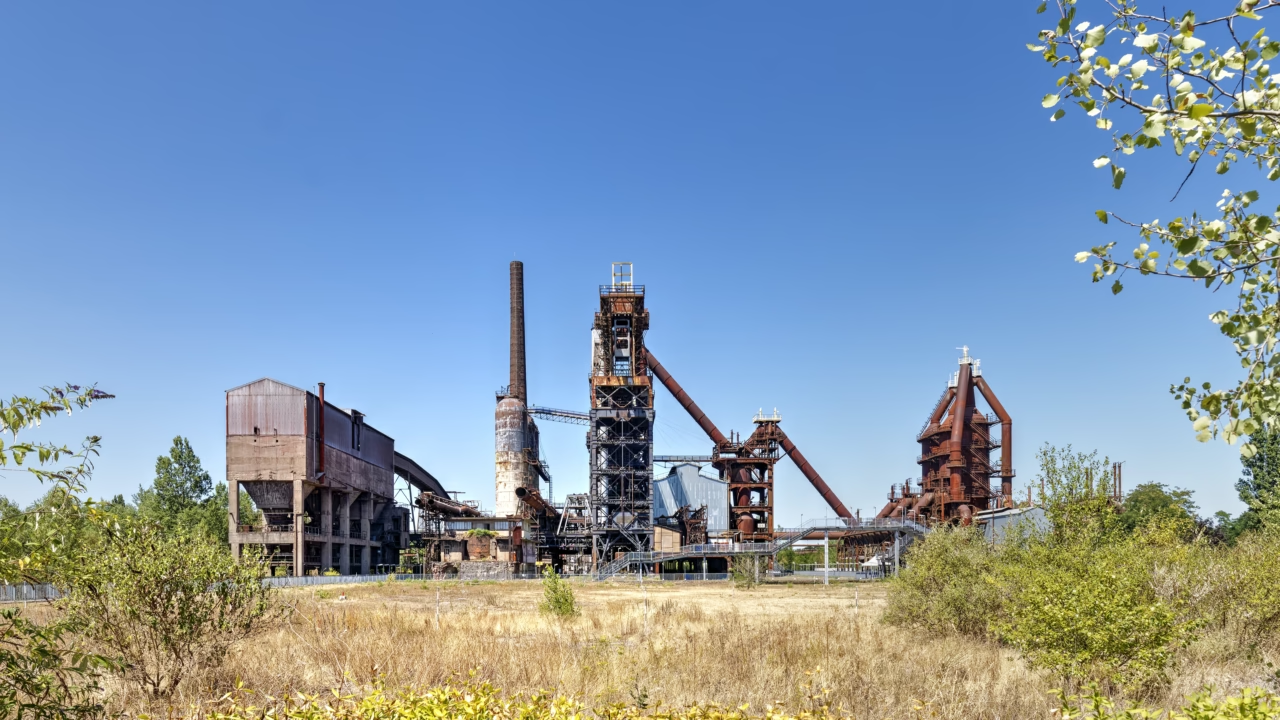
On the way back from a few days on the Nürburgring’s Nordschleife, I stopped in the Fensch valley to visit the U4 blast furnace at Uckange, the sole survivor of six installations at an ironworks that went cold in December 1991, and the only blast furnace in France open to visitors. Thirty acres of industrial wasteland, a 270-foot chimney, a cast house frozen exactly as it stood on the evening of the last tap: the place owes its survival to former workers who fought for ten years to get it listed as a historic monument. Between the Staehler bucket, the production board ruled in chalk, and the union posters from 1991, you grasp what 1,200 people working around the clock actually produced. But a country that puts its blast furnaces behind glass has already answered the question of its industrial sovereignty, and the tour, fascinating as it is, looks a great deal like a very well lit death certificate.
Philosophy When a carmaker discovers a defective part, it issues a recall notice. France has never done so for its intellectual products. Yet Foucault, Derrida, and Deleuze supplied the mechanisms that American campuses assembled into an identitarian war machine, with no manual and no safeguards, while their authors looked on, flattered. Forty years later the product is coming back to us by the containerload, and indictments are no longer enough. Here is the recall notice, and the warranty work starts now.
Politics Eric Zemmour’s debate with François Bayrou is the best France has seen in a long while: two speakers who listen, argue, and summon French history without demonizing each other. But debating well is not the same as debating the right thing. Behind one man’s civilizational hierarchy and the other’s fiscal alarm lies a shared blind spot: the 1.7-trillion-euro state machine that produces both crises at once, and that neither proposes to dismantle. With every figure checked, from the foreign holders of French debt to the wealth gap with the Netherlands, this article shows why the face-off replays Marc Bloch’s strange defeat in miniature. And why 1958, which Zemmour invokes, was saved not by an orator but by an economist.
Democracy Le multiculturalisme ne peut pas fonctionner dans le cadre d’une démocratie libérale. Ce n’est pas une question de dosage, de bonne volonté ou de moyens. Appelons ça une loi, si le mot gêne les puristes : une tendance lourde, une constante empirique que trois continents et un siècle d’expériences reproduisent sans exception. Putnam l’a démontré malgré lui : plus un quartier est culturellement diversifié, moins les individus se font confiance, pas seulement entre groupes différents, mais au sein de chaque groupe. Quand le “nous” commun s’effondre, les individus retournent à leur appartenance primaire, l’élection devient un recensement ethnique, et le perdant ne reconnaît plus la légitimité du vainqueur : il conteste celle du système.