Château de Malbrouck: film magic where I least expected it
On July 31, 2026, in the middle of a trip through Lorraine that had already taken me to the U4 blast furnace in Uckange and onto the treetop walk above the Saarschleife, I drove up to Manderen-Ritzing, at the northern tip of the Moselle, a few miles from the point where France, Germany, and Luxembourg meet. I came for the fortress. I left with something else entirely on my mind.
A fortress that doesn’t pretend
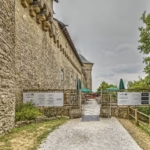
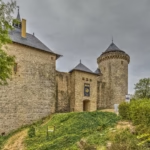
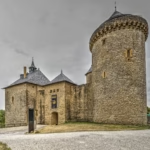
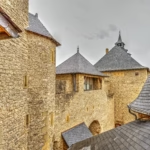
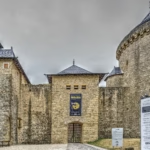
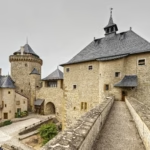
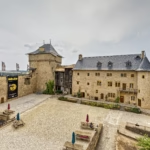
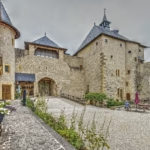
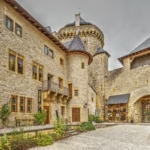
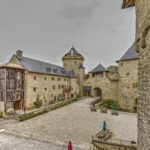
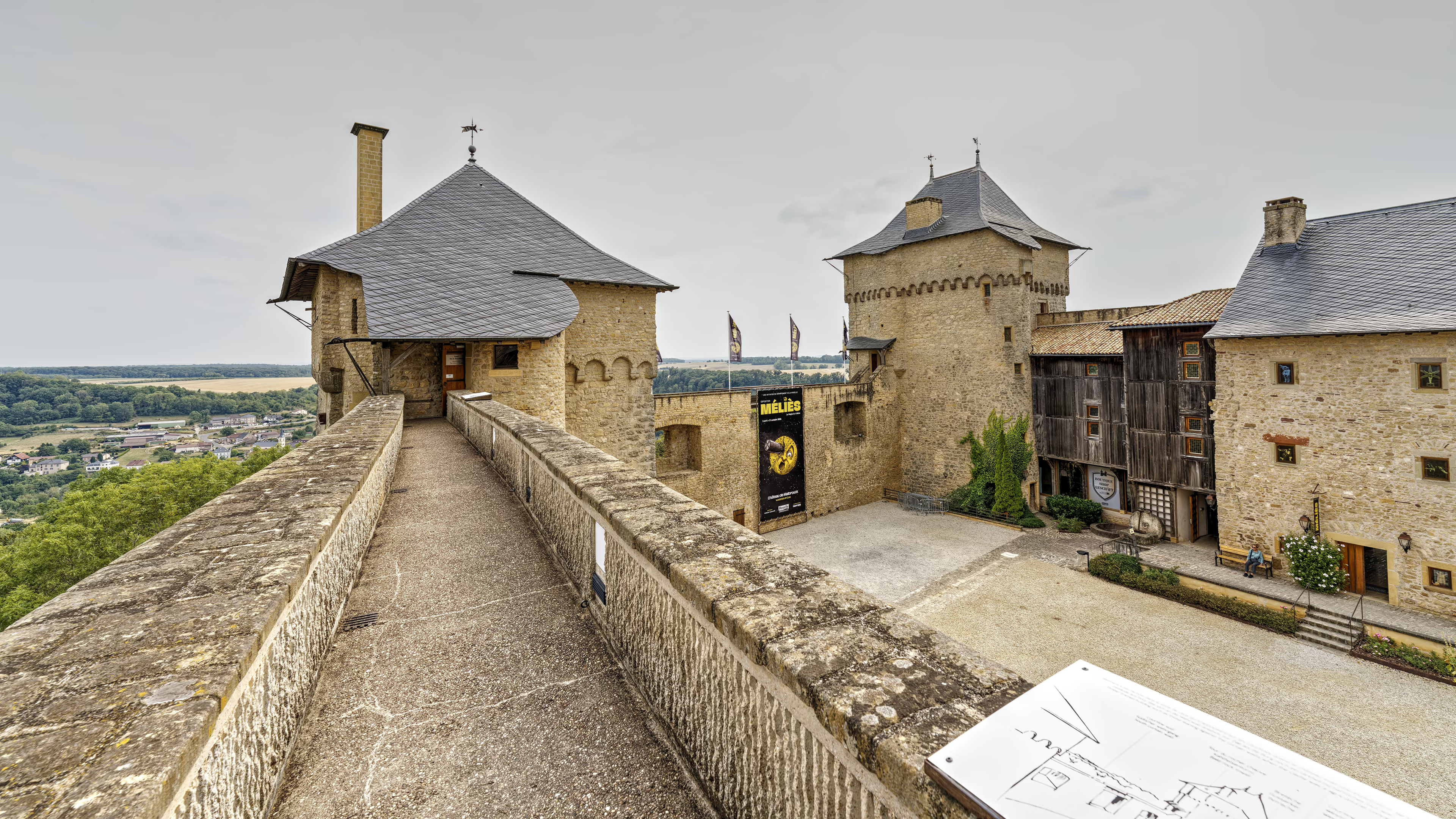
You see the Château de Malbrouck before you reach the village. It sits on the Meinsberg hill, three hundred and sixty feet above Manderen: four heavy corner towers, curtain walls that look nothing like decoration, and a position that tells you immediately why it was built here and not three hundred yards farther on. This is an early fifteenth-century stronghold, raised between 1419 and 1434 by the knight Arnold VI of Sierck, and known at the time as Meinsberg.
The name it carries today comes from a much later episode. In 1705, during the War of the Spanish Succession, John Churchill, Duke of Marlborough, made the castle his headquarters. The name stuck, worn down in French to Malbrouck, and lives on in a nursery-rhyme tune that generations have hummed without knowing who it was about. The building then met the usual fate of fortresses that outlive their purpose: abandonment, ruin, encroaching vegetation, and finally the destruction of the Second World War. Listed as a historic monument as early as 1930, it was bought in 1975 by the Moselle departmental council, which launched a restoration campaign in the late 1980s and completed it in 1998.
A heavy-handed restoration, then, and I know how that phrase lands. I have written before about the jarring contrasts of the Notre-Dame reopening, and I stay alert to the precise moment when a monument tips over into stage set. Malbrouck doesn’t tip. The slate roofs, the exposed oak framing, the old tiles on the main range, the wall-walks you can actually walk: you move through a castle here, not through a reconstruction. Compared with other buildings I’ve looked at more closely, such as the Château Laurent in Saint-Nazaire-en-Royans and its far less certain future, Malbrouck had the good fortune to be taken on by a public body that stayed the course.
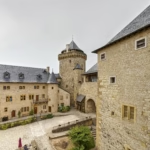
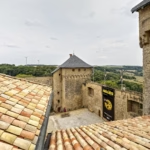
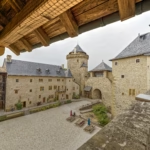
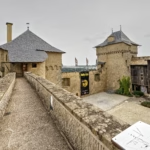
That, in fact, is the first pleasure of the visit, before you reach a single exhibition room. You climb onto the ramparts, follow the wall-walks, look down into the courtyard from beneath a timber roof, and the layout of the place becomes something you understand physically rather than intellectually. The landscape of rooftops seen from above, all conical turrets and bell-cotes, is worth the trip on its own if you’re carrying a camera.
The exhibition I never saw coming
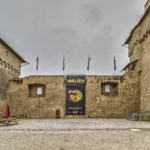
I had prepared nothing. I had no idea a temporary exhibition was occupying the castle this season, still less that it was devoted to Georges Méliès. Spotting the banner in the courtyard was, to put it mildly, a very welcome surprise, because Méliès is a figure I’ve been drawn to for a long time.
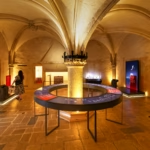
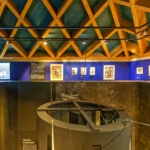
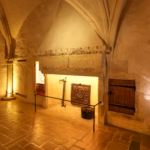
The exhibition is called “Méliès, la magie du cinéma.” It runs from April 3 to October 31, 2026, and was put together with the Cinémathèque française, which is celebrating its ninetieth anniversary this year. After eight seasons given over to comics, the Moselle department is changing ground and moving from the ninth art to the seventh. The route opens with a screening of restored films, then unfolds through the vaulted halls and up under the roof timbers.
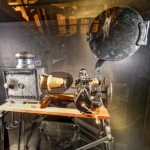
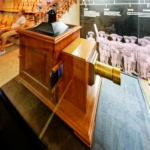
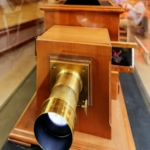
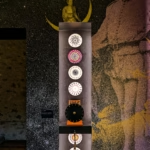
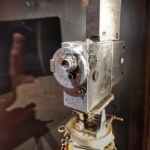
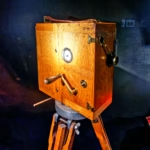
What strikes you is the decision to show the machines. Not just the posters and the images, but the objects themselves: magic lanterns in wood and brass, hand-painted glass slides, phenakistiscope discs, hand-cranked projectors, movie cameras mounted on wooden tripods. You see where the moving image came from, and how thoroughly it began as a matter of mechanics, light, and stubborn tinkering.
If you’d like to arrive with the context already in place, or simply to fill in what school never bothered to teach you, I strongly recommend Vincent Tulli’s talk on the birth of cinema, posted on his Cineastuces channel. A sound engineer by trade, with two Césars to his name, he traces the entire lineage of moving images, from optical toys to the first cameras, with a clarity I haven’t found anywhere else. An hour well spent, and the visit is all the better for it.
Méliès, or illusion without apology
What makes Méliès so compelling is that he came to cinema through the stage rather than through the technology. A conjurer and the director of the Théâtre Robert-Houdin, he bought a camera because he saw in it a new instrument of illusion. Where the Lumière brothers filmed a train pulling into a station, he filmed things that did not exist. Between 1896 and 1913 he made more than five hundred films and invented, along the way, more or less the entire grammar of the trick shot: substitution, superimposition, dissolves, painted backdrops, miniatures.
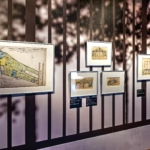
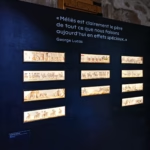
The exhibition displays the plans of his property in Montreuil along with the architectural drawings of his glass studio, the transparent shed where he shot by daylight. That is where the nature of his work shows most clearly: a craftsman’s workshop, not a laboratory. A George Lucas quotation painted across one wall sums up the debt his heirs owe him, and it isn’t overstated.
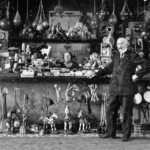
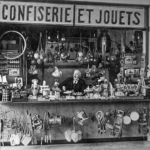
The end of the story isn’t glossed over. Ruined and stripped of his films, a portion of which were melted down to recover the celluloid, Méliès spent years running a candy and toy stall in the Montparnasse train station. The 1931 photographs showing him behind the counter, white mustache and dark suit, surrounded by pull-along horses and toy drums, are among the hardest images in the show. The inventor of special effects selling barley sugar: it would be difficult to find a more brutal shortcut between an invention and its reward.
And I can’t help hearing an echo of more contemporary arguments. I’ve written here that the pixel has become a commodity, and that image generation tends to produce fake vector art rather than the real thing. Méliès is a reminder of something simple: the trick was never the problem. What matters is what you use it to tell, and who ends up collecting on it. The lesson reaches well beyond cinema, and it lines up with what I’ve argued about unique know-how as the only durable advantage once the tool itself becomes ordinary. Méliès had the know-how. What he lacked was the structure to protect it.
Dinner at the Relais Manderen
One detail that turns out to matter after a day spent climbing up and down stone staircases: we had dinner at the Relais Manderen, on rue du Château, a few hundred yards from the castle. Excellent meal, faultless welcome, local cooking and a menu that follows the seasons. Worth noting if you’re planning a late-afternoon visit, all the more so because having the place right there spares you from getting back in the car to hunt for a decent table, which is not always a given in this stretch of border countryside.
If you go
The Château de Malbrouck is on rue du Château in Manderen-Ritzing, in the Moselle, close to Schengen. The cultural season runs from April through November, and “Méliès, la magie du cinéma” is on view until October 31, 2026. Give yourself enough time to take it slowly: between the exhibition route, the historic rooms, and the wall-walks, half a day goes by easily. Check hours and admission on the official site before setting out, and note that the ticket office closes an hour before the castle does.
A note for photographers: the yellow limestone of the façades and the slate of the roofs work beautifully under an overcast sky, which spares you the unmanageable contrast in the courtyard. As at the U4 and the Saarschleife, I left my beloved 35 mm at the bottom of the bag and shot everything on the Sony 14 mm f/1.8 GM. It’s the right call here: the vaulted rooms are dark and the volumes tight, the wall-walks give you no room to step back, and the wide aperture keeps you from pushing the ISO, a subject I’ve already had my say about in connection with the Minolta legacy at Sony. The one discipline a focal length like that demands: keep the camera level, or the towers will start converging the moment you tilt up.
Gallery