Zemmour vs. Bayrou: Two Brilliant Officers Fighting the Last War
There are debates you watch to see someone get destroyed. And there are debates you watch because you learn something. The one that pitted Éric Zemmour against François Bayrou on Alexandre Devecchio’s show, under the title “Can France Still Avoid Another Strange Defeat?”, belongs to the second category. Let me say this up front, for the reader skimming in a hurry: the defeat this article ends on is not the debate itself, which was excellent. It lies elsewhere, it is collective, and both debaters take part in it without knowing. But first, let us give the exercise its due.
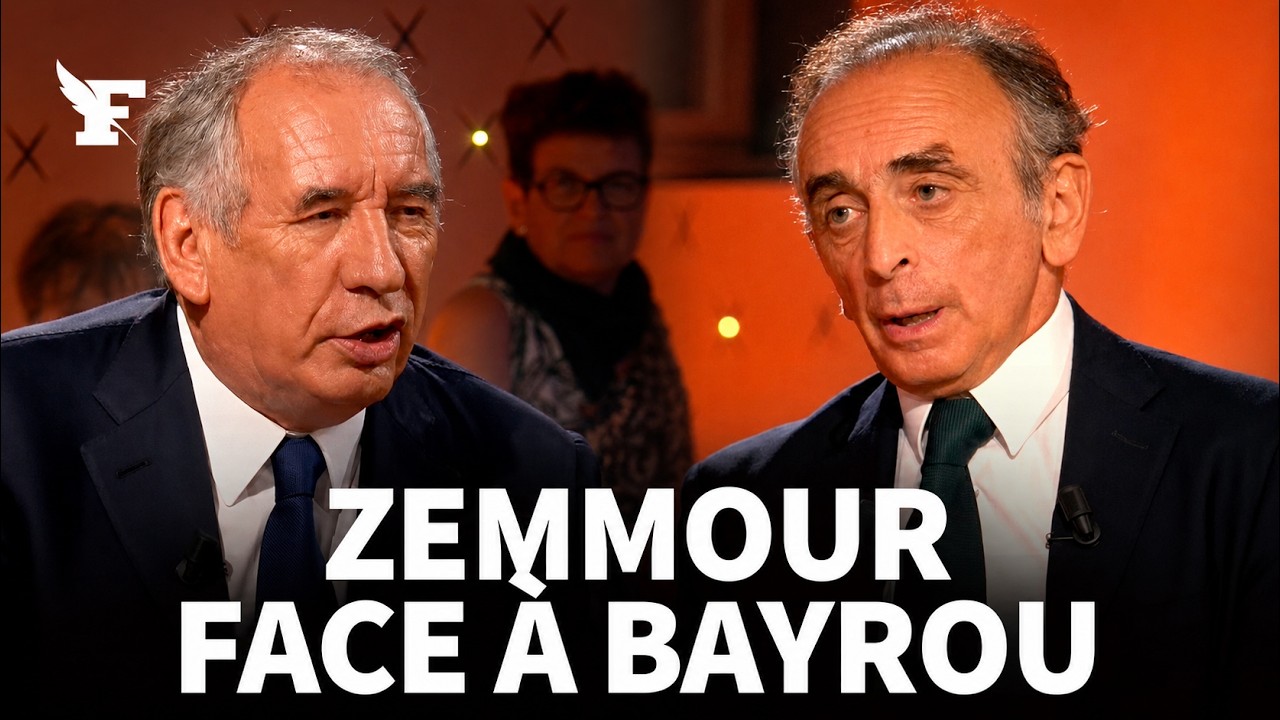
The serenity of people who have something to say
The first sign that a speaker is in trouble is compulsive interruption. When you cut someone off before they finish, it is almost always out of fear. Fear that they will plant an argument you won’t know how to demolish. Fear of forgetting your rebuttal if you wait too long. Fear of losing control of the tempo.
There are, of course, strategic interrupters, who cut in not out of panic but to break a narrative that is starting to take hold. Jean-Luc Mélenchon excels at this. But for the vast majority of debaters, interruption is not a weapon. It is a confession.
Zemmour and Bayrou rarely interrupt. Not because they are especially polite, but because they have working memory. They can hold the opponent’s argument in mind, spot its flaws, and calmly wait their turn to exploit them. A good speaker can even take pleasure in listening to the other side unspool, watching the weaknesses pile up, knowing he will get to dismantle them when the floor comes back to him.
It is a skill that comes with experience. Young debaters interrupt. Seasoned orators wait.
Two coherent worldviews
The second reason the exchange works is that both men hold positions that are structured from end to end. Zemmour lays out an explicit hierarchy from the start: the civilizational question outranks the economic one. The debt is a serious problem, but a secondary one next to the risk of the French people becoming a minority on their own soil. Bayrou answers with the inverse hierarchy: the immediate danger is the public impotence generated by the debt, and without economic sovereignty, no policy, on immigration or anything else, can be carried out.
Both lines of reasoning hold together. The two men disagree, but they are debating the same subject with the same conceptual tools. That is rare. Most televised debates pit someone who argues against someone who demonizes. Here, both argue.
Disagreement as an engine
The most revealing moment is the exchange over the Edict of Nantes, the 1598 decree by which Henri IV granted France’s Protestants freedom of worship. Bayrou, a self-proclaimed heir of Henri IV, argues that tolerance bought eighty years of peace. Zemmour retorts that it was Richelieu who settled the question by taking La Rochelle. And Bayrou immediately reaches for the reductio ad absurdum: you see what he is saying, he is saying they must be liquidated.
That move is dishonest, and Zemmour calls it out. But the more interesting point is that both positions bend history, each in the direction of its own thesis. Because what follows the fall of La Rochelle is the Peace of Alès of 1629, and that settlement does both things at once: it destroys the Protestant state within the state, its fortified towns and its armies, while fully preserving the freedom of worship guaranteed by the Edict of Nantes. Richelieu neither liquidated nor merely tolerated. He disarmed a community while leaving its faith intact. It was Louis XIV who broke the balance in 1685 by revoking the Edict, triggering one of the first great episodes of capital flight and brain drain in French history: the Huguenots carried their savings, their workshops, and their know-how off to Amsterdam, Geneva, and Berlin.
So Bayrou caricatures Zemmour, and Zemmour claims a victory for force where Alès was in fact an armed compromise. But the exchange itself, two men summoning the history of France to illuminate the present, is exactly what political debate ought to be.
What this says about the general level
We find this exchange enjoyable because the ambient level has sunk so low that two men who argue without calling each other fascists pass for philosophers. That is a somewhat bleak observation. But it is also useful information: in a landscape where most debaters demonize, dodge, and recite poetry, mastering the basics of argumentation has become a considerable advantage.
That observation, however, is not the end of the story. The show’s title refers to Marc Bloch, and Bloch deserves better than decorative use. Strange Defeat, his firsthand autopsy of the collapse of 1940, is not the story of an army short on means. The France of 1940 fielded more tanks than Germany. It is the story of an intellectual failure: brilliant, cultivated, courageous officers who were thinking the previous war. So the question is not whether Zemmour and Bayrou debate well. They debate remarkably well. The question is whether they are debating the right thing.
The false alternative
The two hierarchies that structure the debate, civilization first or debt first, share a common blind spot: neither man questions the machine that produces both crises at once. A state that captures 1,714 billion euros in spending in 2025, or 57.2 percent of GDP, the second-highest level in the European Union, and one that, in Bayrou’s own words, wages war on its own companies.
And the problem is not merely the machine’s size. It is its nature. A state at 57 percent of GDP is no longer a referee; it is the country’s largest economic actor, and it behaves like one: it captures, it redistributes to client constituencies, it discourages the very production it then claims to subsidize. Every euro levied buys an electorate, every regulation shelters a rent, every subsidy creates the lobby that will defend it. Zemmour actually grasps part of this truth, since the clientelism of immigration and identity politics is indeed one of the machine’s service windows, one of those that feed the spending while manufacturing the very tensions he denounces. But he stops at the window that offends him. Bayrou, for his part, wants to patch the treasury of the whole. Neither proposes dismantling the machine itself.
Since both men had the elegance to argue rather than demonize, let us return the courtesy by checking their numbers, in both directions.
Zemmour is right about the amount: 1,714 billion euros in 2025, accurate to the billion. But his claim that the state now spends more than during the “whatever it costs” era of Covid support is a nominal artifact. As a share of GDP, public spending stands at 57.2 percent in 2025 against 61.7 percent in 2020, and most of the increase in current euros since 2019 is inflation. Better, or worse, depending on your vantage point: from 2019 to 2025, French public spending rose by 1.9 points of GDP, against an average of 2.7 points across the eurozone. The French scandal is not the recent drift. It is the starting level. An honest argument is stronger than a spectacular one.
Bayrou, meanwhile, rounds his “nearly 60 percent foreign creditors” upward: non-residents hold 54.7 percent of the French state’s negotiable debt as of the first quarter of 2025, 55.4 percent in the second, and roughly half of those holders are located within the eurozone. But his trajectory is right, and on two points it actually understates reality. First, the short end: 83 percent of French Treasury bills maturing within a year are in non-resident hands, which means the French state’s permanent refinancing depends, week after week, on the goodwill of foreign investors. Second, the dynamics: debt held by non-residents rose from 946 to 1,456 billion euros between 2019 and 2025, while holdings by French insurers fell from 336 to 261 billion. The French saver is withdrawing; the foreign pension fund is taking his place. As for the interest bill, 66 billion euros in 2025 and a projected 78 billion in 2026, it has become the state’s largest budget line, ahead of Defense, and swallows roughly three quarters of income tax receipts. On the hemorrhage, Bayrou speaks the truth.
On one point he even understates it: his 30 percent gap with the Netherlands is conservative. Adjusted for purchasing power, Dutch GDP per capita reaches 55,600 euros against 40,700 for France, a gap of 37 percent, and nearly 48 percent in nominal terms. A country with no oil, no sprawling megacity, no mystique of the strategist state produces more than a third more wealth per person than we do. Only his claim that 500 of the last 1,000 billion euros borrowed went to pensions rests on contested accounting, the ongoing dispute over the state’s implicit over-contributions as an employer, and should be handled with care.
The overall picture, then, is this: both diagnoses are largely accurate on the facts, and that is precisely what makes their shared blindness so striking. They describe the symptoms with precision and argue over the order of treatment, without ever naming the pathology: a state apparatus that absorbs more than half the nation’s wealth, discourages the production it then claims to redistribute, and borrows the difference from abroad. Bayrou’s debt and Zemmour’s collapse of state authority are not two competing crises. They are two invoices from the same supplier.
What 1958 really says
Zemmour closes with an analogy to 1958, the year France was piling up the Algerian war, an institutional crisis, and a financial crisis all at once, and pulled through because France is never stronger than with its back to the wall. The analogy contains an irony he does not seem to see.
Because 1958 was not saved by an orator. De Gaulle’s rhetoric did not fix a single economic aggregate. What straightened France out was the Pinay-Rueff plan: Jacques Rueff, a free-market economist steeped in the Austrian school, a lifelong enemy of inflation and phantom entitlements, who imposed honest prices, an end to cascading subsidies, genuine fiscal consolidation, and a return to convertibility with the new franc. And de Gaulle’s greatness, in this instance, was to accept that plan against his own dirigiste temperament, because reality was no longer negotiating. The recovery of 1958 was not a victory for eloquence. It was a capitulation of politics to economic reality.
That is why this debate, the best we have seen in a long while, remains a strange defeat in miniature. Two brilliant officers are thinking the previous war, one with the cards of civilization, the other with the cards of the treasury, while the machine that produces both routs keeps turning at 1,714 billion euros a year and no one thinks of cutting the engine. The France of 2026 does not lack orators. It lacks a Rueff. And the day it finds one, it will still need a politician with the intelligence, as in 1958, to keep quiet and let him do the counting.