Economy On August 19, 2026, the U.S. Treasury tore up its own schedule to double its long-end buybacks, a day after the 30-year yield hit its highest level since 2007. Behind a move framed as technical lies an unprecedented collision: the AI hyperscalers, carrying $3 trillion in off-balance-sheet commitments, are borrowing along the same maturities and from the same lenders as the federal government. The pool of investors willing to lock up capital for thirty years is finite, and the sovereign has just lost that contest. The bill will not wait for an official crisis: it is already showing up in mortgage rates, in Europe as much as in America.
Softwares Recent iPhones shoot in HEIC, a format no browser displays except Safari. The result on my Invision Community forums: hundreds of photos arriving every day as unusable download links. Rather than explain to every member how to change a setting buried deep in their phone, I built HEIC Uploads, an application that converts those photos to AVIF in the background without ever blocking the post. AVIF turned out to be five times lighter than WebP and four times faster to encode, so there was no trade-off to weigh. The code is published under the MIT license.
Artificial Intelligence ComfyUI and n8n share the same visual grammar, nodes and connections, but they don’t do the same job: one manufactures media with AI models, the other orchestrates events, services, and business rules. Pitting them against each other is a false debate. The real question is where to draw the line between them, and how to combine them into a hybrid architecture in which n8n drives ComfyUI as an asynchronous render engine. From securing the API to decoupling GPU costs, this article lays out the design rules, illustrated by a concrete case: a video translation and lip-sync factory.
Technology The introduction of an invisible statistical watermark in Claude’s outputs marks a troubling shift for regular power users. Beyond this forced text tagging, restricting subscription tokens outside official interfaces and Anthropic’s hostile stance toward open-source AI create major daily friction. As agile competitors rapidly close the gap, Claude’s value proposition no longer makes it an obvious default choice for developers and writers. This article outlines the five key grievances making me seriously reconsider my Pro and Max subscriptions, from ethical concerns to pure economic pragmatism.
Society In Los Angeles, a stage set reproducing the cabin of a private jet rents for under $55 an hour, and it is booked around the clock. Around it, a complete supply chain for the lifestyle has been built: châteaux by the day, Lamborghinis by the half hour, photo cruises on the Seine, Rolexes handed over in the lobby of a luxury hotel. Not one of these companies deceives anyone, they publish their rates online, and that is exactly what makes the operation impossible to prosecute. What remains to be understood is why these accounts always declare the same handful of occupations, the ones nobody can audit, and how they guarantee one another a success none of them has the capital for. An inquiry into Potemkin influencers, and into what it says about a country that success can be rented there by the hour.
Artificial Intelligence Since the AI Act’s transparency obligations came into force, every text produced by Claude carries an invisible statistical signature, woven into the choice of words themselves. Anthropic has signed the European Code of Practice and applies the marking worldwide, including where no legislator ever asked for it. The mechanism is technically sound, unlike the detectors it replaces, but its own author concedes that a detected mark does not prove authorship, and that its absence proves nothing either. What remains is a signal institutions will treat as evidence, a language boundary that is enough to erase it, and a locally run open model that becomes the quiet privilege of producing text whose origin cannot be read.
Justice “For the last month, just take it out of the deposit”: the sentence every French landlord eventually hears, resting on a stubborn misunderstanding. A security deposit can indeed cover unpaid rent, but the landlord applies it at move-out, against receipts, rather than the tenant deciding in advance. Between the statutory cap, the return deadlines, the 10 percent penalty and the 20 percent holdback in condominium buildings, Article 22 of France’s 1989 tenancy law already sets careful limits on both sides. Which leaves a few myths to dismantle along the way, starting with the supposed “registry of defaulting tenants” that does not exist in France and whose very creation would be a criminal offense.
Democracy Bruno Le Maire sat down with Thinkerview, and the comment sections fixed on the interviewer’s crude, familiar tone: the office, apparently, commands respect. That is an Ancien Régime sentiment, because in a republic deference runs from the officeholder toward the sovereign, and what the office adds is not immunity from rudeness but an obligation to account for itself. Yet these critics are holding a good argument they never use: what was missing was not respect, it was the follow-up question. Behind the interview lies the same prosecutorial liturgy that runs on prime-time television, with the prosecutor’s allegiance reversed and the job description unchanged. And as long as accountability exists nowhere, not at the ballot box, not in Parliament, not before a judge, even the best interviews will remain substitutes for the real thing.
Culture 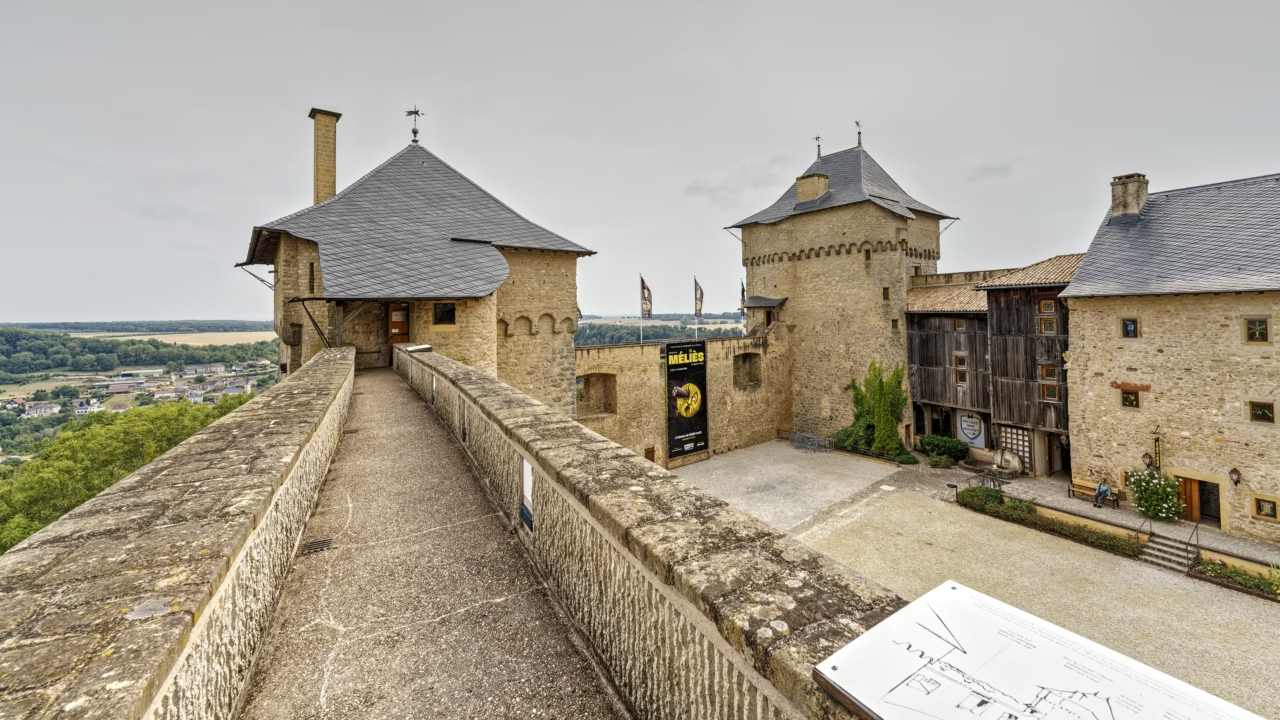
On July 31, 2026, as an extension of a trip through Lorraine, I drove up to Manderen-Ritzing to visit the Château de Malbrouck, a fifteenth-century fortress planted on its rocky spur in the heart of the Three Borders country. I came for the stone, the wall-walks, and the oak framing, with no idea that the castle was hosting an exhibition devoted to Georges Méliès this season, mounted with the Cinémathèque française. A fine surprise for anyone with a long-standing interest in the pioneer of the trick shot: magic lanterns, phenakistiscope discs, hand-cranked cameras, and the plans of the Montreuil glass studio tell the story of a moving image built first from mechanics and stubborn tinkering. A visit recounted, a reflection on what Méliès still has to say about illusion in the age of generated images, and a good place to eat a short walk from the site.
Philosophy Techno-optimist discourse no longer promises tools. It promises deliverance: the end of disease, and then of aging itself. This essay does not try to say whether that promise will hold, but examines its shape, which borrows the grammar of religious eschatology. Noting the resemblance is not enough to discredit a claim, on pain of committing the genetic fallacy. What separates science from belief here is not the content of the promise but its relationship to evidence: what result, what failure, would make you give it up? One of the great forms of faith of our era is taking shape in front of us, and it is being written entirely elsewhere.