Navier-Stokes, PISA 2025, Tondelier: France Meets the AI Shock
Three stories broke on the same day, Tuesday, September 8, 2026. In San Francisco, OpenAI announced that a swarm of 10,000 agents had solved one of the seven Millennium Prize Problems, the Navier-Stokes equations, in 88 hours. Also in San Francisco, an Anthropic researcher resigned, saying that his employer and its rival were gambling with humanity’s survival, and the company’s head of alignment agreed with him. In Paris, the OECD released PISA 2025, and France posted the worst results in its history. And the evening before, on LCI, on a lighter note, a presidential candidate had found nothing to say about Georges Pompidou.
I don’t believe in meaningful coincidences, and I’m not going to sell you a cosmic convergence. But a thread runs through these episodes, and it deserves a pull: from one end to the other, everyone is speaking in the future tense, and no one is rereading the past.
Ten thousand agents and two humans
Let’s start with the one that looks most like a feat. According to OpenAI’s announcement, an unreleased internal model, “significantly more capable than GPT-6 Astra,” coordinated up to 10,000 concurrent agents that exchanged 2.7 million messages and burned through some 130 billion tokens to establish that the three-dimensional Navier-Stokes equations can develop a singularity in finite time. In plain terms: there exist perfectly smooth initial conditions for which velocity becomes infinite in a finite amount of time. This is a mathematical blowup within the terms of the problem statement, not a tsunami in the kitchen sink. Physicists have always known that Navier-Stokes is a continuum approximation of matter, one that stops holding at the scale where matter becomes discrete. The stakes of the singularity lie elsewhere, in whether the equation itself is well posed: whether the model remains deterministic and continuous, or breaks down formally. That is the question the proof claims to settle, in the negative. Sébastien Bubeck, who led the project, calls it the “spectacular culmination” of twelve months of mathematical AI.
Nothing has been validated by the Clay Institute yet, and the announcement is already being challenged on a point far more interesting than the proof itself. Two mathematicians, Tristan Buckmaster (NYU) and Levent Alpöge (Anthropic, working in a personal capacity), had spent nearly a year on exactly this family of approaches, with help from Claude and Codex, and had posted their results in August. OpenAI admits it launched its computation only after hearing rumors of their progress. What followed, as Buckmaster tells it, including the two proposals he was offered and the question of what the model was trained on, deserves an article of its own. It will come in a few days, once both sides have had their say. For now, hold on to one thing: the machine did not ignore the past. Humans decided that a year of work by two other humans did not exist.
Terence Tao reacted even before the announcement, and his phrase is the one to keep. He compares the labs’ race to crack the great open problems to strip mining, which destroys the ecosystem that produced the next generation’s techniques, problems, and mathematicians. AI produces answers, he says, but rarely the idea that explains why this answer and not another, and never the list of dead ends, which is precisely what moves a discipline forward. It’s the same complaint I made last week about the videos that put words in Napoleon’s mouth: the result is dazzling, and it knows nothing of what made it possible.
The salaried prophets
That same Tuesday, Jacob Coxon, 27, with three years of pretraining research at OpenAI and then Anthropic, posted his resignation letter on X. “Neither company is acting responsibly. They are racing straight to self-improving superintelligence and gambling with our lives.” He is leaving the industry. A few hours later, Evan Hubinger, alignment science lead at Anthropic, answered in his own name: Jacob is right, we earnestly believe AI could kill all humans, I personally put it above 10% within the decade, and the company has no plan for aligning a superintelligence and is not clearly on track to have one. OpenAI’s chief scientist, Jakub Pachocki, said the same day that he hoped the industry would slow down.
These are not skeptics. The people who predicted the failure of electric cars, reusable rockets, or robotaxis were saying “it won’t work.” Coxon and Hubinger are building the thing and saying “it works too well.” What stands out in both of their statements is the absence of any chronology. No plan, says Hubinger, so no stages; and without stages, all that remains is a calendar: “within ten years,” “by the end of next year,” as Coxon told the Wall Street Journal. A prophecy that has only dates is the opposite of an analysis, which has causes. And it is being issued from companies whose bankers, that same week, were lobbying the rating agencies for an investment-grade rating ahead of an IPO. An extinction probability above 10% has never appeared in a prospectus. I described in the French-speaking AI bubble on X how manufactured urgency becomes the product; when the urgency comes from inside the lab, it commands a higher price, but nothing proves it is anything else. Sincere or sold, it has the same flaw: no operative past, only a calendar.
Meanwhile, PISA
That same Tuesday again, the OECD published the results of the test taken in spring 2025 by 768,000 fifteen-year-olds across 91 countries and economies, 6,500 of them in France. The OECD’s country note puts it bluntly: the 2025 results are among the lowest France has ever recorded in all three domains, and well below those of 2015. In mathematics, the score fell from 474 to 458 in three years, a sixteen-point drop against nine for the OECD average. In 2012, France stood at 495. Thirty-six percent of students are struggling. The gap between the most advantaged quarter and the most disadvantaged quarter reaches 100 points in science, against an OECD average of 85. We rank 27th, level with Spain and Croatia.
Education Minister Édouard Geffray called the results “worrying” but “not a surprise.” He is right on the second count, and that is exactly the problem: a country that slides with every edition since 2012 and is not surprised by it has stopped rereading its own past. The thread by Charles W., from whom I borrow the line about hitting bottom and continuing to dig, points to a comparison that stings. The United Kingdom was on the same downward slope as France until the mid-2010s, then broke upward after a series of reforms that did precisely what our teacher-training colleges teach you not to do: explicit instruction, mandatory phonics, silence in the classroom, final exams graded by external examiners. The result in 2025: 13% of students at the top performance levels in mathematics across the Channel, against 5% here. One caveat is in order, and Charles W. raises it himself: England excluded 7.6% of its target population in 2025, above the 5% cap set by the OECD, against roughly 3% for France, and part of the gap comes down to that sample. Not all of it, since Scotland and Wales, which share the same bias and did not adopt the reforms, are collapsing just as we are. The countries climbing back are the ones willing to look at what used to work.
Now set the day’s two figures side by side. On one side, several million dollars of compute (at public token prices, the estimate comes to six or seven) and 10,000 agents to close a problem that three generations of mathematicians had failed to close. On the other, one French student in twenty able to reach the level at which one begins, very modestly, to understand what “finite-time singularity” means. The question for France is not whether AI will kill us. It is who, here, will still be able to read the proof.
The night before, on LCI
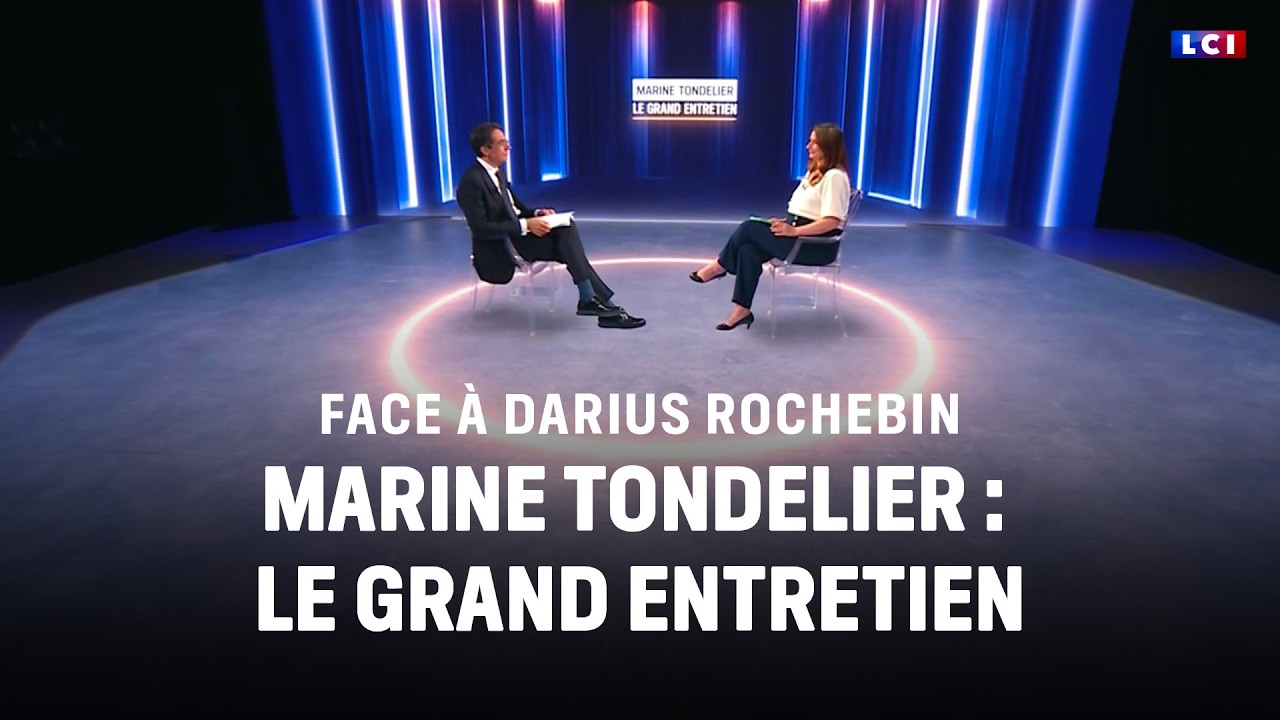
An anecdote to close, and I take it for what it is, but it carries PISA forward by a generation. On Monday, September 7, Darius Rochebin put Marine Tondelier through the closing ritual of “Le Grand Entretien”: a word about each president of the Fifth Republic. “Nothing striking to say” about Pompidou, Giscard “reminds her of Macron,” “no memory” of Mitterrand in office, pesticide-free apples for Chirac. Born in 1986, she cannot remember Pompidou, and that is not the point: she was not being asked for a memory but for an opinion, which is to say for work, the same work we have stopped asking of students. One fifteen-year-old in three no longer commands the basics; thirty years on, a candidate for the Élysée has not opened a textbook on the people whose office she wants, and says so on air without seeing a problem. Last year I described the collapse of France’s political class as a cognitive crisis before an institutional one. At forty, the posture of a twenty-year-old is not a regret. It is a platform.
What remains
I don’t believe AI is going to exterminate us, and I still think that those announcing it from an office valued in the hundreds of billions are selling something. But I also don’t believe France can settle for laughing at the doomers. September 8 showed what a world looks like where knowledge is produced by the token and traded between labs, and it showed, on the same day, a country that no longer learns to read or count and a political class that rereads nothing. Some speak in the future tense because they are building the future. Others speak in the future tense because they no longer have a past to draw on.
In a few years, someone will read the Navier-Stokes proof, understand it, and draw the next question from it. Nothing in PISA 2025 says that someone will have been educated in France.