My life 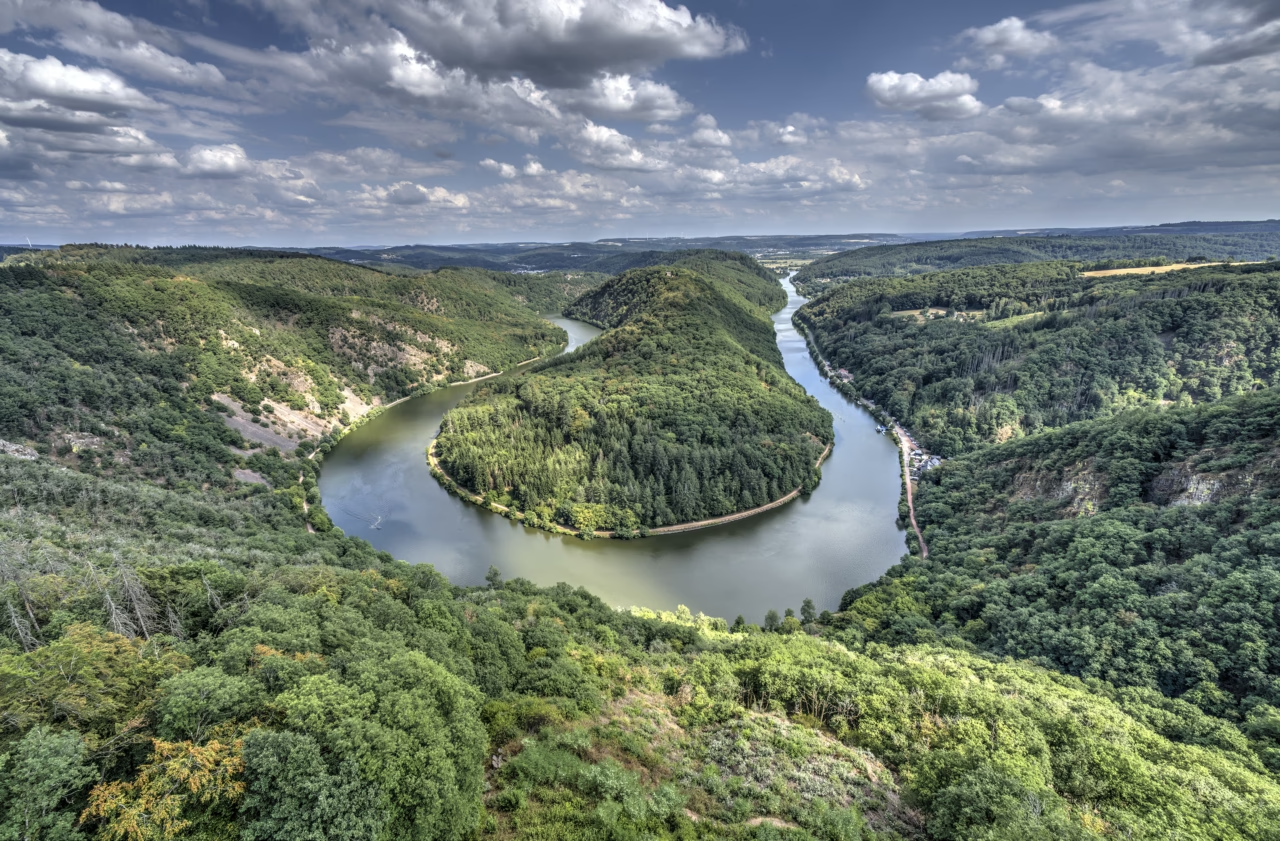
After the U4 blast furnace at Uckange, one hour of driving to the northeast takes you from industrial wasteland to forest canopy. At Orscholz, the Saarschleife treetop walk unrolls 1,250 meters of timber walkway through beech, oak, and Douglas fir, up to a 42-meter tower overlooking the most spectacular river bend in Germany. Not a single step from the parking lot to the top, a maximum grade of 6 percent, and a privately run structure maintained without a euro from local taxpayers. A visit, a note on the photography, Siegfried Line remnants a few hundred meters away, and everything you need to plan your own trip.
History 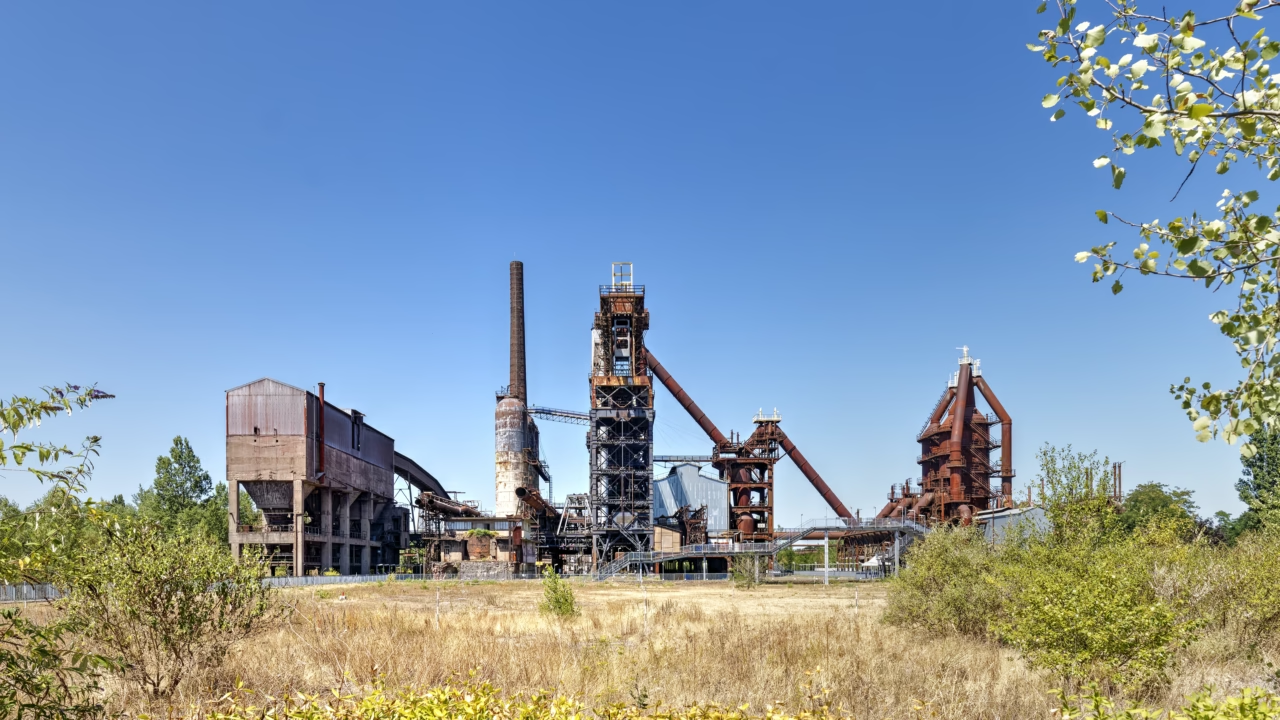
On the way back from a few days on the Nürburgring’s Nordschleife, I stopped in the Fensch valley to visit the U4 blast furnace at Uckange, the sole survivor of six installations at an ironworks that went cold in December 1991, and the only blast furnace in France open to visitors. Thirty acres of industrial wasteland, a 270-foot chimney, a cast house frozen exactly as it stood on the evening of the last tap: the place owes its survival to former workers who fought for ten years to get it listed as a historic monument. Between the Staehler bucket, the production board ruled in chalk, and the union posters from 1991, you grasp what 1,200 people working around the clock actually produced. But a country that puts its blast furnaces behind glass has already answered the question of its industrial sovereignty, and the tour, fascinating as it is, looks a great deal like a very well lit death certificate.
Digital sovereignty On July 28, 2026, China began volume production of its own immersion scanners, the 60-million-euro machines that print circuits onto silicon and that only ASML truly knows how to build: five units this year, about twenty in 2027, against ASML’s 130 systems a year. One to twenty-five: the ratio looks trivial, yet Seoul dropped 10% and Tokyo 4% in the days that followed, because a technology embargo has no proportional value. Its value is binary, and it has just stopped being a wall and become a delay, something that can be calculated, amortized, and planned around. By removing the alternative, export controls created the competitor they were meant to smother, exactly as they had taught Chinese AI frugality. Three days later, Bpifrance sold 2.5% of Orange for 1.1 billion euros and called it asset rotation: for the same sum, one bought productive capital, the other three months of cash.
Digital sovereignty For his very first post on X, Jensen Huang said nothing about GPUs: he shared a letter defending open models, signed by NVIDIA, Meta, Mistral and Hugging Face, but conspicuously left unsigned by OpenAI and Anthropic. That list of absentees says a great deal: the line between those who signed and those who held back maps precisely onto the line between an economy built on openness and one built on the tollbooth. The text speaks of “American leadership,” yet every one of its arguments makes the case, in spite of itself, for everyone else’s sovereignty. Because an open model knows no borders: the same file that spreads AI through the factories of Ohio also lets you run inference at home, out of reach of the Cloud Act.
Softwares Switching from WordPress to a static generator like Astro is frequently framed as the ultimate move toward simplicity and high performance. However, replacing a single, consolidated dashboard with Markdown files, Git workflows, and fragmented cloud services shifts technical complexity rather than removing it. This transition creates organizational bottlenecks for non-technical teams and exposes projects to npm supply-chain vulnerabilities instead of traditional CMS threats. Furthermore, relying entirely on proprietary cloud stacks trades open-source flexibility and digital sovereignty for vendor lock-in. Ultimately, for standard marketing websites, a battle-tested, self-hosted CMS remains the most practical and reversible choice.
Technology On July 20, Anthropic folds Claude Fable 5 into its Max and Team Premium plans at 50% of limits, on the very day those base limits drop by about a third. Compound the two cuts, both publicly announced, and a Max 20x subscriber goes from a nominal 20x to effective Fable access of roughly 6.7x, a two-thirds erosion of the promise. This is not a hunch; it is arithmetic on official figures. While Washington keeps its grip through the Cloud Act and a rival undercuts on price, Anthropic keeps the premium badge on the invoice while rationing the engine under the hood. Welcome to shrinkflation applied to tokens.
Politics The French Senate wants to hunt down “domestic interference,” an oxymoron that turns the critical citizen into a foreigner in his own country. Let’s take them at their word: applied honestly, their own definition points not to alternative media or anonymous accounts, but to the circulatory system connecting the machinery of the French state to McKinsey, Lazard, FTI, and General Electric. From Bruno Le Maire at Macro Advisory Partners to the McKinsey nexus under judicial investigation since 2022, the list is long, documented, and signed off at every step by the official ethics bodies. At the top, the revolving door is an asset; at the bottom, citizen speech is a risk to be mapped before 2027. Domestic interference is real: it doesn’t post, it invoices.
Politics On July 1, 2026, Sony buried the physical disc and absorbed its players’ fury without flinching, just as the Élysée has absorbed street protests for eight years. This indifference is no accident: the French still believe their elected officials owe them an accounting the way employees answer to a boss, while the system has methodically defused that balance of power, from the Matignon Accords to the pension reform, by way of the betrayed referendum of 2005. Constitutional locks, hardened policing doctrine, the discrediting of dissent, all the way to a QR code required to commemorate the storming of the Bastille: every crisis has been a training session for those in power. The sovereign customer and the citizen-employer died the same death, the death of the power to make anyone bend. What remains is to rebuild our levers, in our institutions and in our digital lives.
Geopolitics April 2013: an Alstom executive is arrested at JFK, and the group’s energy business ends up at General Electric. Thirteen years later, France is requiring its companies to route their entire invoicing flows through a hundred-odd private platforms: customers, suppliers, actual prices, volumes, dependencies, a real-time map of its economy. No hacking required when an extraterritorial subpoena, a platform acquisition, or a well-placed source will do. The sharpest irony: the most sensitive data doesn’t sleep in the administration’s fortress, but at the weakest link. In the name of VAT collection, France has just assembled the most complete economic intelligence trove in Europe, with no doctrine to protect it.
Surveillance and civil liberties On July 8, 2026, the French Senate published Report No. 875 on the regulation of information in the digital space: fifty-six recommendations, the very first of which proposes to “render invisible” certain users as elections approach. Behind a largely accurate economic diagnosis unfolds a complete apparatus: a disinformation observatory, a legal definition of truth, offenses without intent, ethics-based accreditation, and media promoted by algorithms configured on government instruction. No one will be forbidden to speak; some will simply be unfindable, unfunded, unrecognized. Having outsourced its censorship to Brussels, France is now bringing the political administration of visibility in-house. A recommendation-by-recommendation analysis, written by one of the parties concerned.