Sony Imaging : mathematical excellence at the cost of Minolta’s soul ?
Reflections from a photographer after a decade spent on Sony A7R bodies, and an observation that keeps coming back with awkward regularity: why do skin tones always turn green?
A decade with Sony: the observation
It’s been more than ten years since I traded my Canon 5D Mark III for a Sony A7R, then a series of successors up to my current A7R IV; passing notably through an A7R II I used at length and from which, even then, I drew a mixed verdict. The trigger for that migration, in 2014, came down to one word: dynamic range. The gap between the Sony Exmor sensors of the time and the Canons of the 5D Mark III generation was abyssal. You recovered shadows in Sony files where Canon delivered nothing but chroma noise. For anyone shooting in contrasty natural light, the choice was almost obvious.
That gap has largely closed since, even reversed on some recent models. The dual-gain CMOS sensors of the Canon R series are now on par, and Nikon Z, for that matter, mostly benefits from sensors made by Sony Semiconductor. The “dynamic range” argument no longer discriminates in 2026 (for most uses, at least); a few niches remain where Canon stays a notch more comfortable in very low light and where Nikon keeps a perceived lead on extreme wildlife tracking, but these are specialized grounds that don’t concern the generalist photographer.
What remains is a nagging observation I’ve carried since the first A7R, and that has never truly disappeared despite the successive generations: Sony’s colorimetry, particularly on skin tones, drifts toward green. This drift I observe on portraits in natural light as in mixed light, and (this is the point that long intrigued me) I can never quite catch up with it fully in post-production, despite a systematic uncompressed-RAW workflow.
The phenomenon is well enough known to the photo community to have earned a nickname: the Sony green. So it isn’t a personal whim. But what few articles really explain is why this drift exists, where it technically sits, and above all why it persists at a manufacturer that inherited, in 2006, the colorimetric expertise of Konica Minolta.
It’s this investigation I’m offering you.
Anatomy of a drift: the color chain in three levels
To understand where the problem sits, you first have to lay out cleanly the three levels that make up the “color science” of a digital body. This distinction is rarely drawn in the consumer photo press, which is content to talk about “Canon rendering” or “Sony rendering” as if it were an indivisible essence. It’s precisely this confusion that makes the subject illegible.
| Level | Name | Role | Modifiable by… |
|---|---|---|---|
| 1 | Spectral sensitivity of the sensor | CFA (Bayer) filters that decide which wavelengths reach each photosite | A new sensor generation only |
| 2 | Colorimetric transformation matrix | 3×3 matrix converting RAW values into colors in a standard space (sRGB, XYZ) | The manufacturer (firmware/RAW), partly the photographer (custom DCP profile) |
| 3 | Final rendering / look | Tone curve, saturation, contrast applied to produce the JPEG or preview | In-camera Creative Style / Creative Look, or RAW-conversion software in post |
Level 1 — The spectral sensitivity of the sensor
At the base of everything is the color filter array (CFA) deposited on the sensor, most often in a Bayer pattern. On this pattern, only one photosite in four sees red, one in four sees blue, and two in four see green. This imbalance is deliberate and stems from human perception: our eye is more sensitive to green wavelengths, which carry most of the luminance. Doubling this channel improves the perception of sharpness and the signal-to-noise ratio. But this physical dominance of green has a flip side: the entire downstream color chain has to deal with a signal in which the green channel is over-represented.
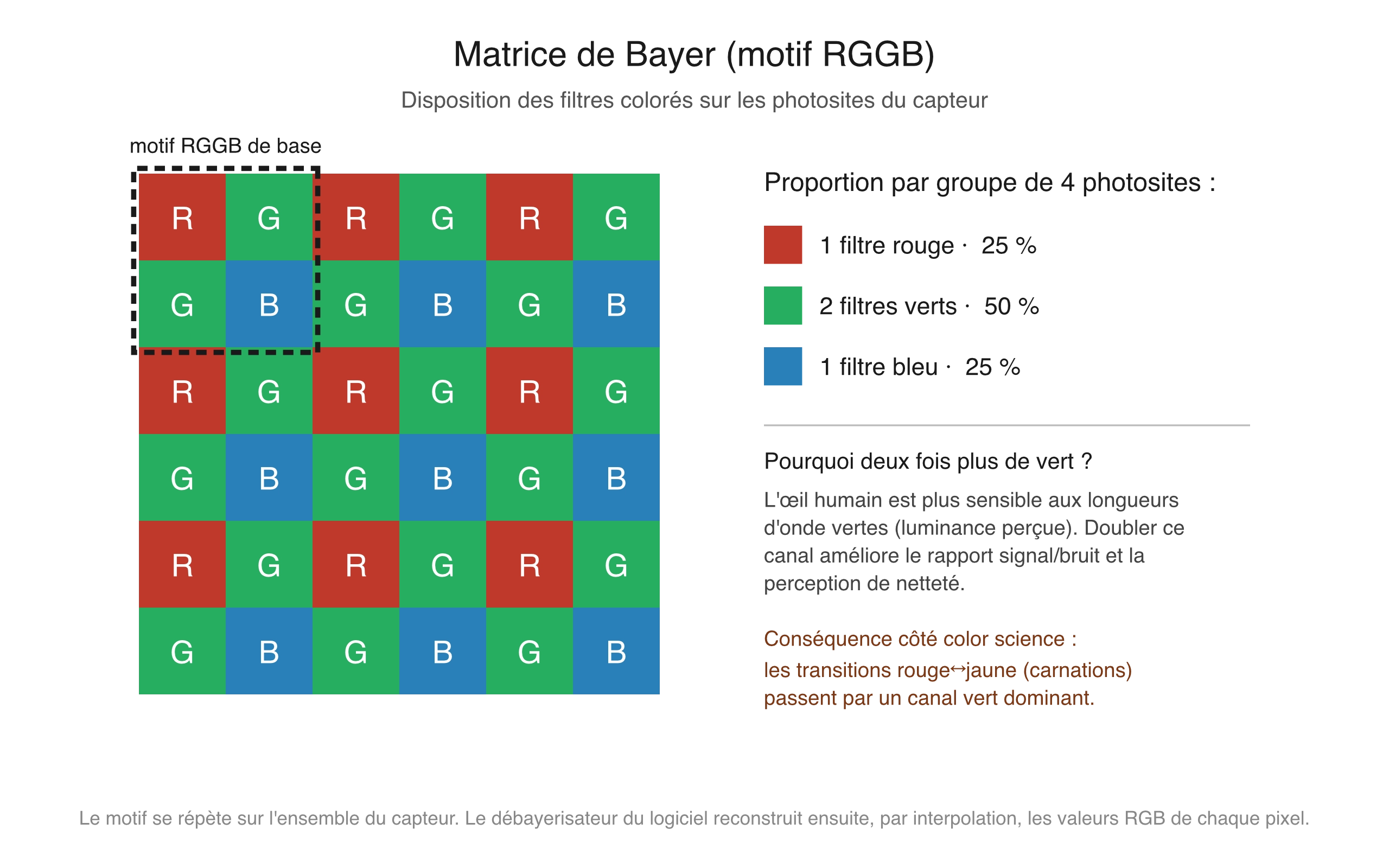
Each filter has its own spectral sensitivity: it doesn’t let through a single wavelength, but a more or less broad band around its dominant color. Sony, which dominates the CMOS sensor manufacturing market via Sony Semiconductor, has historically chosen a fairly strong weighting of the green channel; a defensible choice in terms of signal-to-noise ratio, but one that by construction “contaminates” the chromatic transitions between red and yellow. Which is to say, exactly the zone where human skin tones live.
It’s a sensor-engineering choice, made at the moment the silicon is designed. It changes only with a new hardware generation. This level can’t be modified by firmware or software: it’s the physical foundation.
Level 2 — The colorimetric transformation matrix
The raw values read off the sensor (R, G1, G2, B) aren’t “colors” in the colorimetric sense. They’re counts of photons filtered by the CFA. To transform these values into colors in the human sense (that is, into a standard color space like XYZ, sRGB or ProPhoto), you have to apply to them a 3×3 transformation matrix, calibrated by the manufacturer from measurements taken under standard illuminants (D50, D65, A).
This matrix is the heart of a body’s “color science”.
It’s computed by Sony, encoded in the MakerNotes metadata of the RAW files, and supplied to software publishers (Adobe, Phase One, DxO, Capture One) who use it as the basis for their DCP or ICC profiles. When we say a body “renders skin yellow” or “the reds too saturated”, we’re really talking, nine times out of ten, about this matrix; not the underlying physical sensor.
It’s also this level that explains why the same RAW file can give noticeably different results depending on whether you open it in Lightroom, Capture One or DxO PhotoLab: each publisher applies its own interpretation, more or less faithful to the Sony reference matrix, more or less “corrected” according to the publisher’s aesthetic choices.
Level 3 — The final rendering (looks, JPEG profiles)
Once the file is converted into a standard color space, you apply on top a tone curve, work on saturation, contrast and sharpness. That’s what produces the final image, whether the embedded JPEG or the preview rendering in the RAW-conversion software.
On Sony bodies, this level corresponds to the old Creative Style settings (Standard, Vivid, Neutral, Portrait, Landscape) found on the A7R IV and the entire earlier generation. It’s the equivalent of Canon’s Picture Styles, Nikon’s Picture Controls, and (in a far more accomplished version) Fujifilm’s Film Simulations.
For anyone shooting RAW, level 3 is in theory without effect: the profile selected in the body touches only the preview JPEG, not the RAW data. That’s what explains why a full-RAW photographer can legitimately think none of these settings concern them.
That’s true in the strict sense. And it’s false in the sense that matters.
The “Creative Look” misunderstanding
In 2020 with the A7S III, then generalized from the A7 IV in 2021, Sony introduced the Creative Look settings (FL, FL2, VV, VV2, FH, IN, SH, BW, SE…) to replace the historic Creative Styles. The marketing communication presents them as “the new generation of creative profiles”. The specialist press describes them as enriched picture profiles. Everyone mentally files this under level 3, and moves on.
This is precisely the misunderstanding Sony maintains; perhaps deliberately.
Because the introduction of the Creative Look settings doesn’t merely add new looks at level 3. It came, on the bodies concerned, with an overhaul of the level 2 colorimetric matrix. In other words: Sony took advantage of the introduction of a visible feature to push, under the hood, a revision of its reference color science.
The indirect proof reads in the Adobe Camera Raw profiles for the A7 IV and A7R V: their colorimetric values are noticeably different from those of the profiles for the A7 III and A7R IV, particularly in the red-orange zone; skin tones, once again. It isn’t Adobe that changed its algorithm. It’s the matrix supplied by Sony that changed.
Why doesn’t Sony say so clearly? Because admitting an overhaul of the matrix would amount to admitting the previous one was improvable. A difficult commercial confession for a brand that sold A7Rs for fifteen years on the strength of their color science. The Creative Look feature, by dressing the change in a new marketing name, lets them push the correction without naming the flaw. Clever. But disorienting for the photographer trying to understand.
What this concretely implies for my A7R IV (and for any Sony body from before 2021): the colorimetric matrix encoded in our RAWs is that of the previous generation. No consumer firmware will modify it (technically it’s possible, and some manufacturers have done it quietly in the past, but for Sony it would be commercially delicate: it would invalidate the consistency of the millions of files already archived and processed by users). Sony prefers to sell the new matrix with a new body. The mechanism is exactly the one Apple applies to the iPhone’s color science: you “improve” with each generation, you don’t update retroactively.
The A7R IV sits in the worst possible configuration: a 61-megapixel sensor of remarkable finesse, which exhibits with surgical sharpness every chromatic transition and therefore renders the green cast in skin tones more visible than it was on 24 MP sensors where the chroma noise of the mid-tones partly masked the problem. The higher the resolution climbs, the more the drift leaps out at you.
Is Sony really “wrong”? The laboratory argument
Before accusing Sony of having made a poor colorimetric choice, we have to do justice to the internal coherence of their approach. The “cold-green” matrix Sony is reproached for isn’t the result of negligence: it’s probably a deliberate positioning choice, dictated by a logic of measurement rather than of perception.
The industry’s reference colorimetric rankings (foremost among them DxOMark, which was long authoritative) assess the “accuracy” of colors by measuring the gap between the reproduced values and the theoretical colorimetric values of a reference target lit by a standard illuminant. The closer the matrix sticks to the theoretical values, the better the score. What mathematically flatters the target is rarely what flatters a human skin.
A matrix that pushes the red-oranges to make skin tones warm (the Canon signature) sacrifices the pure precision of the primary colors on the patches of a ColorChecker target. Conversely, a “neutral-cold” matrix (the Sony signature) maximizes mathematical fidelity to the primaries, but pays for that score in coldness on faces. Sony, which has sold itself for fifteen years on measurable spec arguments (dynamic range, resolution, readout speed), made a choice consistent with its positioning: laboratory truth rather than human truth.
It isn’t a mistake. It’s a manufacturer’s ethic. The problem is that it was imposed silently, without the average photographer understanding that, in buying a Sony, they were buying not a “neutral” body but a body optimized for the scoring grids of the test benches. And that’s precisely what Fujifilm understood in the opposite direction: making color science a deliberate aesthetic stance, and selling it as such.
The Minolta heritage: a squandered treasure?
Where this observation becomes truly awkward is when you put the Sony Imaging business back into its genealogy.
In 2006, Sony bought the photo division of Konica Minolta. The deal is generally presented as an acquisition of a mount (the A bayonet, which would later become Sony A) and of sensor technology. That’s only part of the story. Sony also inherited, and above all, decades of colorimetric expertise from a manufacturer that had built its reputation on natural rendering; particularly on skin tones.
Minolta is a lineage running from the SR-7 in the 1960s to the Dynax 7 and the Maxxum 9 at the end of the 1990s, by way of the Rokkors (lenses whose optical formulas favored a warm, organic chromatic rendering), distinct from the “flattering Canon” and the “clinical Nikon” that dominated at the time. Film portraits shot on the Dynax 7, processed on Konica Centuria or Impresa film, remain in the photo history books as a reference of Japanese skin rendering.
When Sony absorbed this heritage in 2006, it therefore acquired:
- patents on image processing and color management,
- the optical formulas of the Rokkors (which would feed the Zeiss/Sony range),
- and theoretically the teams and the culture of colorists who had calibrated this rendering over decades.
Twenty years on, the observation is troubling: Sony dominates the CMOS sensor market, supplies the imaging chains of half the photo and smartphone industry, but still drags, on its own bodies, a reputation for a green cast on skin tones. So much so that the manufacturer had to rework its colorimetric matrix in 2020-2021; and pass it off as a feature rather than a correction.
How to explain this squandering of heritage? Several hypotheses, which it’s wise to put forward cautiously for want of public internal sources:
A corporate culture dominated by Sony Semiconductor. Sony’s sensor division is driven by an engineers’ logic: maximize dynamic range, resolution, readout speed, SNR. Color science, which belongs to a more artisanal and cultural expertise (calibration on human references, deliberate aesthetic choices), has probably dissolved into this logic of specs.
A priority given to the video and cinema market. Sony invested heavily in the Cine Alta and hybrid video segment. The color science suited to these uses (designed for post-production in log, with creative LUTs applied downstream) favors a “neutral-cold” matrix that is then graded. This logic probably contaminated the stills pipeline, where on the contrary an already flattering rendering is expected out of the box.
An incomplete absorption of the Konica Minolta teams. Little is publicly known about what was really passed on versus what was dissolved during the 2006 integration. It’s plausible that the colorist expertise was lost with the teams, where the intellectual property stayed in the vaults but with no one to bring it to life. It’s a pattern I’ve described elsewhere: know-how is the competitive advantage acquirers never know how to preserve.
Meanwhile, Fujifilm (which doesn’t have the Minolta heritage but has that of its own films) made color science the central marketing argument of its entire X range. The Film Simulations (Provia, Velvia, Astia, Classic Chrome, Acros, Eterna) became a differentiating feature to the point that photographers choose Fuji specifically for it. Sony, sitting on a Minolta heritage equal or superior, still communicates in 2026 about the number of megapixels and the number of autofocus points.
That, to my mind, is the real waste of this acquisition. Not a technical waste: a strategic and cultural one.
The software’s share: Adobe, DxO, Capture One
Before giving in to a reverse-fanboy piece, we have to honestly qualify the charge. Because what most photographers call “Sony color science” is in reality, in 90% of cases, the default interpretation of the Sony matrix by their usual RAW-conversion software. And there, the gaps between publishers are considerable.
Adobe Lightroom / Camera Raw applies the “Adobe Standard” profile by default, which is a neutral-cold interpretation of the Sony matrix. It’s probably the pipeline that exhibits the green cast most visibly, because it attempts no aesthetic correction: it flatly restores what the Sony matrix gives it.
DxO PhotoLab, my current working tool for several years, chosen notably to get out of the Adobe ecosystem whose business model long ago drove me away, uses profiles computed in the lab from its own spectral measurements (DxO Mark was originally their internal sensor-characterization tool). Their DxO Color Rendering module even offers to emulate the rendering of other bodies (Canon, Nikon, Fuji) applied to a Sony file. This, incidentally, is a feature no competitor matches, and probably the most telling test for demonstrating that a skin-tone drift is a software choice and not a sensor inevitability. The downside: DxO tends by default toward a rather cold and desaturated rendering, inherited from their very scientific-measured approach. On Sony skin tones, it partly corrects the green cast but can introduce a cyan-neutral lightness that isn’t ideal either for warm portraits. (I’ve written elsewhere about DxO’s frustrating pricing policy, but that’s another debate.)
Capture One Pro remains the reference in the professional studio for Sony portraits, and that’s no accident. Phase One has historically had a privileged relationship with Sony Semiconductor (the sensors in Phase One digital backs are Sonys), and their ICC profiles encode a noticeably warmer matrix in the red-oranges. Their “Portrait” variants are calibrated specifically on skin tones. Add to that an advanced Color Editor that allows surgical selection by hue/saturation/luminance, and you probably have the cleanest pipeline for a portraitist on a Sony body.
A telling detail of this alliance: Sony long offered an entirely free Capture One Express for Sony version, supplied by default to its customers. The most charitable reading is that it was a commercial gift aimed at retaining buyers. The less charitable reading is that Sony knew full well its default matrix produced a better result in Capture One than in Lightroom; and that it was better to steer its customers toward the pipeline that most effectively masked the weaknesses of the RAW file. A discreet industrial confession, or a simple commercial gesture? Probably both at once. In any case, you don’t ally yourself by chance with a publisher whose profiles correct exactly the chromatic zone where your matrix is most contestable.
The most rigorous solution, independent of the publisher, remains to produce a custom DCP profile with a ColorChecker Passport (~100 euros) and the free Adobe DNG Profile Editor software. You photograph the target in your reference light, the software computes the correction matrix that brings the patches back to their theoretical colorimetric values, and you obtain a profile that replaces the default matrix in Lightroom. Many pros who migrated to Sony do this systematically and consider the problem disappears by 90%.
What this nuance means for my earlier criticism: “Sony color science” is a two-story object. There’s an irreducible part that belongs to level 1 (the sensor’s spectral sensitivity) and level 2 (the reference matrix supplied by Sony), over which the photographer has no control. And there’s an interpretive part, considerable, that belongs to level 2′ (the software’s DCP/ICC profile) and that is largely correctable by anyone who takes the trouble.
The real criticism that can be leveled at Sony, then, isn’t “the color science is bad”; it’s “the matrix supplied by default to publishers isn’t optimal for skin tones, and for fifteen years the manufacturer didn’t see fit to rework it”.
The AI flight forward: correcting in real time what was missed in the matrix?
There remains a dimension specific to 2026 that no discourse on color science can do without: the irruption of dedicated AI chips into the real-time imaging pipeline.
On recent bodies (A7 V, A1 II, A9 III) as on almost all high-end smartphones, image processing is no longer a deterministic chain (sensor → matrix → JPEG). It’s now a pipeline augmented by embedded machine-learning models that detect faces, skin, skies, foliage, and apply selective corrections in real time: local retouching of skin tones, desaturation of overly prominent greens in foliage, surgical enhancement of the eyes. On its latest models, Sony mentions skin-tone enhancement features driven by its AI processor (whether Real-time Skin Tone Processing or commercial equivalents depending on the generation), and the feedback on the A7 V in particular confirms a noticeably more organic color science, with skin tones at last described by reviewers as “accurate” rather than “technical”.
But let’s honestly reformulate what this means: through these features, Sony implicitly acknowledges that its level 2 colorimetric matrix does not produce satisfactory skin tones out of the box, and that an AI-driven correction is needed to set things right downstream. It’s an ingenious admission of failure or an ultimate solution, depending on how you look at it.
Three possible readings, and all three have their share of truth:
Optimistic reading. AI now allows the best of both worlds: a “neutral-cold” matrix that maximizes mathematical fidelity (and therefore keeps performing well on the DxOMark test benches), and a perceptual correction layer that flatters human faces at output. The photographer wins on both counts. Mission accomplished.
Pragmatic reading. This AI correction applies to the JPEG and the preview. On the RAW, it’s without effect, like the Creative Look settings. For the full-RAW photographer, Sony’s investment in AI skin processing therefore changes nothing about their problem. They remain faced with a reference matrix they’ll have to keep correcting in post.
Critical reading. At this point in the decade, we’re witnessing a phenomenon broader than the Sony case alone. The whole imaging industry (bodies, smartphones, software retouching) is shifting toward pipelines where the final result is less and less deterministic and more and more the product of statistical inferences. This drift has a name: photography is becoming a probabilistic rendering of presumed intent, rather than a faithful capture of light. The implications go far beyond the green cast of Sony skin tones, and I’ll come back to it in another article: I’ve already sketched some aspects of it regarding the commoditization of the pixel by generative AI.
For my 2019 A7R IV, these considerations are in any case largely theoretical: no AI skin processing came to retroactively rescue the matrix. And on the RAW, in any case, it wouldn’t.
2026: is color science still an argument?
As I write these lines, sensor dynamic range no longer discriminates between brands on everyday ground, resolution is no longer a battlefield, autofocus is converging toward equivalent performance across the big three. A few niches hold out (Canon in very low light, Nikon in extreme wildlife tracking) but they don’t concern the overwhelming majority of photographers. Color science is one of the last grounds of perceived differentiation, and paradoxically, one of the most catchable-up by the photographer themselves via the choice of RAW converter, custom profiling, or fine post-production adjustment.
The underlying question then becomes: is it the photographer’s role to compensate for the manufacturer’s default choices, or is it for the manufacturer to assume an aesthetic stance and deliver a reference rendering?
Canon made the historic choice of the “flattering, Western-skin-oriented” rendering; a deliberate commercial choice, which retained generations of portraitists and wedding photographers.
Fujifilm made the choice of the “catalog of simulated films”, which turns color science into a central marketing feature and a pleasure of use.
Sony, for its part, has remained in a technicist posture: we deliver you a “neutral” matrix, it’s up to you to bring it to life. A position consistent with the Sony Semiconductor culture; but one that becomes a problem when the claimed “neutrality” is in reality biased toward green on the most sensitive zones of photography: human faces.
For my A7R IV, the practical verdict comes down to three avenues I’ll be exploring in the weeks to come:
- Systematically test the DxO Color Rendering module in “Canon emulation” mode on my problematic portraits.
- Evaluate Capture One Pro in parallel (free 30-day trial), with a rigorous side-by-side comparison on the same RAW files.
- Invest in a ColorChecker Passport and produce my own custom DCP profiles, calibrated on my own light and my own vision.
In the longer term, the question of replacing the body arises. Not to flee Sony (the optical ecosystem and the sensor remain excellent) but to benefit from the revised colorimetric matrix of the A7R V and later. It’s no detail: it is, at bottom, what Sony has been selling us since 2021 without saying so clearly.
Coda: what this story tells
Beyond the technical debate, this investigation tells something about the Japanese photo industry, and more broadly about the contemporary technology industry: the forgetting of intangible heritages in favor of the race for measurable specs.
Sony Semiconductor knows how to make the best CMOS sensors in the world. Sony Imaging sells bodies that are technically beyond reproach on the spec sheet. But between the two, what’s missing is what Konica Minolta had built over fifty years and that Sony filed away in a cupboard in 2006: a deliberate colorist culture, an aesthetic vision of human rendering, an editorial responsibility on the manufacturer’s part for what its tools produce by default.
It isn’t just a matter of a green cast in skin tones. It’s a matter of industrial memory. And that one, unlike a colorimetric matrix, isn’t updated by firmware, nor by company acquisition. It’s passed on by the men and women who carry it, or it’s lost when they’re let go.