One shoe at a time
A few days ago, I woke up firmly resolved to go do a little shopping. Those who know me will appreciate the scale of the sacrifice: wandering strip malls under fluorescent lights appears nowhere on my list of earthly pleasures. But sometimes you have to force yourself, if only to replace a pair of shoes that had started telling their own story.
I hadn’t finished my coffee before the news had already set the stage. That Thursday, July 2, Lidl was putting 200,000 fans and air conditioners on sale across its entire French network, days ahead of another forecasted heat wave. The result: stores stormed at dawn, lines forming at four in the morning, sliding doors ripped off their tracks in Nanterre, brawls, police and gendarmerie interventions all over the country, and even tear gas sprayed inside a Paris store where some 400 people were fighting over two air conditioners. Two. Some stores had to close; others canceled the sale altogether. One woman clung to her box while being trampled by the crowd.
What a society, what an era. I got dressed thinking the day was off to a promising start.
The fan riot
Let’s take a cool-headed look at this, no pun intended. Lidl did what Lidl does: a carefully calibrated promotion, rock-bottom prices, a portable air conditioner at 179 euros, a delivery announced publicly 24 hours in advance, in the middle of a nationwide shortage of cooling equipment. With roughly 125 units per store against hundreds of customers massed outside the doors, the arithmetic of the stampede was written in advance. The CEO of FnacDarty confirmed that same day that customers were lining up outside his own stores at four in the morning, and Carrefour claimed 30,000 units sold in a single day in late June, a thousand times its normal volume.
One could stop at the spectacle; it is edifying enough on its own. Citizens of a developed country, the world’s seventh-largest economy, physically fighting over a 13-euro table fan, while others walked out with four or five units apiece, their destination on the French equivalent of Craigslist before the heat peak requiring no great feat of deduction. The overnight lines, the battered doors, scarcity administered through weekly deliveries: it took the very particular talent of our era to recreate a Gosplan atmosphere inside a German discount supermarket.
And that is precisely what strikes me. When price can no longer do its job as a signal, because it has been set low and in advance on a quantity that is derisory relative to demand, rationing does not disappear: it merely changes form. It gets paid in hours of waiting, in elbows, in tear gas. Economists call this rent dissipation; the news cameras call it a riot. It is the same thing, filmed from two different angles.
And for those just discovering the subject along with the heat wave, let me add that this shortage did not fall from the sky. For years now, air conditioning has been treated in this country as a moral vice rather than a piece of comfort equipment, indeed survival equipment for the most vulnerable, while heating, which consumes vastly more energy, escapes all scrutiny. I set the thermal record straight right here: in July 2026, we are reaping what a decade of guilt-tripping has sown. A market you discourage does not invest, does not stock up, does not equip itself. Then the heat arrives, and everyone is astonished that France is brawling over cardboard boxes.
One shoe at a time
It is therefore in an already thoroughly cheerful frame of mind that I push open, a few hours later, the door of a shoe store. I make my choice fairly quickly, a small miracle in itself. I grab the box, sit down, open it, and there, to the novice’s astonishment: a single shoe. The right one, to be precise. I inspect the neighboring box. One shoe as well. The entire aisle is like this: dozens of boxes each containing half a pair, the other half being held hostage at the front desk, where one must go and politely request it, model ticket in hand, like picking up a package at the post office.
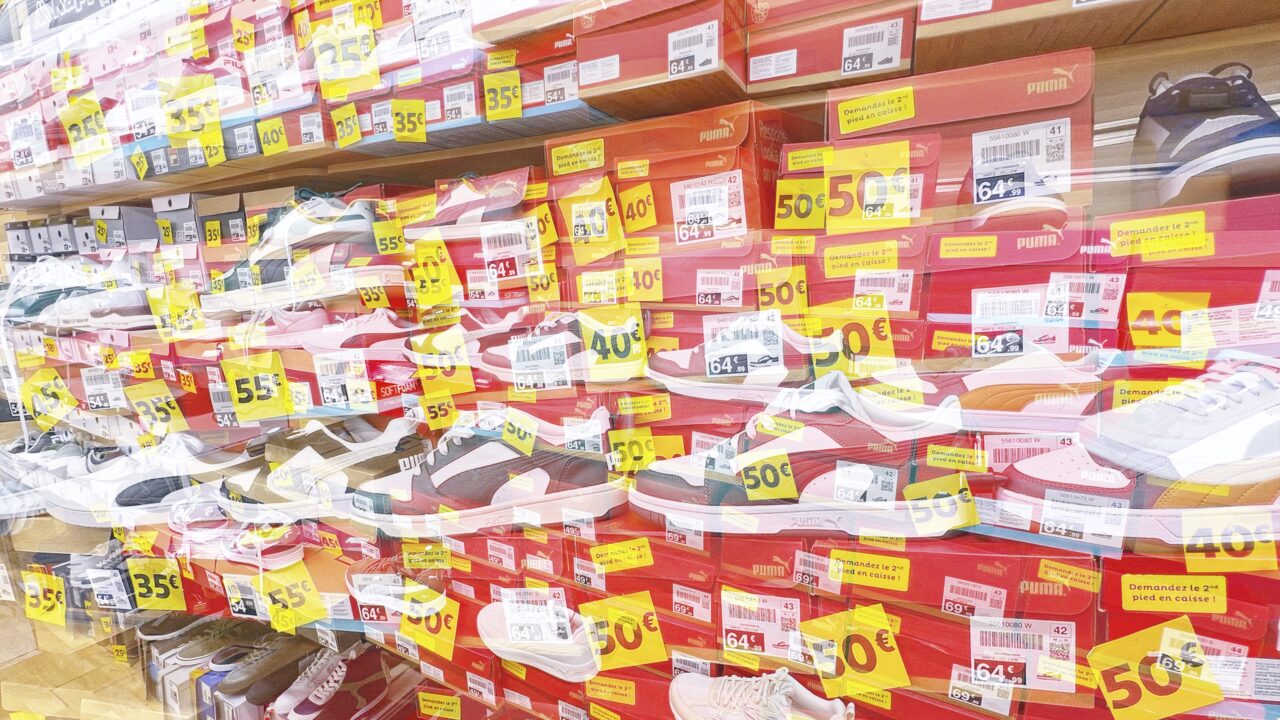
I am no doubt discovering, very late, a practice that regulars of the trade have known about for years. But allow me to savor my naivete: I blithely assumed I would be able to try on, at my leisure, the coveted pairs. Let’s not overstate the coveting; these were sensible shoes. It was not to be. The store, for its part, had done the math: shoplifting eats up an average of 1 to 2 percent of retail revenue, and up to 3 percent in apparel, with shoes ranking among the most frequently stolen items because they are the easiest to resell. Against that, the countermeasure is biblically simple: nobody steals a left shoe.
Technically, it is airtight. Humanly, it is fascinating. Here is a business that, to protect itself from a minority of thieves, assigns the entirety of its honest customers the status of suspect by default. Every fitting becomes a supervised transaction. Every complete pair is a favor granted by the staff. The customer is no longer someone you sell to; he is someone you keep an eye on while hoping, incidentally, to sell him something. And the best part is that I understand the shopkeeper perfectly. That is exactly the problem.
What this reveals
I will be told that I am making a great deal of noise over one left shoe and a few fans. It is precisely because these are details that they are interesting. Great ruptures are rarely legible in grand declarations; they are legible in cardboard boxes.
These two scenes from the same day tell the same story from both ends. Upstream, a society that has sufficiently unlearned restraint to turn a supermarket promotion into a scene of pillage, where the prospect of ninety degrees in the shade is enough to bring down doors and dignities alike. Downstream, retailers who have sufficiently internalized everyday predation to physically reorganize their aisles around the presumption of theft. The two phenomena feed each other: the more trust recedes, the more protections proliferate, and the more protections proliferate, the more everyone behaves as an adversary of the system rather than a participant in it.
Yet trust is not some spiritual garnish. It is capital, the most invisible and most productive capital of all. A high-trust society tries on both its shoes unescorted, leaves its deliveries on the shelves without a guard, and needs no tear gas to distribute fans. A low-trust society pays a permanent tax: security gates, tags, guards, sequestered shoes, time lost at the front desk, employees turned into wardens. That tax appears in no budget bill, yet every one of us pays it at every checkout, in prices, in friction, and in small reciprocal humiliations. Theft costs European retail billions; the distrust it installs costs far more, because that, no one ever inventories.
Honesty
Let us be fair to everyone involved. Lidl did nothing illegal or even abnormal: announcing a delivery is elementary marketing, and the chain points out that its products are ordered a year in advance, at a fixed price. The tumult owes less to the promotion than to the shortage it collided with, and to weather that, without indulging in climate hysteria, makes the need very real, particularly for people of modest means who cannot afford a fixed installation. Getting up at four in the morning to cool your children’s bedroom is not ridiculous; the stampede is, not the need.
Likewise, my shoe merchant is no paranoiac: he is a rational agent responding to incentives. If the single-shoe box has become standard practice, it is because shrinkage made the old arrangement untenable. I do not blame him for his countermeasure; I take note of the world that made it necessary. And I will readily admit that high-trust societies have existed with blind spots of their own, and that mine, the one of my youth, also benefited from a homogeneity and a prosperity that made virtue easier.
But admitting all of this does not dissolve the observation; it hardens it: when every actor behaves rationally and the collective result is a riot in the morning and a sequestered shoe in the afternoon, it means something has degraded, deep down, in the unwritten rules that used to hold us together.
Starting off on the right foot
I did, in the end, walk out with my pair, complete, after the regulation pilgrimage to the front desk. The saleswoman was charming, the system absurd, and the two coexisted without anyone finding anything left to object to. That may be the most unsettling part: not the degradation itself, but the speed at which we metabolize it into normality.
A civilization does not collapse on a Tuesday at 3 p.m. in a thunder of falling columns. It crumbles on a Thursday morning outside a Lidl, then a little more that afternoon in a shoe aisle, while everyone adapts, shrugs, and gets in line at the front desk. Our trust is not confiscated all at once. It is taken from us like everything else, one shoe at a time.