Sovereign AI : why local open source has cecome the only path to independence in 2026
Let’s pick up where we left off. An AI agent is running in the background on your infrastructure. It reads your logs, queries your database, accesses your code repositories, and orchestrates your business processes. It never sleeps. It never takes a vacation. It is, to borrow the phrase from the second article in this series, the electrical system of your operations, present everywhere and invisible as long as it runs.
And the brain of that agent runs on servers you don’t control, in a foreign jurisdiction, subject to extraterritorial law that can compel the provider to hand your data over to third-party authorities without ever telling you. Every request the agent makes crosses the Atlantic, passes through a data center in California or Ireland, and comes back carrying a response, along with a fundamental legal uncertainty.
This isn’t a paranoid hypothesis. It’s how the public cloud ordinarily works in 2026. And it’s precisely the question this third installment tackles head-on: can you run a capable, reliable, and economically viable AI agent on infrastructure you control yourself?
The answer, in 2026, is yes. With a few caveats that deserve to be stated plainly.
The CLOUD Act and the Problem No One Names
The Server Is in Europe. The Law Is Not.
The Clarifying Lawful Overseas Use of Data Act, passed by the U.S. Congress in 2018, lets American federal authorities require U.S. companies to turn over data hosted anywhere in the world, including in Europe. The physical location of the server offers no protection against an American court order if the entity operating the service is incorporated under U.S. law.
OpenAI is American. Anthropic is American. Google is American. Microsoft is American. Their models, even when accessed from European data centers, remain subject to this legal framework. For any company that handles health data, financial data, internal communications, defense-related data, or simply commercially sensitive information, this legal reality radically changes the risk equation. It’s the same logic that makes Signal the messaging app of choice for anyone who takes confidentiality seriously: end-to-end encryption isn’t enough if the provider remains subject to an extraterritorial court order.
This isn’t a regulatory technicality. It’s a geopolitical fault line that now runs through every AI architecture decision, the same fault line I documented in connection with the digital euro, where the location of the infrastructure ultimately determines who controls what. And that, by implication, is exactly what the local open-source movement resolves, partially but concretely.
Mistral’s Structural Contradiction
Here we have to say something uncomfortable about Europe’s AI champion. Mistral AI today embodies the promise of French digital sovereignty better than any other player: a framework agreement with the Ministry of the Armed Forces signed in January 2026, 10,000 civil servants equipped under a cross-government pilot run by DINUM, a Franco-German partnership with SAP announced in November 2025 to equip both countries’ public administrations with a sovereign AI, and its own data center funded to the tune of $830 million in spring 2026, with a first site at Bruyères-le-Châtel (Essonne) and a Swedish expansion planned. The trajectory is real. The intent, credible.
And yet. Mistral’s consumer distribution runs primarily through a partnership with Microsoft Azure, announced in 2024. Mistral’s most capable models are available through the Azure AI platform. Which means that, for a large share of enterprise use cases, Mistral is hosted on American infrastructure, subject to the CLOUD Act. The server may well be in Europe. The legal entity operating it is American. The acquisition of Koyeb and the build-out of Mistral Compute are precisely the attempt to correct this dependency, but the work is far from finished.
This isn’t a betrayal. It’s an infrastructure reality, and the reason the local option, the one where the model runs on your own hardware, stays relevant even when you choose a European model.
The Local Equation: What Has Fundamentally Changed
The Local Formula in 2026
In the spirit of the conceptual formula for the agent introduced in the second article in this series, let’s lay out the equation for local deployment:
Viable local =  Open-source model (freely redistributable weights)
              + Quantization (memory reduction without quality collapse)
              + Inference server (OpenAI-compatible API, running locally)
              + Accessible hardware (consumer GPU or recent CPU)
Remove any one of these terms and you get either a lab prototype or an infrastructure setup beyond the reach of a small company. Combine them, in 2026, and you get something qualitatively new: a high-performing AI agent that is economically viable and legally clean, and that never leaves your server room.
Quantization: The Quiet Change That Made Everything Possible
A modern language model stores its parameters as floating-point numbers. At full precision (FP32), each parameter takes up 4 bytes. A model with 7 billion parameters therefore requires roughly 28 GB of RAM, beyond the reach of a standard consumer GPU. The way AIs read and process this data (in tokens, within bounded context windows) adds a further constraint on the resources available.
Quantization reduces that precision. At 4 bits per parameter (the Q4_K_M format, now standard across the ecosystem), the same 7-billion-parameter model fits into 4 to 5 GB of RAM. Google has pushed this logic even further with TurboQuant, a compression technique that cuts the memory footprint of LLMs by a factor of six, with no notable quality collapse on everyday tasks. It’s this algorithmic advance, not better hardware, that made local deployment viable for teams without a data center of their own.
The corollary matters: the benchmarks the labs publish concern full-precision models running on cloud infrastructure with no memory constraints. A model that posts 79% accuracy on a benchmark can drop to 55% on practical tasks once quantized to Q4_K_M. Knowing how a quantized model performs on your actual use case is the only figure that counts, not its Hugging Face ranking.
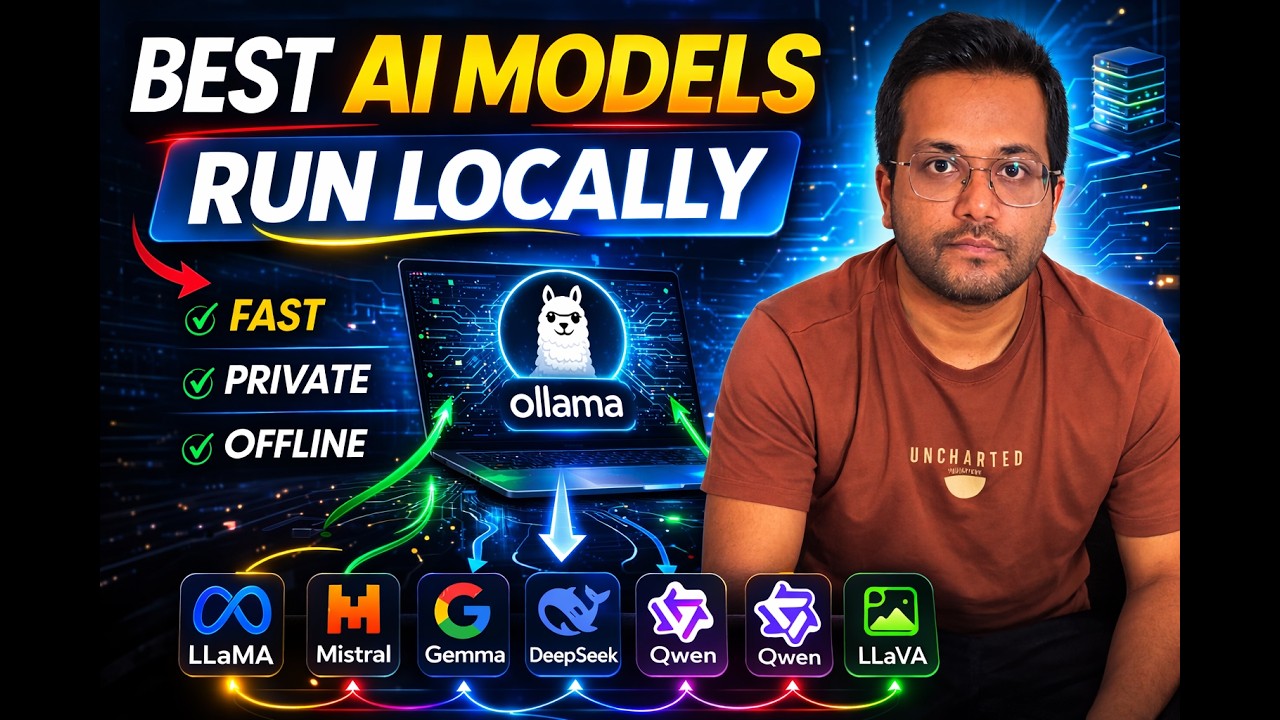
Mistral: Europe’s Choice for Local Production
Among the model families available for local use in 2026, namely Llama (Meta), Qwen (Alibaba), Phi (Microsoft), and Gemma (Google), Mistral holds a special place for European deployment. Three concrete reasons, beyond the political narrative.
First, the license. The Mistral Small models are distributed under Apache 2.0, the most permissive open-source license there is: free for commercial use, free to modify, free to redistribute, with no obligation to publish your changes. For an organization that wants to fine-tune a model on its proprietary data and keep it confidential, Apache 2.0 is the only legally clean answer. This is a fundamental difference from the licenses on Llama (Meta) or Gemma (Google), which impose usage restrictions above a certain user threshold, a nuance the French-speaking AI bubble too often glosses over.
Second, its quality in French. Mistral was trained on a massive corpus that includes French, Spanish, Italian, and German text alongside English. On French-language tasks (writing, document summarization, information extraction), Mistral Small consistently outperforms larger models that were trained on predominantly English corpora.
Third, agentic efficiency. Mistral Small is built natively for function calling and structured JSON, the two primitives the ReAct loop described in the second article depends on. A local agent that can’t reliably call tools is nothing more than a sophisticated chatbot. Mistral Small meets that requirement. The MCP protocol, which standardizes how agents call their external tools, is also fully compatible with a local runtime: the MCP server can stay confined to your network without ever exposing an API on the public internet.

Mistral NeMo, the 12-billion-parameter model co-developed with NVIDIA, pushes this tradeoff even further: a one-million-token context window, a 7 GB memory footprint when quantized, and first-rate function calling. In 2026, it offers one of the best capability-to-resources ratios for running an agent locally on common enterprise hardware.
Ollama: Local Infrastructure in a Single Command
If Mistral is the model, Ollama is the runtime. What it does looks trivial on the surface, but that very triviality is what democratized local deployment: ollama pull mistral-small downloads the model, quantizes it if needed, and exposes an OpenAI-compatible REST API at localhost:11434. An agent built for the Anthropic or OpenAI API can switch to Ollama running locally by changing a single line of configuration: the base URL.

This technical detail has profound implications. It means an organization can develop and test its agents on Claude or GPT-4o during prototyping, then deploy them on a local Mistral model in production without rewriting the architecture. The cost of migrating to local has become marginal. The barrier is no longer technical. It’s cultural and organizational. It’s the same democratizing movement now reshaping open source more broadly: professional-grade tools are no longer reserved for teams with industrial resources.
| Model | Parameters | RAM (Q4_K_M) | License | Strength | Ideal local use case |
|---|---|---|---|---|---|
| Mistral 7B | 7B | ~4 GB | Apache 2.0 | Instruction following, French | Lightweight agent, classification, summarization |
| Mistral Small 3 | 7B dense | ~5 GB | Apache 2.0 | Native function calling, speed | ReAct agent, low latency |
| Mistral NeMo 12B | 12B | ~7 GB | Apache 2.0 | 1M-token context, reasoning | Long-document analysis, local RAG |
| Mixtral 8x7B (MoE) | 47B total / 13B active | ~26 GB | Apache 2.0 | Capability close to the large models | Complex tasks, dedicated GPU required |
The Real Economics of Going Local
The Calculation No One Runs Before Deploying
A cloud agent working on a complex task generates dozens of successive calls, each billed by token consumption. As noted in the second article, an unchecked agent session can cost several dozen euros in a matter of minutes. Over a month of continuous operation, the API bill for an active business agent runs into the hundreds, even thousands, of euros. This isn’t a bug; it’s the business model. I analyzed this mechanism in detail in the case of Anthropic: trust comes at a price, and that price is structurally biased upward as usage intensifies.
Going local inverts that cost structure. The investment is in capital (hardware) rather than in a consumable (tokens). A server fitted with an NVIDIA RTX 4090 (24 GB of VRAM), or even a more modest professional GPU, covers almost every agent use case with Mistral Small or NeMo. That hardware is amortized over three to five years. Past a certain usage volume, which most organizations exceed within the first six months of an agent deployment, local is structurally cheaper than cloud.
The comparison isn’t quite as simple as it looks, however. Local has hidden costs: maintaining the runtime, updating the models, handling incidents, electricity, cooling. Above all it carries a skills cost: someone in the organization has to know how to operate this infrastructure. That cost is real. It isn’t uniform, though: for a team that already administers Linux servers, the marginal burden of running an Ollama service alongside a self-hosted stack is negligible.
Sovereignty Has a Price, and a Return on Investment
Sovereignty isn’t free. But it isn’t a luxury reserved for governments and large corporations either. In 2026, a roughly 20-person company that deploys a local agent on a modest dedicated server, and that handles sensitive data (client files, medical records, contractual information), saves on three fronts at once: the API bill, the legal GDPR risk tied to transferring data to third-party servers, and operational dependence on a provider whose pricing policy can change overnight.
That last point is systematically underestimated. The cloud AI providers have all raised their prices, changed their access terms, or deprecated models within a matter of weeks. An agent built in production on a deprecated model is an agent you’ll have to rebuild. A local agent on an open-source model frozen in your own infrastructure is an agent you control over the long run. This, in fact, is the same logic that leads people to prefer Matomo over Google Analytics: not that the alternative tool is necessarily better on every metric, but because depending on a third party whose terms and pricing you can’t control is a genuine operational risk.
The Limits That Need Stating
The Performance Gap Is Real
Let’s be honest about what local can’t do in 2026. The best cloud models (Claude Opus, GPT-4o, Gemini Ultra) remain superior to local open-source models on tasks that demand complex multi-step reasoning, a fine grasp of implicit context, or high-level creativity. This gap exists. It’s shrinking fast, but it hasn’t disappeared: DeepSeek R1, examined in the first article in this trilogy, showed that a model produced with constrained resources could rival the best reasoning models.
For the most common agent use cases (information extraction, classification, summarization, structured-text generation, repetitive function calling), the gap is negligible and local is sufficient. For tasks that call for nuanced strategic analysis or complex legal reasoning, the cloud still comes out ahead. The pragmatic answer is a hybrid architecture: a local model for volume, a cloud model for high-stakes cases. This, in fact, is what the most mature AI stacks adopted in 2026. AI as a commodity doesn’t mean every model is equivalent: it means the value differential is shifting toward integration and use, not toward the model itself.
The Dependence on American Silicon
There’s a structural irony in the discourse on AI sovereignty that no one can get around: the GPUs needed to run high-performing local models are made by NVIDIA, an American company that controls more than 90% of the market for generative-AI accelerators. NanoIC and the European Chips Act are trying to address this, but SiPearl, the French chip-design initiative, won’t produce its first processors until 2027 or 2028. AMD offers an alternative, but its software ecosystem (CUDA vs. ROCm) remains significantly less mature.
An American restriction on GPU exports, a geopolitical scenario that isn’t far-fetched amid growing tensions over technological dominance, would weaken the entire European local ecosystem, Mistral included. Software sovereignty doesn’t solve hardware dependence. This is the glass ceiling of the local open-source movement, and it deserves to be named plainly rather than buried under rhetorical enthusiasm. This, in fact, is the central criticism I leveled at the question of European semiconductors: declared sovereignty is worth nothing without control over the underlying production chain.
Mistral Isn’t “Truly” Sovereign If It Runs on Azure
The point bears repeating from a different angle. Choosing Mistral as your model doesn’t solve the sovereignty problem if you access it through Mistral’s La Plateforme API hosted on Azure. Sovereignty begins the moment the model runs on infrastructure you control, which means either an on-premise deployment (local, or a dedicated server in France) or hosting on Mistral Compute (Mistral’s own data center in Essonne, operational in 2026 with 44 MW of initial capacity). The “European” label, without the architecture to back it up, is nothing more than a marketing argument. It’s the same reasoning that applies to Air France and Starlink: the sovereignty argument collapses the moment you look at who controls the underlying critical infrastructure.
Summary Table: Cloud vs. Local in 2026
| Criterion | Cloud (OpenAI / Anthropic / Google) | Mistral via Azure | Mistral local (Ollama / on-prem) |
|---|---|---|---|
| Raw performance | Maximal (Opus, GPT-4o) | High | Good to very good (agent use cases) |
| Data jurisdiction | American (CLOUD Act) | American (Azure = Microsoft) | Your jurisdiction |
| GDPR compliance | Partial (contractual clauses) | Partial | Native if hosted in the EU |
| Cost structure | Variable, per request | Variable, per request | Fixed (hardware + operations) |
| Vendor dependence | Maximal | Twofold (Mistral + Microsoft) | None on the open-source model |
| Agent latency | Network + cloud inference | Network + cloud inference | Local (< 1 ms network) |
| Skills required | Low (turnkey API) | Low | Moderate (server ops) |
| Accessible to | Everyone | Everyone | Teams with infrastructure skills |
Sovereignty as Architecture
Let’s return to the central thesis of this trilogy and round it out. In the first article, we saw that alignment isn’t a censorship filter but a training phase that genuinely modifies the network’s weights, and that this technology, long reserved for the big labs, is now within reach of any motivated team. In the second, that the agent isn’t a souped-up chatbot but a qualitatively new paradigm, an AI that embeds itself in processes rather than in conversations.
This third installment adds the final layer: sovereignty is not a label. It’s an architecture decision.
It’s made the moment you choose where the model runs, under which license, on which infrastructure, in which jurisdiction. It’s made once, up front, and it shapes every choice that follows. An organization that deploys a cloud agent without having asked this question hasn’t made a bad technical choice. It has made an implicit one whose consequences it will discover later, at a price change, a security incident, a GDPR audit, or a geopolitical flare-up that suddenly makes visible the dependency it had chosen to ignore. AI text detectors are a perfect illustration of this trap: tools adopted en masse without anyone questioning their actual reliability or the data they pass on to third parties.
The Ministry of the Armed Forces didn’t get this wrong. The framework agreement with Mistral signed in January 2026 writes an explicit red line into its governance: solutions must be deployed on French infrastructure, not in commercial clouds subject to foreign jurisdictions. This isn’t protectionism. It’s chain-of-trust engineering, applied to the most sensitive layer of a state’s digital infrastructure.
For a small business, a professional practice, a local authority, or a healthcare organization, the logic is identical, just scaled down. The question isn’t “Do I trust OpenAI?” The question is: “Do I want my operational capacity to depend on a foreign company, subject to a foreign law, whose pricing policy can change and whose servers may be subject to court orders I have neither the right to know about nor the power to contest?”
If the answer is no, the path to local exists. It’s less simple than calling an API. It’s less capable on the most extreme use cases. It’s less spectacular to demonstrate. But it’s the only one that gives the organization, not the vendor, control over its most strategic tool.
This is what local open source has irreversibly changed in 2026: autonomy is no longer reserved for those who can build their own model. It’s within reach of those who know how to choose the right model, the right runtime, and the right hardware, and who have decided that this autonomy is worth the effort.
Aligning a model, giving it hands, offering it a sovereign shelter: the trilogy comes full circle. What remains to be built is the will to see it through.
Third and final installment of a trilogy on modern AI. Part one, From RLHF to DPO: The Quest for Perfect Alignment. Part two, RAG Is Dead, Long Live the Agent.