When Big Tech Borrows Against the State: The Day AI Made the Treasury Blink
At 8:32 a.m. Washington time on August 19, 2026, the U.S. Treasury put out a statement that read like pure financial plumbing: the ceiling on its long-dated buyback operations would rise from $2 billion to at least $4 billion per operation, covering the 10-to-20-year and 20-to-30-year sectors, effective September 9 through November 4. Back-office jargon, one might say. Except that this statement tore up a schedule the same Treasury had published two weeks earlier, and it landed the morning after the 30-year yield hit a nineteen-year high. When an institution whose entire doctrine rests on predictability starts improvising under pressure, it is never plumbing.
Behind that single day lies a collision almost nobody voted for and everybody will pay for: the one between financing the data centers of artificial intelligence and refinancing American sovereign debt. Both are now competing for the same lenders, at the same window, along the same maturities.
A Wednesday That Should Never Have Happened
Let us roll the tape. Since late June, the long end of the U.S. yield curve has been living through a buyers’ strike. The pension funds and insurers that traditionally absorb 20- and 30-year government paper have been showing up at auctions only reluctantly, if at all. On Tuesday, August 18, the 30-year yield touched 5.33%, its highest level since 2007. A long-scheduled $2 billion buyback operation did nothing to stem the tide. That same day, total U.S. public debt crossed the $40 trillion mark.
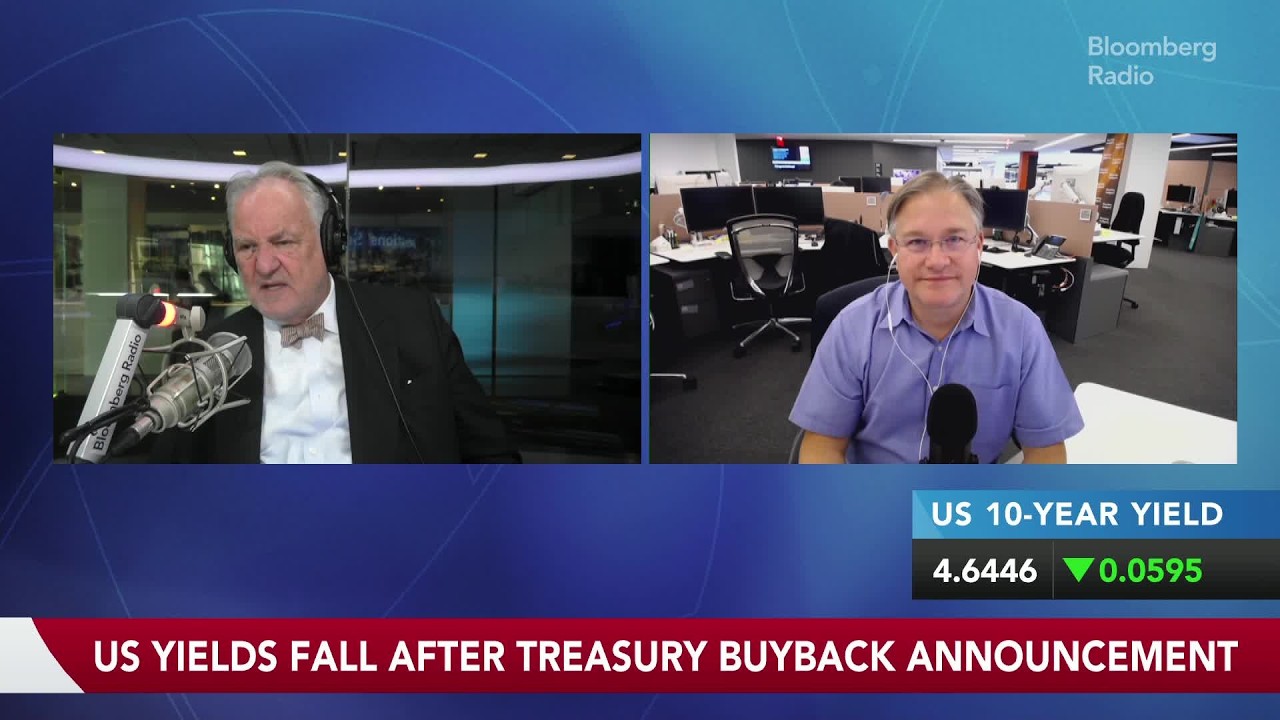
By Wednesday morning, the Treasury folded. It doubled the cap on its long-end buybacks, in flat contradiction of the quarterly schedule it had just released. The effect was immediate: the 30-year eased nine basis points to 5.196%, the 10-year fell nearly six to 4.647%, and equities cheered. An economist at Jefferies captured the mood by describing the decision as shot from the hip, trampling decades of communication built on “regular and predictable” issuance. That is precisely what deserves attention here. The dollar amount is trivial. The methodological panic is not.
The Bond Market, for People Who Never Set Foot in It
A short detour into fundamentals is in order, because everything that follows depends on it.
When a government or a company borrows, it issues bonds: IOUs promising a fixed rate of interest over a set term. The “long end” of the curve refers to maturities of 10, 20, or 30 years. Who lends money for thirty years at a fixed rate? A very particular population of investors: pension funds, life insurers, a handful of sovereign wealth funds. Institutions with very long-dated liabilities on one side of the ledger, looking for very long-dated certainty on the other. That population is finite. It does not expand by decree, and it certainly does not expand because a tech giant needs one more campus in Louisiana.
Next, one has to understand what a Treasury buyback actually is, because the word misleads. The Treasury creates no money and pays down no debt. It repurchases older long bonds that have gone illiquid, known in the trade as off-the-run securities, and it funds those repurchases by issuing short-dated paper instead. The obligation does not vanish. It is pulled closer to the present, to be refinanced in a year or two at whatever rate happens to prevail then. The government is buying back the debt nobody wants by selling more of the debt investors will still take. The stock is unchanged, the maturity profile is rearranged, and refinancing risk is concentrated in the near term.
Some will detect a family resemblance to quantitative easing. The comparison is not absurd: in both cases, a price-insensitive buyer places a bid beneath the long end of the curve. The difference lies in who writes the check, the central bank in one case, the Treasury in the other. The distinction preserves the appearance of Fed independence. It does very little to the underlying mechanics.
The $3 Trillion Buried in the Footnotes
Now to the other bidder, the one that appears in no budget debate.
On Sunday, the Wall Street Journal published an analysis of the footnotes in the most recent regulatory filings of nine major technology companies, among them Alphabet, Amazon, Meta, Microsoft, Oracle, and Nvidia. The finding: roughly $3 trillion in off-balance-sheet commitments, overwhelmingly tied to AI. That total breaks down into two blocks: about $1.2 trillion in leases signed but not yet commenced, mostly for data centers, and about $1.9 trillion in purchase obligations covering chips, compute, construction, and power.
For scale: those same nine companies reported roughly $600 billion in capital expenditure over their most recent reporting year. The off-balance-sheet commitments therefore run to five times official capex, and they are growing faster than it is. Uncommenced leases have roughly quadrupled in a single year.
Let us be clear at once, so as not to slide into accounting conspiracy theory: none of this is hidden, and none of it is illegal. The accounting rules provide that a lease which has not commenced, or a future purchase obligation, does not sit on the balance sheet until the service is actually delivered. These figures are disclosed, in the footnotes, exactly where the rules put them. What is new is not the structure. It is the scale, and the speed.
Because all of these commitments will have to be funded. A data center, a chip supply agreement, a twenty-year power contract are very long-duration assets. And the golden rule of corporate finance holds that long-duration assets are financed with long-duration debt. Which is to say, precisely the product the U.S. Treasury sells.
The Collision: Two Borrowers, One Window
So here is the configuration of August 2026. On one side, a government that must permanently roll over $40 trillion of debt, several trillion of it at the long end. On the other, the largest market capitalizations in history, now beginning to issue hundreds of billions in long-dated debt to honor $3 trillion in commitments, at the very moment their cash generation stops keeping up: Alphabet’s free cash flow turned negative in the second quarter of 2026, a first since 2004, and Amazon’s flipped into the red as early as the first.
Both are knocking on the same door: that finite pool of investors willing to lock up capital for thirty years. And neither is fighting on equal terms. The hyperscaler can offer whatever yield it takes to attract the lender and book the expense as future growth. The government can only watch its refinancing costs climb, until the day it decides to “support liquidity.” That is what happened on Wednesday. In this market, the sovereign just lost an arm-wrestling match with its own national champions, and it lost it by tearing up its own schedule.
The irony is worth pausing on, because it is vertiginous. The rating agencies have stripped the United States of its triple-A. Microsoft still has one. In other words, in the eyes of the raters and of a good part of the market, the signature of a software publisher from Redmond is now worth more than that of the state that mints the currency, levies the taxes, and maintains eleven aircraft carriers. Some investors would rather lend for thirty years to a corporation than to the sovereign that guarantees the legal system in which that corporation exists. The world turned upside down? Not quite. It is the coldly calculated price of forty trillion dollars in accumulated debt set against corporate balance sheets still swollen with cash. And it is precisely this inverted hierarchy of credit that lets Big Tech drain long-term savings without flinching, while the Treasury improvises buybacks.
The bill, meanwhile, is not waiting for the history books. The 30-year Treasury yield is the benchmark that anchors American mortgage lending, and the average 30-year fixed rate currently sits near 6.7%. Let us be precise about the mechanism, so as not to hand the purists an easy target: a mortgage rate does not simply copy the Treasury yield. Layered on top is the spread on mortgage-backed securities, and baked in are expectations about Fed policy. The transmission is therefore indirect. But it is real. The sovereign curve remains the foundation on which everything else is built, and every basis point that the competition between Big Tech and the state durably adds to the long end works its way, with some lag and some friction, into the monthly payment of a household in Ohio. People will pay for this in their mortgage rate long before anyone dares to use the word crisis.
The Serious Objection, and Why It Falls Short
Let us be fair to the opposing case, because it exists and serious people make it.
First argument: $4 billion per operation is a rounding error in a market of more than $30 trillion, roughly $5.5 trillion of which sits in 20- and 30-year paper. Buybacks have been running for two years, they exist to smooth trading in older issues, and calling this a bailout is hyperbole. Second argument: the $3 trillion in off-balance-sheet commitments is not debt. An uncommenced lease becomes a liability when the space is delivered; a purchase obligation becomes capex when the chips show up. Comparing a stock of future commitments to a year of past capex does a great deal of rhetorical work and very little analytical work.
All of that is accurate. And all of it misses the point, for two reasons.
First, routine housekeeping does not require tearing up a schedule published two weeks earlier. If Wednesday’s move had been mere maintenance, it could have waited for the next quarterly refunding. The Treasury chose to sacrifice its single most valuable asset, its predictability, to buy nine basis points, most of which had in any case bled back out of the 10-year by early afternoon. You do not burn that kind of capital to tidy up.
Ira Jersey, chief US interest rates strategist at Bloomberg Intelligence, put it plainly that same day on Bloomberg: the Treasury could simply have issued slightly less long-dated debt come February, an outcome he then put at 15 to 20% odds. It chose to buy back instead.
Second, the accounting objection describes a stock when the problem is a flow. That the off-balance-sheet commitments are not yet debt is true today. But they will become debt, quarter after quarter, precisely along the maturities where the Treasury is already struggling. The question is not whether the $3 trillion is legally a liability in August 2026. The question is who will lend it between 2027 and 2035, and at what price, while the government rolls its own debt at the same window. I described the same mechanism on a French scale when Mistral took on debt for its data center: the American version is identical, multiplied by a thousand.
The Wager Beneath the Wager
There is one more layer the bond-market debate tactfully avoids: the entire structure rests on the assumption that AI revenues will eventually justify these commitments. Yet the business model of the model providers remains nowhere to be found, and competition from open-weight models, good enough and fifty times cheaper, is compressing prices faster than data centers can come out of the ground. If monetization disappoints, the twenty-year leases and the power contracts will still be owed. Long-term obligations backed by hypothetical revenues, funded in a bond market already saturated by the sovereign: financial historians will recognize the pattern.
Nobody Voted for This
Let us close on the political point, because there is one.
What was quietly put in place on August 19, with no parliamentary debate, no presidential announcement, and without the word ever being spoken, is a quasi-monetary policy conducted by the Treasury itself: a public, price-insensitive buyer positioned beneath the long end of the curve to absorb the strain caused, among other things, by the private AI buildout. The state absorbs the volatility, the hyperscalers issue their debt into a market stabilized at public expense, and the taxpayer-borrower settles the difference in his mortgage rate. There is no need for an explicit subsidy when you can socialize the cost of capital instead.
And Europe in all this? Watching, as usual. But make no mistake: the global pool of long-term savings is a common one. When Washington and Silicon Valley bid against each other for pension money, France with its €3.4 trillion of debt and Germany with its infrastructure plans are drawing from the same aquifer. We have neither the hyperscalers, nor the market depth, nor the reserve currency. We will have the rates. While Brussels polishes its regulations and Bercy sells off its industrial stakes to close the books, the structure of the global cost of capital is being redrawn around the needs of six American companies.
Sovereignty is not decided only in chips, models, and cables. It is decided in the queue of borrowers. On August 19, 2026, the United States showed the world who goes first. Nobody voted on that order of precedence, and everyone will find it again in their monthly payment.