Society In Los Angeles, a stage set reproducing the cabin of a private jet rents for under $55 an hour, and it is booked around the clock. Around it, a complete supply chain for the lifestyle has been built: châteaux by the day, Lamborghinis by the half hour, photo cruises on the Seine, Rolexes handed over in the lobby of a luxury hotel. Not one of these companies deceives anyone, they publish their rates online, and that is exactly what makes the operation impossible to prosecute. What remains to be understood is why these accounts always declare the same handful of occupations, the ones nobody can audit, and how they guarantee one another a success none of them has the capital for. An inquiry into Potemkin influencers, and into what it says about a country that success can be rented there by the hour.
Justice “For the last month, just take it out of the deposit”: the sentence every French landlord eventually hears, resting on a stubborn misunderstanding. A security deposit can indeed cover unpaid rent, but the landlord applies it at move-out, against receipts, rather than the tenant deciding in advance. Between the statutory cap, the return deadlines, the 10 percent penalty and the 20 percent holdback in condominium buildings, Article 22 of France’s 1989 tenancy law already sets careful limits on both sides. Which leaves a few myths to dismantle along the way, starting with the supposed “registry of defaulting tenants” that does not exist in France and whose very creation would be a criminal offense.
History 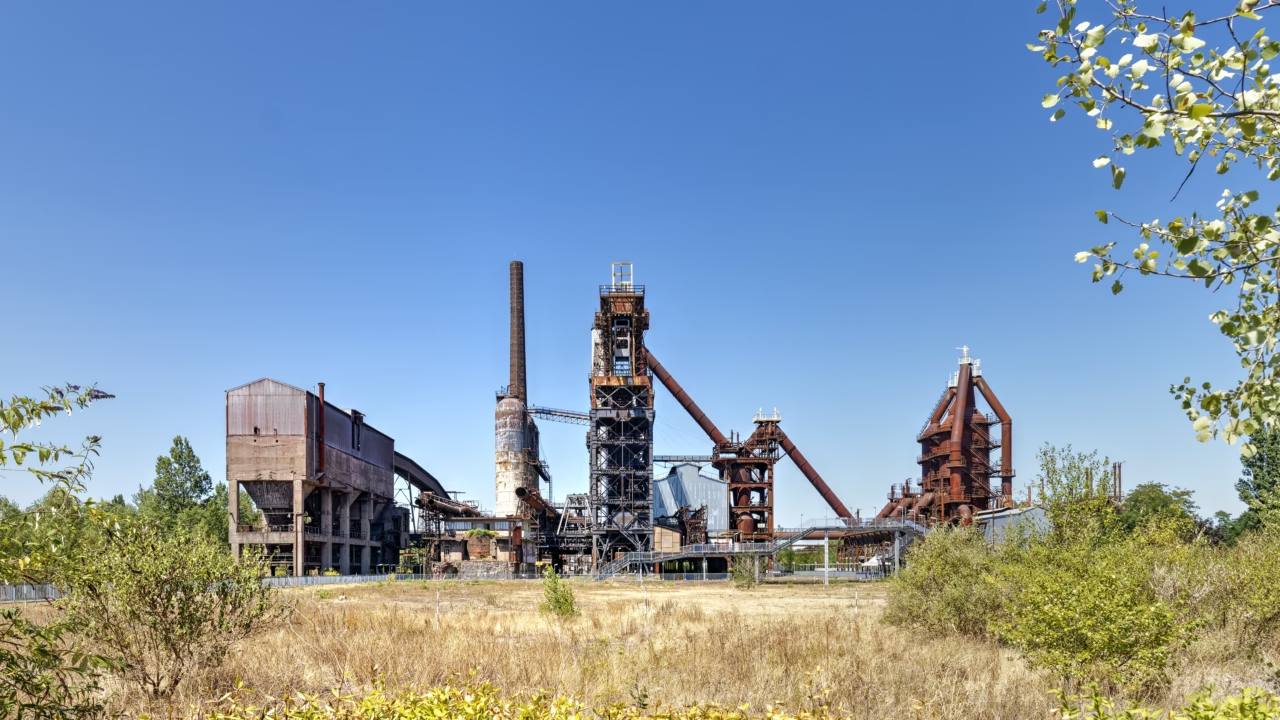
On the way back from a few days on the Nürburgring’s Nordschleife, I stopped in the Fensch valley to visit the U4 blast furnace at Uckange, the sole survivor of six installations at an ironworks that went cold in December 1991, and the only blast furnace in France open to visitors. Thirty acres of industrial wasteland, a 270-foot chimney, a cast house frozen exactly as it stood on the evening of the last tap: the place owes its survival to former workers who fought for ten years to get it listed as a historic monument. Between the Staehler bucket, the production board ruled in chalk, and the union posters from 1991, you grasp what 1,200 people working around the clock actually produced. But a country that puts its blast furnaces behind glass has already answered the question of its industrial sovereignty, and the tour, fascinating as it is, looks a great deal like a very well lit death certificate.
Digital sovereignty On July 28, 2026, China began volume production of its own immersion scanners, the 60-million-euro machines that print circuits onto silicon and that only ASML truly knows how to build: five units this year, about twenty in 2027, against ASML’s 130 systems a year. One to twenty-five: the ratio looks trivial, yet Seoul dropped 10% and Tokyo 4% in the days that followed, because a technology embargo has no proportional value. Its value is binary, and it has just stopped being a wall and become a delay, something that can be calculated, amortized, and planned around. By removing the alternative, export controls created the competitor they were meant to smother, exactly as they had taught Chinese AI frugality. Three days later, Bpifrance sold 2.5% of Orange for 1.1 billion euros and called it asset rotation: for the same sum, one bought productive capital, the other three months of cash.
Geopolitics April 2013: an Alstom executive is arrested at JFK, and the group’s energy business ends up at General Electric. Thirteen years later, France is requiring its companies to route their entire invoicing flows through a hundred-odd private platforms: customers, suppliers, actual prices, volumes, dependencies, a real-time map of its economy. No hacking required when an extraterritorial subpoena, a platform acquisition, or a well-placed source will do. The sharpest irony: the most sensitive data doesn’t sleep in the administration’s fortress, but at the weakest link. In the name of VAT collection, France has just assembled the most complete economic intelligence trove in Europe, with no doctrine to protect it.
Cars On July 9, 2026, Volkswagen announced the unthinkable: its lineup cut in half, options slashed by 75 percent, four German plants under threat, and up to 100,000 jobs on the line. Days earlier, news broke that BYD had twice tried to take control of Renault, rebuffed by a French state playing the hero while Geely was already inside the house. The prevailing narrative blames China; it has the wrong culprit. Entrenched codetermination, an EV calendar set by decree, capital locked up by the Florange law: Europe’s auto industry isn’t dying of competition, it’s dying of fifty years of protection that excused it from adapting. Creative destruction deferred doesn’t disappear, it accumulates until the break, and the wolf never had to force the door: we sold it the keys.
Justice Four years of investigation, search after search, and still no resolution: the McKinsey affair is no longer merely a suspicion of irregular financing of the Macron campaigns, it has become a revealing X-ray of how French justice works. The 2022 Senate report established the inconvenient facts: over one billion euros spent on consultants in 2021 alone, and a firm that paid zero corporate income tax in France for ten years. Against that backdrop, comparing judicial tempos is a cruel exercise: an inquiry opened the very day of the revelations for Fillon, immediate enforcement for Le Pen, eight years and a quiet closure for Mélenchon, perpetual suspension for the party in power. One clock, though, is ticking unwatched: Article 67 of the Constitution, which will make Macron an ordinary citizen before the law in June 2027. Seen from that angle, the next presidential election will also be an election about the judicial fate of the previous one.
Politics Every year in France, nearly 50 billion euros in public funding flows into the nonprofit sector. Behind the legitimate delivery of public services hides a major democratic drift: the funding of organizations whose sole activity is manufacturing rules and influencing policy. Subsidized by the very State they claim to watch, these groups use taxpayer money to wage permanent legal warfare, paralyzing projects and replacing the voters’ ballot with litigation. By losing their financial independence, these precious countervailing powers have changed in nature. Our democracy’s watchdog has become the administration’s lapdog.
Economy A few days ago, I woke up firmly resolved to go do a little shopping. Those who know me will appreciate the scale of the sacrifice: wandering strip malls under fluorescent lights appears nowhere on my list of earthly pleasures. But sometimes you have to force yourself, if only to replace a pair of shoes […]
Politics Eric Zemmour’s debate with François Bayrou is the best France has seen in a long while: two speakers who listen, argue, and summon French history without demonizing each other. But debating well is not the same as debating the right thing. Behind one man’s civilizational hierarchy and the other’s fiscal alarm lies a shared blind spot: the 1.7-trillion-euro state machine that produces both crises at once, and that neither proposes to dismantle. With every figure checked, from the foreign holders of French debt to the wealth gap with the Netherlands, this article shows why the face-off replays Marc Bloch’s strange defeat in miniature. And why 1958, which Zemmour invokes, was saved not by an orator but by an economist.