TurboQuant : How Google cuts your LLM memory sixfold
Ten days ago, I explained why the shift from RAG to CAG wasn’t just an architectural fad, but the logical consequence of exploding context windows. The problem I left hanging: the KV-cache, the bottleneck that turns giant contexts into a memory nightmare the moment you step outside the subsidized cloud.
Google Research just answered it with TurboQuant.
Not a gadget. Not a “revolutionary” tweet. A solid academic paper, presented at ICLR 2026, that brings down one of the last structural walls of local inference.
Here’s what it changes, and what it doesn’t change yet.
The Problem TurboQuant Solves (and That the Tweets Don’t Explain)
The KV-cache is an LLM’s working memory during generation. For every token in the context, the model stores two vectors: Key and Value. These vectors are read back at each step of attention.
The result: a 100,000-token context with Llama-3.1-8B can eat up several gigabytes for the KV-cache alone, independent of the model weights. That’s often what makes inference choke on consumer hardware.
Classic quantization (16 → 4 bits) already existed, but it tacked on 1 to 2 bits of constants per block. TurboQuant removes that overhead. That’s its real contribution.
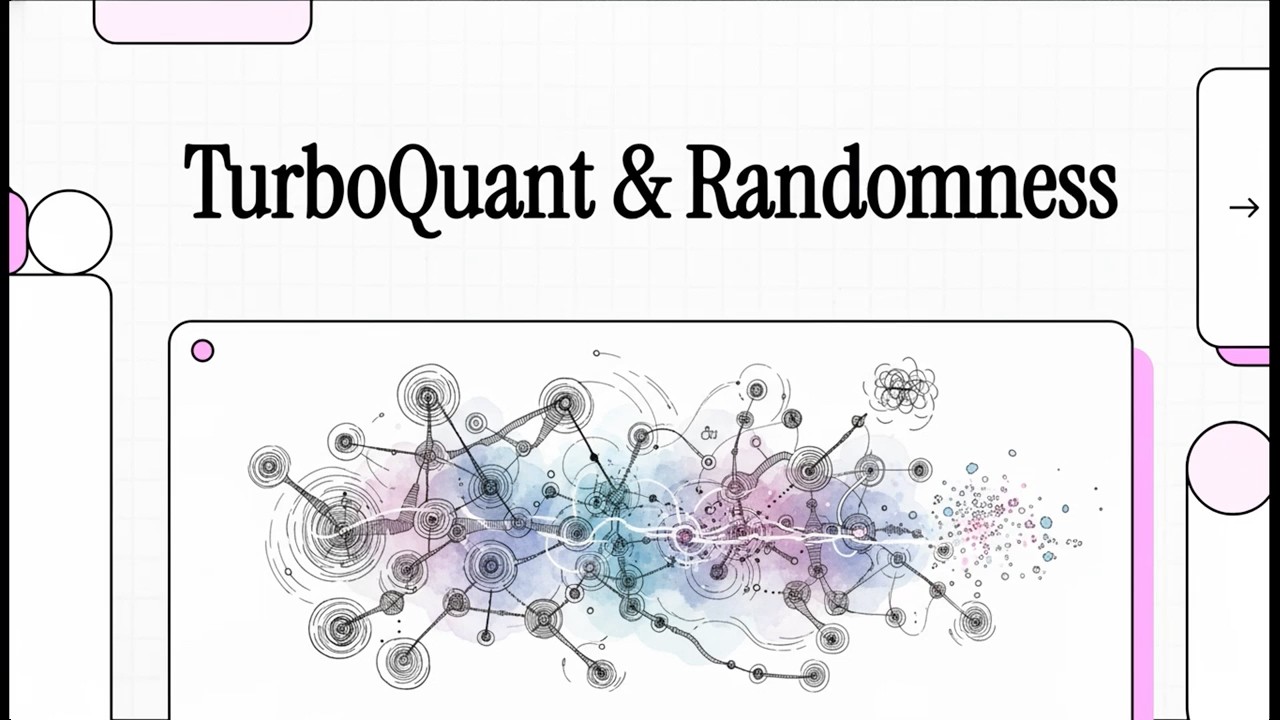
The TurboQuant presentation captures the core idea well: introduce a form of controlled chaos to make compression more uniform, then push down to very aggressive encoding without sacrificing precision.
To picture this bottleneck, this video on TurboQuant does a great job of explaining why the KV-cache has become one of the main locks on local inference.
The Mechanics, Plainly: PolarQuant + QJL
TurboQuant rests on two complementary building blocks:
- PolarQuant: random rotation of the vectors, then conversion to polar coordinates. After rotation, the vectors spread uniformly over a hypersphere → highly faithful 2-bit quantization.
- QJL (Quantized Johnson-Lindenstrauss): encodes the residual with a single bit (sign +1/−1) while preserving cosine distances.
The combination gets down to 3 bits per value in the KV-cache, with no fine-tuning, no per-model calibration, and fully data-oblivious (0.0013 s to index 1536-dim, versus several hundred seconds for classic Product Quantization).
The Benchmarks and Their Real Caveats
- KV-cache memory ÷ 6 at minimum vs 32 bits.
- Attention speed up to 8× on the H100 (measured on the logit computation, not on full inference).
- 100% recall on Needle-in-a-Haystack up to 104k tokens.
- On par with or better than KIVI on LongBench, RULER, ZeroSCROLLS, and L-Eval (Gemma, Mistral, Llama-3.1-8B).
The CacheGen video offers a useful technical counterpoint: it shows how KV-cache compression can cut bandwidth, latency, and memory pressure in long-context language systems.
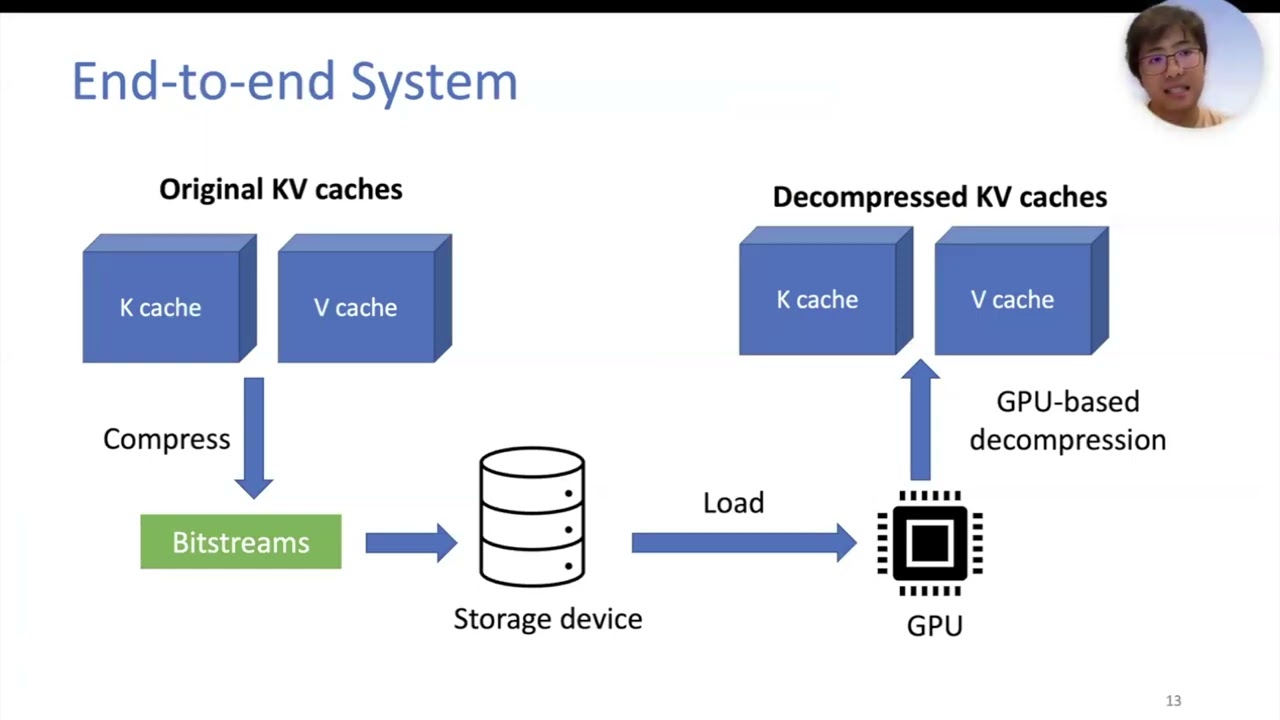
Worth noting: Gemma 2 benefits especially from this method, which is hardly surprising given that it’s a Google model. You can see very clearly here the advantage of a vertical ecosystem where fundamental research and inference optimization are aligned.
Important caveats: the 8× is an isolated measurement. The real gain on end-to-end inference will be more modest. And we’re still at the paper stage: no public implementation in llama.cpp, MLX, or vLLM as of today. Realistic integration: late 2026 / 2027.
While TurboQuant already seems to open a very clear path on the theoretical side, this general-audience video helps gauge the gap between a research demonstration and real adoption in local inference tools.

What TurboQuant Does NOT Do
- It does not compress the model weights. A 70B in 4 bits is still ~35-40 GB. A 16 GB Mac Mini won’t load a 70B, full stop.
- It does not solve the quadratic complexity of attention on very long contexts (an architecture problem, not a quantization one).
What it does do: on a machine that could already load a model, you can now hold contexts six times longer with no OOM and no loss of precision.
What This Changes in Practice, and the Link to CAG
CAG + TurboQuant = the combo I’d been waiting for. You can load a corpus six times larger into the context with no degradation.
So much for the classic excuse: “I have to send my 50 PDFs to the Anthropic API because my local machine maxes out.” The local machine wins on privacy: everything stays with you, on your own hard drive, never passing through a California cloud.
Prompt caching + TurboQuant: the first cuts the cost of repeated reads, the second cuts the cost of dynamic storage. Same efficiency philosophy.
Same signal on vector search: applied to embeddings, TurboQuant divides indexing time by several orders of magnitude.
Google “Open Source”: Neither Naivety nor Cynicism
Google publishes because it’s in its strategic interest (academic reputation, recruiting, TPU infrastructure). But the outcome is concrete: a fundamental KV-cache compression algorithm is now public. For anyone who cares about their digital sovereignty, that’s a real asset.
My Takeaway
TurboQuant tackles a genuinely structural problem: KV-cache memory as the bottleneck of long-context inference. The implications for CAG, prompt caching, and hybrid pipelines are immediate. The hardware impact will be tangible… but in 12 to 18 months.
In the meantime, if you’re building AI stacks: file TurboQuant away as the missing link that will make your future long contexts far less painful.