Structured products : you’re not investing, you’re insuring your bank against crashes
On 6 February 2026, Stellantis shares lost 25% in a single session. The stock, which had still been worth €27 two years earlier, closed at €6.27. For the general public, it was one more industrial tragedy. For tens of thousands of French savers, it was the exposure of a mechanism that had been carefully concealed from them: they had not bought an investment; they had sold their bank a catastrophe insurance policy. And the house was burning.
Some buy-back valuations on structured products indexed to Stellantis now show -99%. Not -10%, not -50%. Near-total erasure of capital. All on instruments sold as “protected”, “regulated”, “with a safety barrier”.
It’s time to ask the uncomfortable question: do these products still have any place in a retail investor’s portfolio?
A market that tripled in four years
First, the scale, because we’re talking about an industrial phenomenon here. The French structured products market has exploded: €23 billion in net inflows in 2021, €42 billion in 2023, and €60 billion in 2025 according to AMF/ACPR figures. That’s a 2.6-fold increase in four years.
This explosion owes nothing to the product’s intrinsic merit. It comes down to three very prosaic factors:
- Rising interest rates allowed banks to advertise attractive headline coupons (6 to 8% per year).
- The euro-denominated fund, which was yielding next to nothing, pushed advisers to seek “dynamic” products with strong commercial potential.
- And above all, structured products are the most profitable products for banks in their entire catalogue: structuring margins, transaction commissions, fees buried in the formula. No other product generates as much for the distributor.
Eighty percent of these €60 billion are distributed through life insurance contracts. In other words, retail investors often don’t even know they hold them — they simply signed up for “dynamic unit-linked funds” their adviser recommended.
What you’re sold, and what you’re actually buying
The sales pitch comes down to one sentence: “You receive 8% per year as long as the stock doesn’t fall more than 30%, and your capital is protected down to -40%.” Framed that way, it sounds almost like an enhanced bond.
The financial reality is radically different. You are not buying an investment. You are selling a put option to the bank, in exchange for a premium disguised as a coupon. You are surrendering the dividends on the underlying asset to the bank, which uses them to finance the mechanism. And you are capping your upside at the coupon level, while retaining 100% of the downside risk beyond the barrier.
Let’s rewrite the contract as it actually is, without the marketing:
“I will pay you an annual premium. In exchange, if the stock collapses by more than 40%, you reimburse me the entirety of the loss. And by the way, I keep all the dividends the stock would otherwise have paid you.”
No rational retail investor would sign that contract if it were worded that way. Which is precisely why it is never worded that way.
The asymmetry illustrated
The chart below summarises the payoff profile at maturity of a typical autocall product (8% coupon, 5-year term, -40% barrier), compared to simply holding the stock with dividends reinvested.
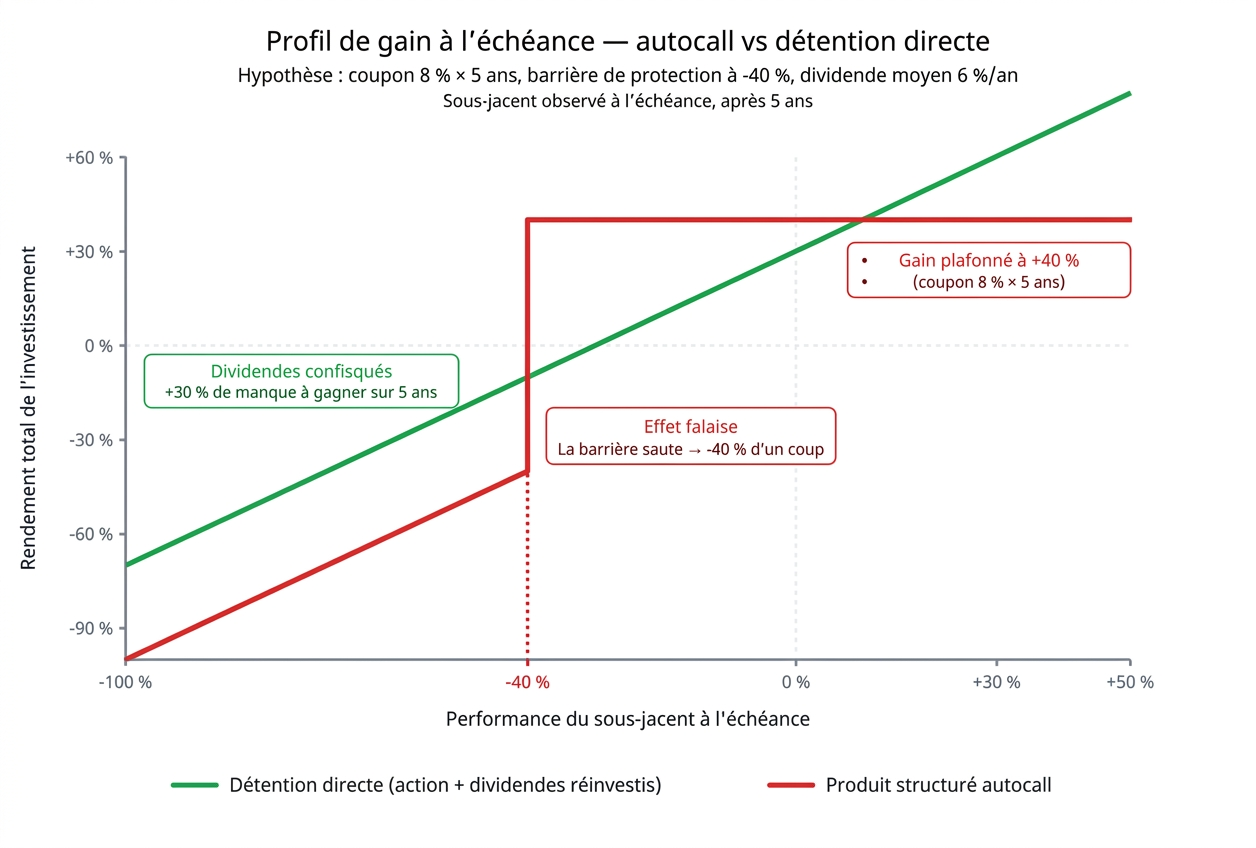
Three lessons are immediately apparent:
- Above +10% performance, direct ownership systematically outperforms the structured product. All upside beyond the coupon is captured by the bank.
- Between -40% and +10%, the structured product creates the illusion of superiority. This is its commercial comfort zone.
- Below -40%, the barrier breaks instantly. The saver goes from +40% total return (accumulated coupons) to -40% (capital loss), with no gradation whatsoever. This is the cliff effect.
Add to this the net dividend shortfall: on a high-yield underlying like Stellantis, that’s 30 to 60 percentage points of cumulative return over 5 years flowing directly into the bank’s pocket to finance the structure.
The coupon is not a gift: it’s your own dividend reformatted
This is the point that commercial communications take great care to obscure. When your adviser proudly presents an 8% annual coupon “guaranteed as long as the barrier holds”, they neglect to mention that this coupon is primarily financed by the dividend you are giving up by not buying the stock directly.
Here is the true economic picture for four typical autocall underlyings:
| Typical underlying | Promised coupon | Average dividend before | Real value creation for the saver |
|---|---|---|---|
| Stellantis (2022–2024) | 8 to 10% / year | 7 to 13% / year (yield trap) | Zero, or negative |
| TotalEnergies | 7 to 8% / year | 5 to 6% / year | ~ 1 to 2% per year |
| BNP Paribas | 7 to 9% / year | 6 to 7% / year | ~ 1 to 2% per year |
| EuroStoxx 50 (index) | 5 to 6% / year | ~ 3% / year | ~ 2 to 3% per year |
Reading the table. On a high-dividend underlying like Stellantis, the “attractive 8% return” of the structured product is actually lower than the dividend the stock was paying. The saver who subscribed to these autocalls in 2022–2023 therefore:
- Gave up a dividend of 8 to 13% per year,
- In exchange for a coupon capped at 8 to 10% per year,
- While bearing 100% of the downside risk beyond -40%.
For underlyings with more modest dividends (TotalEnergies, BNP, broad indices), a net margin does exist, typically 1 to 3% per year in the saver’s favour. This margin barely covers the barrier risk. And it disappears entirely the moment the barrier is breached.
This is the textbook definition of a put option sold at a price that is systematically unfavourable to the seller. The saver is playing against the house, and the house knows how to price.
The barrier probability is not what you’re told
One more point worth bringing to light: the sales argument that “a 40% decline over 5 years is extremely rare” is statistical sophistry. On the EuroStoxx 50, perhaps. On a single stock like Stellantis, it happened twice in five years.
More broadly, across all CAC 40 stocks over the past twenty years, roughly one in five has experienced a drawdown exceeding -50% at some point: Vivendi, Orange, Alstom, Renault, Société Générale, Atos, Worldline, Sanofi, Casino, Carrefour, Engie, and now Stellantis, Kering, Teleperformance. The -40% barrier is not robust protection. It is a statistically fragile promise over a 5 to 10 year horizon, a fortiori when the underlying is selected precisely because it pays an abnormally high dividend, which is itself a stress signal the market has already identified.
This is the dividend yield trap syndrome: a stock whose yield explodes precisely because its price is collapsing. Stellantis was showing a yield of 12–13% at the very moment its share price was cratering. That was not an opportunity; it was a warning signal. The autocall structurers knowingly ignored it, because that elevated yield allowed them to price commercially attractive coupons.
The “bespoke” argument doesn’t hold
Defenders of structured products raise three counter-arguments. Let’s examine them.
- “They let you earn returns in a flat market.” False in 90% of cases, as the table above demonstrates. The coupon is not a gift: it is primarily the dividend of the underlying you surrendered, plus the premium on the short option you sold. On Stellantis with a 12% yield, receiving a conditional 8% coupon with barrier triggers is mathematically unfavourable. You are paying for protection that evaporates precisely when you need it most.
- “They’re bespoke for specific investor profiles.” In theory. In practice, autocall products represent 90% of French issuances, a peculiarity of the French market. Industrial standardisation is total. “Bespoke” means choosing between fifteen shades of the same formula.
- “Investors are free agents — they signed.” A lazy argument. Regulators already ban retail investors from leveraged CFDs beyond a certain threshold, certain cryptocurrencies, and direct trading on futures markets. The principle of absolute contractual freedom has never been the standard in financial services, and rightly so. When 90% of issuances are concentrated in a format whose loss mechanics are poorly understood even by advisers, the “informed consent” argument becomes an alibi.
The Belgian precedent
At this point, I’ll be told that French regulation has done what was necessary: mandatory SRI rating, KID brochures, warnings on capital loss risk. That’s false. These mechanisms have mainly allowed banks to tick boxes and disclaim responsibility.
Belgium took a different approach. As early as August 2011, the FSMA (Financial Services and Markets Authority) introduced a voluntary moratorium on the marketing of “particularly complex” structured products to retail investors. The result is unambiguous: virtually all banks and insurers operating in Belgium signed up, and the overwhelming majority of structured products now marketed there include a full capital repayment guarantee at maturity. Single-stock barrier autocalls with European barriers (the category at the heart of the Stellantis affair) have all but disappeared from the Belgian retail market.
The market did not collapse. Belgian savers continued to invest, but on simpler and better-protected instruments. Complexity migrated to where it should always have been: “private banking” clients with at least €500,000 with the institution, or sophisticated investors capable of evaluating the mechanics themselves.
This is precisely the model France should adopt.
Restricting access to qualified investors: the sensible path
An outright ban would be disproportionate. A qualified investor under MiFID II (that is, a person with the financial knowledge, assets and experience to evaluate a derivative product independently) may legitimately use these structures to hedge a position, smooth income, or execute a volatility strategy. Blocking their access would be over-regulation.
However, the marketing of autocall structured products on single-name underlyings, decrement index products, and more generally any structure whose payoff formula involves more than two sequential mechanisms should be strictly reserved for qualified investors, regardless of the distribution channel, including life insurance. What is today a mass market would become a niche market for sophisticated clients. The ordinary retail investor would retain access to euro-denominated funds, ETFs, SCPIs, and bond funds: an already extraordinarily broad universe, and a far more transparent one.
The objection banks will immediately raise is that they would “lose a diversification tool for their clients”. The truth is that they would primarily lose their most profitable product. That is not the same thing, and protecting their margins is not the regulator’s job.
The deafening silence of the authorities
A political question remains. The AMF and ACPR know these figures. In April 2025 they published a comprehensive mapping report that precisely describes the dividend capture mechanism, the cliff effect of European barriers, and the drift toward decrement indices (which now account for 75% of sales, up 26 percentage points from 2024). They know. And yet the official position remains limited to calling for more transparency, better client information, stronger adviser training.
That is not enough. At this stage, it amounts to complicity. No forty-page brochure has ever stopped a saver from trusting their bank adviser presenting a product as “protected”. No signature at the bottom of a KID document compensates for the radical information asymmetry between the entity that structures the product and the one that ends up holding the loss.
The Stellantis scandal is not an accident. It is the numerical confirmation of a mechanism that has been understood for twenty years and whose consequences European regulators are only now beginning to draw. Belgium acted in 2011. Fifteen years later, France has still not moved. And in the meantime, the inflows keep rising.
At some point, we will have to stop pretending.