Paid parking : anatomy of an institutionalized scam
Because in Saint-Marcellin, as everywhere in France, they take us for suckers, and the numbers prove it.
Foreword: the facts, nothing but the facts
This piece isn’t a baseless rant. It’s a case for the prosecution: documented, sourced, impossible to wave away. If an elected official wants to contradict me, let them start by answering the data below.
Saint-Marcellin is not an isolated case. It’s one laboratory among many for a national policy of disguised skimming, driven by officials you never directly gave a mandate to do this.
A word about vocabulary, because words are weapons. We no longer say contravention (the French word for a fine): too clear, too criminal, too loaded with a bad reputation. Since the 2018 reform, we say Forfait Post-Stationnement (FPS), literally a “post-parking flat fee.” Note the beauty of it: the word “forfait” evokes a subscription, an agreed-upon rate, almost a freedom of choice. The word “post” suggests a neutral, almost technical consequence. And “stationnement” (parking) depoliticizes the act. In three words, a fine imposed by the State has been turned into a simple billing adjustment. And that’s only the beginning: there’s the FPS minoré (pay quickly and we’ll cut you a break), the FPS forfaitaire (you dragged your feet, so it costs more), the RAPO (Recours Administratif Préalable Obligatoire, the mandatory prior administrative appeal) to contest it, the TSP (Tribunal du Stationnement Payant, the Paid Parking Tribunal) if the RAPO is rejected… Welcome to the newspeak of paid parking, designed to discourage you from understanding it, and even more from contesting it.
The Trojan Horse of the 90 free minutes
The machine is well-oiled. They give you the first 90 minutes free, the municipal “gift.” In reality, it’s the dealer’s first dose: free, the better to install the infrastructure, get people used to it, and digitize the plates.
Mandatory registration: to get the free period, you type in your license plate. You have just voluntarily joined an automated surveillance database linked to the Système d’Immatriculation des Véhicules (SIV, the national vehicle registration system), to which the ANTAI (the agency that processes automated fines) has legal access. This isn’t paranoia. It’s written in black and white in the regulations. And if you thought scanning your plates was reserved for serious offenses, remember that our local waste-collection centers already use the exact same setup to gate access to a public service. Parking is the same logic, applied to the street.
The stopwatch trap: who runs their errands, sees the doctor, and stops by the bank in exactly 90 minutes flat, watch in hand? Nobody. Go a few minutes over, and the Forfait Post-Stationnement (FPS) lands. The “free” period is a stressful countdown designed to feed the municipal coffers.
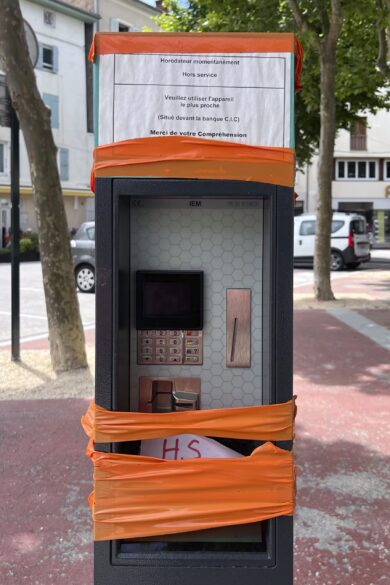
The great fiscal illusion: the raw numbers
Here’s what elected officials don’t like to be reminded of.
📋 Shocking figure: before the reform, the national flat-rate fine was set at €17 nationwide. Since the 2014 MAPTAM law and the decriminalization of parking that took effect on January 1, 2018, each municipality freely sets the amount of its FPS. The result: the average FPS now reaches €25, and in 30% of cities it tops €30. In Paris, it climbs to €75, or even €125 with a surcharge. Decriminalization was an unprecedented pricing windfall for municipalities.
The explosion in revenue speaks for itself:
| Year | National parking revenue |
|---|---|
| 2017 (before reform) | €397 million |
| 2018 (after reform) | €731 million |
| 2022 (FPS only) | €340 million |
💰 Shocking figure: according to the Direction Générale des Collectivités Locales (DGCL, the national directorate for local government), between 2017 and 2018 the parking revenue of French municipalities jumped from €397 million to €731 million, a rise of +84% in twelve months. No mobility policy has ever produced such a result so fast. This isn’t urban management. It’s budgetary predation.
In the span of a year, revenue nearly doubled. Not because the streets are suddenly better managed. Because the rates exploded and enforcement was outsourced to machines.
The industrialized hunt for drivers
The 2018 decriminalization didn’t reduce the number of “squatter cars” (vehicles left parked in the same public spot for weeks on end). It opened a market.
LAPI vehicles (Lecture Automatisée des Plaques d’Immatriculation, automated license-plate reading) crisscross cities photographing every plate, every minute, with no human involvement. Started in Marseille in 2018, this enforcement spread to Bordeaux, Lille, Lyon, Montpellier, Nice, Paris, Rouen, Villeurbanne… According to Jean-Laurent Dirx, president of the Fédération des Métiers du Stationnement (FNMS, the parking industry federation), outsourcing enforcement “cuts costs and raises revenue by 10 to 30%.”
Translation for the ordinary citizen: you can now receive an FPS while you’re still fishing for your bank card in front of the meter.
The business model is unambiguous. These companies are paid on performance, meaning on the volume of FPS issued. The contractor’s interest and the municipality’s interest converge on a single goal: ticketing as many drivers as possible.
This isn’t regulation. It’s a business model.
Romans-sur-Isère, a textbook case within driving distance. In our neighbor across the Drôme, the picture is complete and documented on the city’s own website: parking payment is outsourced to the mobile apps PayByPhone and PrestoPark, two private companies. Resident permits? Managed by PrestoPark, on a dedicated platform. Ticketing? Handed to sworn officers who can legally answer to a private contractor, as the Cerema confirms. When you get an FPS, you pay your fine to a private company. You contest it through a RAPO addressed to a “Paid Parking Disputes Unit,” a municipal cell created from scratch to absorb the flood of complaints the system generates. And if the RAPO is rejected, you take it to the Tribunal du Stationnement Payant. A special court, created to handle disputes from a system that wouldn’t have existed without the 2018 reform. The loop is closed: the State creates the problem, outsources the problem to the private sector, then creates an institution to manage the complaints about the problem. All of it funded by the driver-taxpayer.
And here’s the killer detail: this policy doesn’t come solely from the Romans city council. It’s part of the Master Parking Plan of Valence-Romans Déplacements, the inter-municipal mobility authority that since 2016 has overseen the harmonization of parking practices across the 54 towns in the territory, Romans included. The mayor of Romans sits on this body. She doesn’t chair it. In other words, part of what you put up with on Romans’s main street was decided in a meeting room where you never directly elected anyone. This is the French administrative layer cake in all its glory: the face you see on the campaign poster isn’t necessarily the hand that installed the meter.
The communicating-vessels theorem: cars don’t evaporate
The officials’ knockout argument: make downtown paid in order to “ease” traffic flow and fight squatter cars.
Problem: it doesn’t work as advertised.
The Highway Code already allows penalizing any vehicle parked more than 7 consecutive days in the same spot. If the political will existed, the three squatter cars on the main street would be towed within a week, with no meter, no LAPI, no outsourced company. But the will to enforce existing law is one thing. Deciding to install meters is another. And that decision, often made at the inter-municipal level, is completely out of your hands.
The reality of “shifting the misery”: the vehicles simply move two streets over, into the adjacent residential neighborhoods, which then get saturated. You clean up the storefront for the tourism office’s photo, and you poison the lives of the locals. A head-in-the-sand policy funded by the taxpayer.
The turnover paradox: the “flow” that generates traffic
This is the argument officials systematically forget to mention. By forcing drivers to give up their spot quickly, paid parking doesn’t reduce traffic, it multiplies it. Every turnover generates two extra trips: one entry into the zone, one exit. A car parked two hours longer generates no extra pollution, no extra congestion. The vehicle hunting for a spot, on the other hand, circles, pollutes, and clogs.
And if the ecological argument appeals to you, recall that Low-Emission Zones use the exact same rhetoric of “green flow”, with the same perverse effects on the most vulnerable, and the same disastrous real carbon footprint.
🚗 The crowning irony: the policy meant to “ease the flow” of the city produces exactly the opposite effect. It turns stationary drivers into drivers in permanent circulation. Forced turnover is a traffic-manufacturing machine, and nobody on the city councils seems to have modeled it.
The “no parking, no business” myth: turned on its head by research
Here’s the argument shopkeepers wave around and that officials adopt as their own: without free parking, customers won’t come anymore. Research dismantles this myth, and that’s where it really stings.
Shopkeepers massively overestimate the share of their customers who drive.
🔍 Shocking figure: according to a Cerema study relayed by the Ademe, in Nancy shopkeepers estimated that 77% of their customers came by car. Measured reality: 35%. They thought pedestrians made up 11% of their clientele. In reality, pedestrians made up 39%. Officials built a policy on an illusion.
This bias has a simple explanation: customers who drive complain loudly about parking. Pedestrians say nothing. The shopkeeper hears “you can’t park anymore” five times a day, and infers a reality that isn’t theirs.
The same study is damning for other cities: in Lille, the car accounts for only 21% of how downtown customers get there, behind walking (42%) and public transit (28%). And when Madrid’s officials set up a Low-Emission Zone that shopkeepers were billing as catastrophic, the district’s revenue didn’t drop 15% as predicted, it rose 8.6% in a year.
In other words: even among those who come by car, parking isn’t the number-one issue.
The scheduled suicide of the town center
At a time when commercial vacancy tops 10% in most French cities, according to the Fédération pour la promotion du commerce spécialisé (Procos), paid parking worsens an already critical situation.
The fatal asymmetry: the out-of-town retail park offers acres of free parking, no meter, no stress, no fine. By making downtown paid, you hand big-box retail an extra competitive advantage, the very one you claim to be fighting.
The customer isn’t irrational: if every downtown visit means a mental stopwatch, a risk of an FPS, and the friction of the meter, they’ll go where the welcome is simple. It isn’t a question of price. It’s a question of experience. And meanwhile, the same municipality is committing €9.4 million to a wood-fired heating plant that nobody really knows who will pay the final bill for. The handling of priorities is telling.
People don’t come to “stroll” through town anymore. They come to dispatch their business before the meter blows up.
A regressive tax that hits the most vulnerable
Paid parking has become a budget-balancing variable. A tax in all but name: it isn’t subject to any vote on tax rates, it doesn’t appear in city council debates under the “taxation” heading, but it fills the coffers with the regularity of a metronome.
And it is deeply unfair.
For an executive or an elected official, €2 at the meter and a €25 FPS are nuisances. For the factory worker doing the shopping on Saturday morning, for the retiree seeing her doctor, for the student stopping by the bank, it’s a real bite out of a tight budget. It’s the same logic as the progressive VAT dreamed up by certain technocrats: a tax that drapes itself in the veneer of modernity to keep hitting the same people.
That’s the definition of a regressive tax: its relative weight increases as income decreases. Economists have a name for it. Officials, for their part, prefer to talk about “urban flow.”
The double penalty for downtown residents
There’s one group nobody ever defends in this debate: the people who live downtown.
These people already pay. Property tax, rental charges, rents higher than on the outskirts: the price of centrality has been built into their budget from day one. Parking in front of their home was, implicitly, a trade-off for that situation. Property tax is already, on its own, a documented legal racket, calculated on fictitious rental values with no connection to market reality. Adding a layer of paid parking on top is piling racket onto racket.
Paid parking breaks this tacit contract. They are now charged for access to their own front door. Not because they park abusively, not because they clog up the center, but because they don’t have a garage and their street is now a revenue stream.
🏠 The double penalty: the downtown resident pays a property tax or an inflated rent to live in the heart of the city. Then they pay a meter (or risk an FPS) to park in front of their own home. Taxed twice for the same space. Consulted zero times.
It’s a tax on residence in all but name. And unlike the property tax, it appears on no ballot, in no municipal debate, in no campaign platform. It shows up one morning, in the form of a blue sign and a card-payment terminal.
Conclusion: what we’re actually demanding
Paid parking is not a mobility policy. It’s a revenue policy dressed up as a mobility policy.
The data is there, beyond dispute:
- Revenue leapt +84% in twelve months after the 2018 reform
- Forced turnover generates traffic instead of reducing it, the exact opposite of the stated goal
- Shopkeepers overestimate the driving customer share by a factor of 2
- Residents are taxed twice to access their own homes
- Squatter cars can be penalized without any meter thanks to the existing Highway Code
- LAPI enforcement is outsourced to private contractors paid by the volume of FPS
What we demand from elected officials is courage and clarity: own up to the fact that this is a revenue stream. Don’t sell us meters under the cover of urban policy. And if you want to understand why this kind of decision is imposed on us with no real democratic debate, it’s the very structure of the French administrative layer cake that needs questioning, and the anger rising in our streets, farmers leading the way, has plenty to do with all this.
And if you genuinely want to solve the squatter-car problem? Enforce the Highway Code. It’s been around since 1958.