Behind your router : seven companies you never chose
I recently published a piece on the French administrative layer cake, those overlapping tiers of local authorities, intermunicipal bodies, and phantom districts that ensure no one is ever accountable to anyone for anything. Since then, several readers have written to tell me they were going through exactly the same thing with their fiber-optic hookup. As it happened, I’d just been through it myself. So here’s volume two: same logic, different terrain.
The Illusion of Simple Progress
I assumed it would be simple. One provider, one technician, one router. The kind of job that takes half a day and leaves you with 500 Mbps and the faint pride of a newly modernized homeowner.
My DSL line had been coughing up its last bytes for months. Saint-Marcellin was now eligible. I placed my order. And then, instead of a clean confirmation and an appointment with a technician, I started getting text messages from companies I’d never heard of. Unfamiliar names. Different case numbers. Booking platforms that didn’t seem to know what the others had already scheduled.
When I lifted the hood, what I found wasn’t technology but a human and institutional chain of a complexity I’ll do my best to map out here. Not to heap blame on anyone (every link does its job), but to ask a simple question: was it really necessary to build something this complicated just to run a glass cable to my phone jack?
Public Money, Quietly
Before we talk about the companies that knocked on my door, we have to talk about the money. Because behind rural fiber optics there is, first and foremost, public money, a great deal of it, that no one really mentions when you order your router.
Saint-Marcellin is part of the Isère THD network, the publicly funded broadband initiative (Réseau d’Initiative Publique, or RIP) launched by the Isère county government in 2017. The principle is straightforward: rural and semi-rural areas aren’t dense enough for private operators to invest in them on their own. So the national government and local authorities fund the infrastructure, and a private operator runs it.
The figures are public. The project comes to 510 million euros in total, of which 285.5 million is public money: 97.5 million from the national government through the France Très Haut Débit broadband plan, roughly 70 million from the Isère county government, and the rest from the regional government and co-financing intermunicipal bodies. The remaining 225 million comes from the private concession-holder’s own funds.
To do what, exactly? To connect 466 towns across Isère, lay 2,500 kilometers of buried fiber, and build 110 optical connection nodes. The county retains ownership of this backbone network. But it has handed operation over to a private operator under a public service delegation, for 25 years, until 2042.
Twenty-five years. With a subsidiary of Altice.
The Institutional Russian Doll
This is where the layers start to stack up.
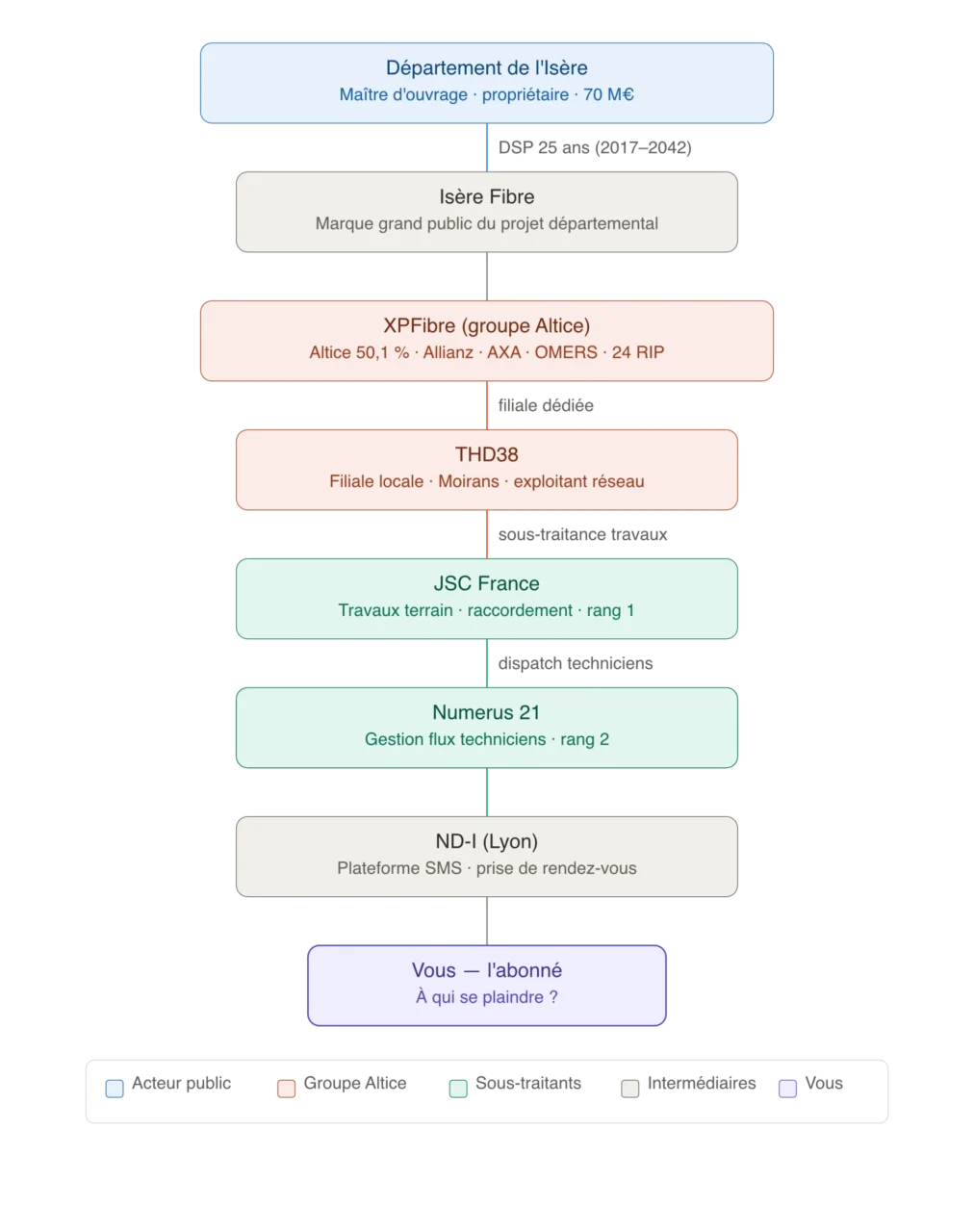
Layer 1: The Isère County Government.
Project owner, owner of the backbone network, signatory to the public service delegation. The elected body answerable to taxpayers, in theory. It set the terms of the game.
Layer 2: Isère Fibre.
The project’s “consumer-facing” brand name, the institutional storefront you see on construction-site signs and official communications. It isn’t a standalone legal entity; it’s the presentable face of the arrangement, designed to give you the impression of a local public service.
Layer 3: XPFibre.
The economic reality behind the storefront. Formerly SFR Collectivités, then SFR FTTH, rebranded XPFibre in 2021. It’s 50.1% owned by Altice France (SFR), with the remaining 49.9% held by a consortium of Allianz, AXA, and a Canadian pension fund (OMERS). XPFibre runs 24 publicly funded networks across France; Isère is one of those 24 files.
There’s one detail no one mentions in the county’s press releases: according to reports from several specialized outlets, Altice is said to be looking to sell XPFibre in order to pay down a considerable debt. Among the potential buyers being floated: foreign investment funds. If the sale goes through, Isère’s taxpayers will have financed 285 million euros of infrastructure, and a foreign pension fund will collect the operating revenue until 2042. The question deserves to be asked in public.
Layer 4: THD38.
The local shell company XPFibre created specifically for this contract. Based in Moirans, in Isère. Formerly named “Isère Fibre”: the name change alone shows how hard the whole setup is to read. It’s the legal entity that builds the capillary network, the last mile to your front door, and sells access to internet service providers.
Four institutional layers. And we still haven’t seen a single technician.
The Contractors’ Waltz: What I Saw From My Window
THD38 doesn’t do the work with its own hands. It subcontracts, which is an entirely standard model in the telecom sector. That isn’t an anomaly in itself. What’s more of one is the sheer depth of the cascade.
On my own installation, I was able to identify the successive involvement of several distinct entities, whose roles I’ll simply describe as I observed them, without claiming to judge the quality of their work.
Layer 5: JSC France.
The company contracted to handle deployment and hookup work in the area. This is the tier-1 boots on the ground: the ones who physically show up, pull the fiber, install the junction boxes. Their name appeared in my hookup paperwork without my having sought it out or chosen it.
Layer 6: Numerus 21.
A tier-2 subcontractor, a firm that specializes in managing technician workflows on a regional scale. Its role in the chain: dispatching the jobs for the final hookup. Why is a company based in Burgundy handling the scheduling of fiber technicians in the Sud-Grésivaudan? The honest answer is that I don’t know, and that’s exactly where the problem lies. This isn’t a criticism of Numerus 21: it’s a question about the architecture of the system that places them there.
Layer 7: ND-I.
The Lyon-based coordination platform that sent me my appointment-confirmation texts and managed my installation calendar. My only “human” point of contact in the entire operation: an automated interface run by a company I never chose and had never heard of before it turned up in my notification bar.
And if you’re wondering why something as simple as a fiber hookup requires a chain this long, the answer follows a relentless logic: every link bills for its part. The county delegates because managing technicians isn’t its job. XPFibre subcontracts because field labor isn’t its business. JSC France hands off the scheduling because managing appointment flows on a regional scale is yet another thing entirely. And ND-I takes on the texts because no one above it wanted to deal with them. At every level, a margin. Behind every margin, a justification. And at the end of the chain, a subscriber paying a monthly bill with no idea how many companies he’s keeping afloat at once, and no say in any of them.
Seven layers. To run a glass cable to my phone jack.
When Things Go Wrong: The Hot-Potato Game
Let’s suppose, realistically, since it happens regularly on these public networks, that there’s an outage or a faulty connection after installation.
You call your ISP. It opens a ticket with THD38. THD38 assigns its tier-1 subcontractor. That subcontractor may in turn assign its tier-2 subcontractor for dispatch. A technician shows up, without the full case history, with no idea what his predecessor did. You get a text from ND-I confirming a new appointment. The technician decides the issue has to go up a level. The ticket heads back to THD38.
And at every level, the same answer: “It’s not us, it’s the infrastructure operator.” / “It’s not us, contact your ISP.” / “It’s not us, it’s the subcontractor.”
Have you read my piece on the territorial administrative layer cake? The mechanics are identical. Power is always somewhere else, responsibility always one rung back. In local government, they call it “that’s the intermunicipal council’s department.” In fiber, they call it “open a ticket.” I had a similar experience on the law-enforcement side, which I recounted in another administrative autopsy. The mechanism is universal: every institution produces its own way of answering to no one.
In an earlier piece on the Saint-Marcellin biomass heating plant, I also described how a 9.4-million-euro public investment decision had been made without directly consulting residents. The Isère THD network is 510 million euros decided, structured, and committed over 25 years, with the same level of democratic visibility for the ordinary taxpayer.
The Light at the End of the (Bureaucratic) Tunnel
Let’s be honest all the way through: the fiber works. The technical goal has been met. As I write these lines, my connection speed is everything it promised to be, and I have no complaint about the technology itself. But that’s not the point.
The question is: did getting there really require a chain this complex, this illegible, this impervious to accountability? And above all: if XPFibre changes hands tomorrow morning, who answers to Isère’s taxpayers for the 285 million euros they committed? The county signed on until 2042, but with whom, exactly, if the shareholder changes?
These questions don’t necessarily call for outraged answers. They call for answers, full stop. Public accounting, readable reports, elected officials who explain their choices to the people footing the bill.
In the meantime, I have fiber. But if it goes down, I still don’t know whether to call my ISP, the Isère county government, a company in Moirans (THD38), a platform in Lyon (ND-I), a firm in Burgundy (Numerus 21), or just go straight to a Canadian pension fund.