Artificial Intelligence Napoleon, Cleopatra, or Josephine Baker telling you their life story to camera in thirty seconds: these AI-generated videos are everywhere on Instagram and TikTok, and as entertainment they work rather well. The trouble lies elsewhere. AI doesn’t know history; it assembles likely patterns, which is why historians keep flagging one anachronism after another. Watch them as fiction and there’s no harm done. The risk starts when the testimony format passes itself off as a source, especially on sensitive subjects. And when a synthetic Josephine Baker signs off with a question about which country we belong to, that isn’t history anymore, it’s ventriloquism.
Democracy In late August, LCI aired the Medef debate: seven chairs, seven candidates for the 2027 French presidential race, and no published selection criteria. Behind that stage sits an invisible round of voting, in which invitations, polls, airtime, and published sponsorships assemble the shortlist that voters will merely ratify in April. The seven disagree in real ways, but only within the walls: nobody there ever questions the walls themselves, from the European Union to the death penalty, birthright citizenship, or the church-state settlement of 1905. A democracy that never lets certain questions reach the ballot turns its political choices into dogmas. The test is not whether those ideas are good, but whether they can be beaten fairly or only ruled out in advance.
E-invoicing One in two French micro-entrepreneurs reports no revenue at all: half the scheme is an intermittent France of trial ventures, side income, and businesses in transition. To that dormant half, the e-invoicing reform says: pick a private operator and appear in the directory, not in order to invoice, but in order to be capable of it someday. The mandatory-subscription argument is wrong, though: thirteen of the nineteen offerings audited by l0g include a genuinely free tier. The real toll lies elsewhere, in a cognitive barrier to entry and in the precariousness of a free tier that has no reason to survive for customers who generate nothing. By scrapping in 2024 the free public gateway promised in 2020, the state locked in the intermediary requirement and put a price on its entrepreneurs’ sleep.
Society On France’s “free flow” stretches of motorway, the barriers are gone, replaced by a seventy-two-hour countdown nobody told you about. Miss it and the bill climbs to 10 euros, then 90, then 375, for a toll that was worth six. Motorway companies can obtain your mailing address, but they only write once the penalty has accrued. Article 529-6 of the Code of Criminal Procedure lets them record the offense themselves and keep the proceeds. A business model that thrives only on the user’s ignorance isn’t progress, it’s a trap.
Society Hundreds of consumers are telling the same story on social media: “CBD” bought in a legal shop, then hallucinations, tachycardia, sometimes the emergency room. French customs have documented the reason: hemp flowers sprayed with synthetic cannabinoids like EDMB-4en-PINACA, a hundred times more potent than CBD and invisible to standard drug screens. Contrary to the conspiratorial reading, the state never wanted these shops: it tried to ban them and lost twice in court. But it has since built no oversight, no traceability, and no testing requirement, because this gray market suits every level of society. An investigation into France’s third drug, the one nobody will claim.
Society In Los Angeles, a stage set reproducing the cabin of a private jet rents for under $55 an hour, and it is booked around the clock. Around it, a complete supply chain for the lifestyle has been built: châteaux by the day, Lamborghinis by the half hour, photo cruises on the Seine, Rolexes handed over in the lobby of a luxury hotel. Not one of these companies deceives anyone, they publish their rates online, and that is exactly what makes the operation impossible to prosecute. What remains to be understood is why these accounts always declare the same handful of occupations, the ones nobody can audit, and how they guarantee one another a success none of them has the capital for. An inquiry into Potemkin influencers, and into what it says about a country that success can be rented there by the hour.
Democracy Bruno Le Maire sat down with Thinkerview, and the comment sections fixed on the interviewer’s crude, familiar tone: the office, apparently, commands respect. That is an Ancien Régime sentiment, because in a republic deference runs from the officeholder toward the sovereign, and what the office adds is not immunity from rudeness but an obligation to account for itself. Yet these critics are holding a good argument they never use: what was missing was not respect, it was the follow-up question. Behind the interview lies the same prosecutorial liturgy that runs on prime-time television, with the prosecutor’s allegiance reversed and the job description unchanged. And as long as accountability exists nowhere, not at the ballot box, not in Parliament, not before a judge, even the best interviews will remain substitutes for the real thing.
Philosophy Techno-optimist discourse no longer promises tools. It promises deliverance: the end of disease, and then of aging itself. This essay does not try to say whether that promise will hold, but examines its shape, which borrows the grammar of religious eschatology. Noting the resemblance is not enough to discredit a claim, on pain of committing the genetic fallacy. What separates science from belief here is not the content of the promise but its relationship to evidence: what result, what failure, would make you give it up? One of the great forms of faith of our era is taking shape in front of us, and it is being written entirely elsewhere.
History 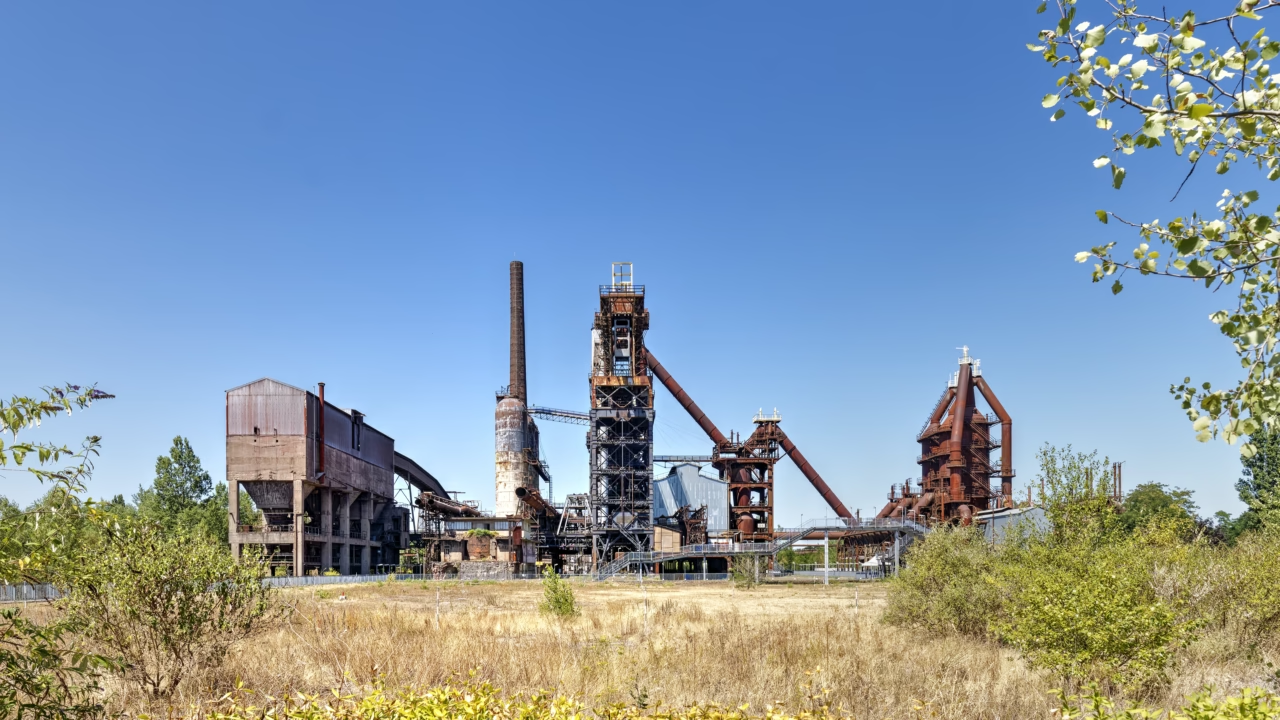
On the way back from a few days on the Nürburgring’s Nordschleife, I stopped in the Fensch valley to visit the U4 blast furnace at Uckange, the sole survivor of six installations at an ironworks that went cold in December 1991, and the only blast furnace in France open to visitors. Thirty acres of industrial wasteland, a 270-foot chimney, a cast house frozen exactly as it stood on the evening of the last tap: the place owes its survival to former workers who fought for ten years to get it listed as a historic monument. Between the Staehler bucket, the production board ruled in chalk, and the union posters from 1991, you grasp what 1,200 people working around the clock actually produced. But a country that puts its blast furnaces behind glass has already answered the question of its industrial sovereignty, and the tour, fascinating as it is, looks a great deal like a very well lit death certificate.
Politics On July 1, 2026, Sony buried the physical disc and absorbed its players’ fury without flinching, just as the Élysée has absorbed street protests for eight years. This indifference is no accident: the French still believe their elected officials owe them an accounting the way employees answer to a boss, while the system has methodically defused that balance of power, from the Matignon Accords to the pension reform, by way of the betrayed referendum of 2005. Constitutional locks, hardened policing doctrine, the discrediting of dissent, all the way to a QR code required to commemorate the storming of the Bastille: every crisis has been a training session for those in power. The sovereign customer and the citizen-employer died the same death, the death of the power to make anyone bend. What remains is to rebuild our levers, in our institutions and in our digital lives.