AI image generation in 2026 : the pixel has become a commodity
In April 2026, generating a photorealistic image indistinguishable from a professional photograph costs between one and eight cents. One cent for Z-Image Turbo, in one second. Eight cents for Imagen 4 Ultra, in twenty seconds, with a quality the best studio photographers struggle to tell apart from a real shot. OpenAI’s GPT Image 1.5 tops the Image Arena ranking, established from more than 24,000 blind comparisons between competing models. Midjourney V8 is in alpha. Flux 2 Pro has established itself as the default model of tens of thousands of professional workflows. Nano Banana 2, the image model of Google’s Gemini 3.1 Flash, is free and generates in under three seconds.
Three years after DALL-E 2, which inspired fear and pity at once, the AI-generated image is no longer a lab curiosity or a conference-demo gadget. It’s an industrial commodity. The same path traveled by disk storage from 1980 to 2000, or bandwidth from 1995 to 2010. The marginal cost tends toward the electrical cost of a few seconds of GPU, and that trajectory doesn’t reverse, it’s the economic reading grid already developed here on AI’s commodity status.
This text doesn’t aim to draw up an enthusiastic catalog of available tools. It aims to map without indulgence what this shift implies: who loses their trade, who loses their proof, who loses their rights, and what, against all expectation, gains value in a visual regime with no guaranteed referent.
Photography as a social institution lasted roughly from 1839 to 2025. What replaces it is not another photography.
The state of the art in 2026: a map of real competencies
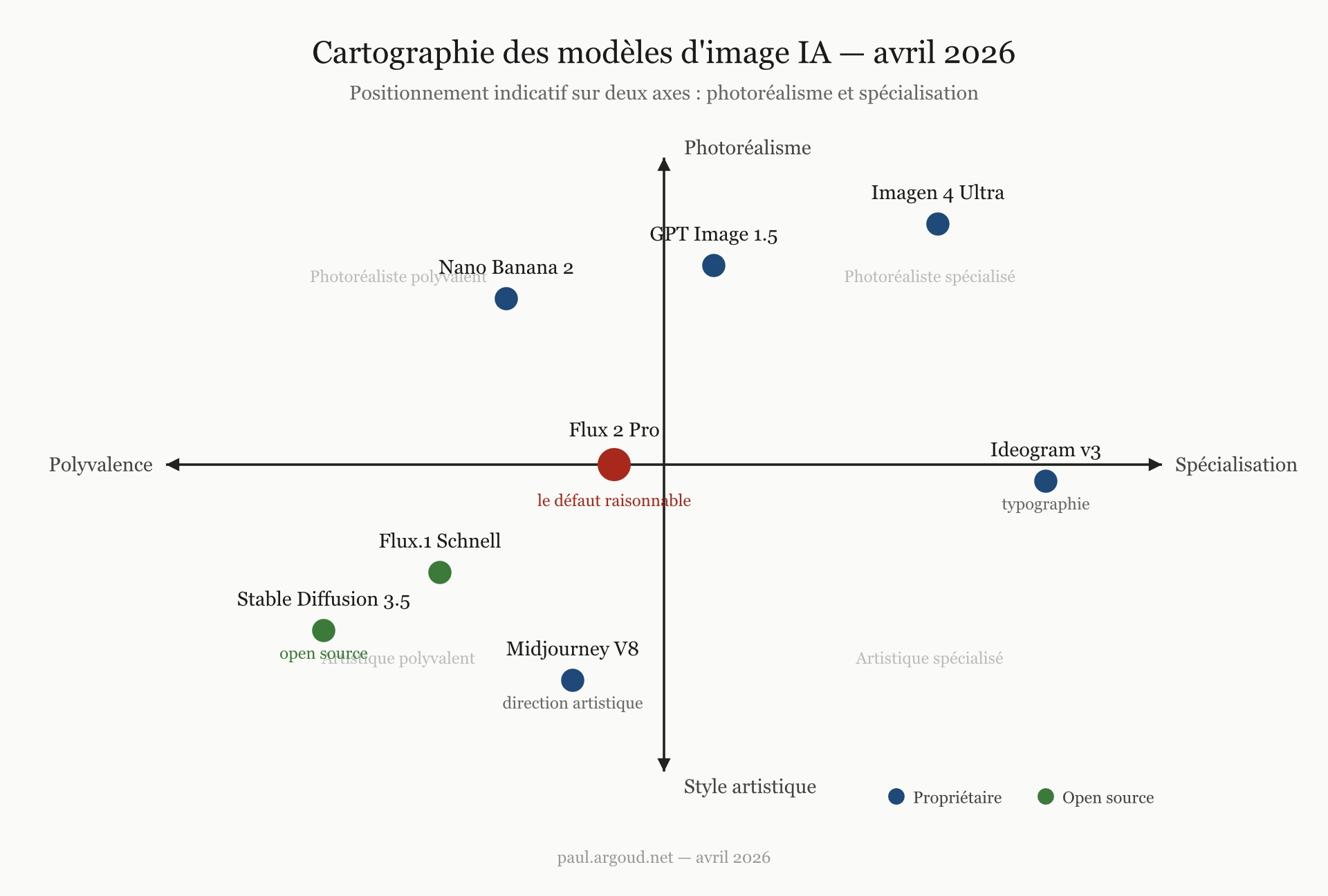
There’s no use listing thirty models. There’s use in understanding the map of real niches, because contrary to what each one’s marketing claims, no model is best at everything.
Imagen 4 Ultra (Google DeepMind): the ceiling of photorealism
Imagen 4 Ultra is, at the time of this article, the model that produces results most indistinguishable from real photographs. Human skin, fabric texture, the reflection of light on complex surfaces, depth of field, grain: the fidelity is at a level where blind tests run by professional photographers fail to identify the fake systematically. The price is accordingly, about $0.08 per image via API, and speed isn’t its strong point.
The natural use is high-end productions: premium editorial visuals, brand assets requiring maximum quality, advertising campaigns where the image is the product. For everything else, it’s oversized.
GPT Image 1.5 (OpenAI): prompt adherence and contextual understanding
What sets GPT Image 1.5 apart from its competitors isn’t raw photorealism but something more subtle: the ability to understand complex instructions, to respect precise compositions, to maintain coherence over multi-element scenes. It’s the model that produces what you asked for, not what it feels like producing.
Its native integration into ChatGPT is a structural advantage for non-technical users. For teams that need a predictable model on complex briefs, specified packshots, constrained editorial compositions, multi-constraint illustrations, it’s hard to beat. It holds first place in the Image Arena ranking, computed by TrueSkill, a Bayesian rating system adapted to multi-model blind comparisons, where each model’s conservative rating corresponds to μ − 3σ, ahead of Google’s Gemini 3.1 Flash and Gemini 3 Pro image models.
Midjourney V8: art direction as a product
Midjourney never sought to be a photorealistic model in the strict sense. Its positioning is different: it produces images that have a visual intention, a grain, an atmosphere. V8, currently in alpha, has thoroughly overhauled its engine, five times faster than V6 according to published tests, native 2K resolution, better stylistic coherence.
What Midjourney sells is a form of artificial taste. Its images have a recognizable signature, which is both its strength (aesthetic coherence, high perceived quality) and its weakness (hard to use when you want something neutral or strictly precise). For artistic photography, high-end editorial illustration, campaign art direction, it’s still the reference model. It doesn’t generate SVG natively, an important point we’ll return to in the article devoted to vector graphics.
Flux 2 Pro (Black Forest Labs): the reasonable default
Flux 2 Pro has become, in the last twelve months, the default model of the majority of teams integrating image generation into their workflows. Not because it’s the best on any precise criterion, but because it’s excellent on all of them: quality sufficient for production, acceptable speed, competitive price around $0.03 per image, clear commercial license.
It’s the model you install first and replace with a specialist only when a precise need demands it. For e-commerce teams, digital agencies, content publishers, it’s the Swiss army knife that does its job honestly. With Black Forest Labs having published open-source versions of Flux (Flux.1 Schnell in particular), it’s also self-hostable on modest GPU infrastructure, which opens the way to sovereign workflows with no cloud dependency, a subject I addressed specifically regarding sovereign AI and local open source.
Nano Banana 2 (Google, Gemini 3.1 Flash Image): speed and free access
Nano Banana is the informal name under which the image model of Gemini 3.1 Flash, Google’s lightweight model, circulates. Its proposition is simple: free within the limits of the Google AI Pro plan, generation in one to three seconds, consistent and natural results. The comparative tests published in January 2026 credit it with the most precise prompt adherence among consumer models, it captures the requested details where others make approximations.
Its limit is symmetrical to its strength: it produces photorealistic and cinematic images with no difficulty, but struggles with illustrative, artistic or graphic styles. For marketers who need visuals that support content rather than dominate it, it’s a working tool that’s sufficient and remarkably accessible.
Ideogram v3: typographic rendering as an absolute specialty
Typography in AI-generated images was, for three years, a joke. Distorted letters, invented words, characters superimposed in an unreadable mush. Ideogram solved this problem methodically, and v3 is, with no serious competition, the only model that renders complex text reliably in an image.
For graphic creations that include legible titles, signage elements, packaging with text, social-media templates: it’s the must-have choice. Outside this precise use case, other models are superior to it.
Open source and data sovereignty: a structural shift
Stable Diffusion 3.5 and Flux.1 Schnell deserve a separate mention because they represent something the proprietary models can’t offer: total control, real free access, and a fine-tuning community that produces stylistic specializations daily. You can run them on local infrastructure, without sending a single image to third-party servers, with no subscription, no acceptable-use policy.
Stable Diffusion 3.5’s quality made a significant leap over SDXL. It remains below the cutting-edge proprietary models for strict photorealism, but for many uses, illustration, artistic style, integrated workflows, the gap has narrowed enough that the choice between paying and self-hosting becomes a real architecture decision rather than a default.
But the real stake of self-hosting in 2026 is no longer free access, it’s data sovereignty. For a growing number of sectors, submitting one’s prompts and visual references to the servers of OpenAI, Google or Adobe is simply not an option, regardless of price.
Defense, aerospace and sovereignty-sensitive manufacturers can’t send classified technical references or product concepts to third-party APIs whose American jurisdiction imposes obligations to cooperate with federal agencies, the CLOUD Act creates an extraterritoriality that neither the GDPR nor European case law really neutralizes. The luxury groups, LVMH, Kering, Hermès, face the same calculation on future-collection concepts, whose leak before launch represents tens of millions of euros in lost earnings. Medical imaging, pharmaceutical concepts, visualizations of patented industrial processes, sensitive architectural plans: for all these use cases, the generated image must stay within the company’s walls, on controlled hardware, under a verifiable data-retention policy.
Self-hosting open-source models answers exactly this need. Modest GPU infrastructure, a few Nvidia cards of the RTX 5090 or A6000 generation, is enough to run Flux.1 Schnell or Stable Diffusion 3.5 with acceptable generation times for internal workflows. For organizations that have already invested in internal compute infrastructure, in-house datacenters, GPUs shared with the data-science teams, the marginal cost of adding sovereign image-generation capacity is low.
The shift to watch over the next twelve months will no longer be that of the quality of open-source models relative to proprietary ones: it will be that of hybrid architectures, where non-sensitive workflows go through public APIs for their maximum quality, and where sensitive workflows stay in-house on less perfect but sovereign-controlled open-source models. This segmentation, already visible in enterprise LLM use, will spread to image, and eventually to video.
Condensed comparison table
| Model | Price per image | Speed | Specialty | Commercial license |
|---|---|---|---|---|
| Imagen 4 Ultra | ~$0.08 | Slow (~20 s) | Maximum photorealism | Yes (API) |
| GPT Image 1.5 | $0.04–0.12 (by quality) | Medium | Prompt adherence | Yes |
| Midjourney V8 | Subscription | Fast (~4–5 s) | Art direction | By plan |
| Flux 2 Pro | ~$0.03 | Medium | Versatility | Yes |
| Nano Banana 2 | Free (AI Pro plan) | Very fast (1–3 s) | Accessible photorealism | Yes (paid plan) |
| Ideogram v3 | Freemium | Medium | Text within the image | By plan |
| Stable Diffusion 3.5 | Free (self-hosted) | Variable | Total control, fine-tuning | Open source |
| Flux.1 Schnell | Free (self-hosted) | Very fast | Self-hosting | Open source |
Under the hood: five minutes to understand why it’s irreversible
To understand why this shift doesn’t reverse, you have to understand the mechanism. Not in mathematical detail, but enough to grasp the economic invariant that makes the trajectory inescapable.
Diffusion: denoise the randomness
The vast majority of image models work by diffusion. The principle is counterintuitive but simple: you start from pure random noise, a screen of snow, in the literal sense, and you progressively denoise it over a series of steps, each step guided by a vector representation of the prompt.
The model has learned, on billions of image-text pairs, to associate concepts with regions of this noise space. When you ask for “red-haired woman in nighttime rain in Tokyo, neon light”, the model doesn’t look for an image in a database, it sculpts the noise in the direction of that concept, step by step, resolving at each step the question: which modification of the noise brings me closest to what the prompt describes?
That’s why generation takes several seconds. It’s also why it’s creative in the strong sense: each generation starts from a different noise and produces a slightly different result.
Autoregressive: predict the next piece
GPT Image 1.5 uses a different approach, inherited from large language models: autoregressive generation. Instead of progressively denoising a whole image, the model generates the image in successive pieces, each piece conditioned by the pieces already produced.
It’s this architecture that explains why GPT Image 1.5 is particularly good at respecting precise compositions and maintaining internal coherence: it “sees” what it has already produced before generating the rest, exactly as an LLM sees the previous tokens before predicting a new one.
The latent space: don’t work in the pixels
The key to computational efficiency is that these models don’t work in pixel space. They work in a latent space, a compressed mathematical representation where semantic concepts have geometric positions. A 1024 × 1024 pixel image represents about a million numerical values. The corresponding latent space represents a few thousand, but encodes meaning rather than pixels.
That’s what makes generation computable on consumer hardware, and that’s what explains why the costs drop so fast: the optimization happens in a space much smaller than the final image.
The marginal cost tends toward zero
The economic consequence of all this is mechanical. Generating an image involves no photographer, no model, no studio, no human post-production. It involves a few seconds of GPU computation, whose cost drops structurally with each hardware generation. The image has become what file copying is: a near-free act whose unit cost becomes negligible at scale.
Stock photography services built their margins on the artificial scarcity of the professional image. That scarcity has vanished.
The real losers: a cold inventory
The disruption of labor markets by AI is the subject of many optimistic analyses based on historical precedents, “every technological revolution created more jobs than it destroyed”. This reasoning, debatable for LLMs applied to developers, is particularly ill-suited to image generation, because the destruction of value is precise, massive, and concentrated on identifiable trades. It isn’t a transformation, it’s a direct substitution over a bounded perimeter.
Stock photography: clinical death
The global stock-photography market was valued at around $4 billion in 2023. Getty Images, Shutterstock and Adobe Stock controlled most of it. This market is undergoing structural destruction.
Getty attempted the judicial route: a lawsuit against Stability AI for unauthorized use of its archives in training. The defensive strategy has its legal merits, but it doesn’t solve the fundamental economic problem: a client who can generate in ten seconds an image of a “smiling businesswoman in a bright open space” for three cents no longer has any reason to pay twelve dollars for a stock-photo license of the same scene.
Adobe chose the integration route: Firefly is now built into Photoshop and Illustrator, and Adobe Stock offers generated images alongside the classic ones. It’s an intelligent adaptation that preserves the ecosystem but doesn’t save the stock-photographer trade. It turns Adobe into a reseller of generated pixels in place of captured pixels.
Shutterstock signed partnerships with OpenAI and Google to supply training data, thereby monetizing its own programmed destruction. The transition business model exists; the market as it was will no longer exist.
E-commerce catalog photography: mechanical destruction
This is the most immediately affected use case, and the most directly relevant for anyone running online stores. The packshot, product on a white background, even lighting, several angles, was a recurring budget line for mid-sized e-commerce merchants: studio rental, photographer, retouching, file delivery.
In 2026, the same operation can be carried out by contextual image-generation tools that compose the real product into generated environments, or by models trained on the brand’s visual references. The result is good enough for the majority of product categories.
Exceptions remain: products with complex texture (leather, jewelry, liquids), packshots requiring legal dimensional precision (food, pharmaceutical), and productions requiring an authenticated context of use. For everything else, e-commerce catalog photography is a budget line destined to disappear from the P&L of online stores in the next two to three years.
And video amplifies this dynamic rather than slowing it. The 2026 video models, Sora 2, Veo 3, Kling 2, can generate a five-second sequence from a product image or a simple text prompt. Direct consequence for catalog photography: if a merchant can produce a product-presentation video for a few dozen cents, the still image becomes a free by-product, extracted from the video in post-production rather than produced separately. The catalog-photographer trade isn’t only replaced by still-image generation, it’s absorbed into a video production that makes it obsolete as a distinct category. The technical boundary between image and video, which structured two distinct professional markets for a century, fades in under three years. A specific article will be devoted to video generation; the halo effect it exerts on the still image is already measurable.
The junior editorial illustrator: downward compression
Editorial illustration, the thumbnail that dresses up the blog article, the corporate icon adorning the PowerPoint presentation, the HR pictogram, the hook visual for social media, was the daily bread of beginner and intermediate illustrators.
Recraft V4 generates vector illustrations in seconds for four cents. Midjourney V8 produces editorial-quality illustrations effortlessly. Ideogram v3 inserts legible text into them. The “generic illustration to dress up content” segment is structurally dead for the profiles who brought nothing more than fast execution.
What remains: the illustrators who have their own visual world, recognizable, signed. Illustration as a work versus illustration as an interchangeable service. The boundary between the two isn’t new, it has simply become brutally visible.
The intermediate advertising graphic designer: forced bifurcation
The designer who produces Instagram carousels, display banners, seasonal promotional visuals, newsletter templates: a significant part of their deliverables can now be produced by a non-designer operator assisted by an LLM for the prompt and an image generator for the visual.
The trade doesn’t disappear, it bifurcates. Upward, toward art direction, brand design, strategic visual storytelling: everything that demands aesthetic judgment anchored in a deep knowledge of the client, the market, visual semiotics. Downward, toward animating prompts, validating outputs, curating generated images: a significant wage compression for those who only do execution.
There’s no stable middle path. The sector’s shift is accelerating, and the intermediate profiles that haven’t yet chosen their positioning will find themselves, in two years, in the most intense compression zone.
The retoucher: progressive push-button
Generative inpainting, the replacement of a zone of an image in keeping with its context, has been available in Photoshop since 2023 and reached an operational quality level in 2025. Background removal, cutout, frame extension, intelligent upscaling: these tasks that made up a substantial part of routine retouching are now one-click operations.
What remains for the retoucher: advanced psychological and aesthetic retouching on the portrait (skin, light, expression), sophisticated color correction, complex multi-element composition, judicial and documentary retouching where the integrity of the original file must be preserved and traced. The volume of work shrinks; the qualification required rises.
Low-end illustrated press: already here
Generic illustrative photography, the image that dresses up a news article with no direct relation to the event covered, is already produced by AI generators in newsrooms that don’t claim it. Not the major newsrooms, not yet systematically. But the high-volume pure players, the content aggregators, the budget-strapped niche media: the economics of the thing are too favorable to ignore.
The most worrying result isn’t yet visible in the apparent quality of the articles but in the value chain: the photo agencies that supplied these illustrative images see their order volume shrink without the newsrooms explicitly announcing their replacement.
What resists, and why
Everything that requires being there. Event press photography, documentary, field reportage, the commissioned psychological portrait, wedding and event photography, fine-art photography. These are categories that share a common property: their value resides partly or entirely in the fact that a human was present at a precise moment and place, with a camera, and captured something that existed.
A generative model can produce an image of an armed conflict indistinguishable from a real war photo. It can’t have been there. This distinction, which seemed obvious, is becoming the only bastion that protects documentary photography, and we’ll see in the next section how fragile this bastion is.
The end of visual proof: an institution collapsing
This is the most political part of this analysis, and the least covered in mainstream discussions about AI. Photography isn’t only a market or a trade. It’s a social institution: a shared regime of proof, accepted as such by the courts, the insurers, the newsrooms, the States, and individuals in their daily lives. For a hundred and eighty years, the photo has had a particular epistemic status: it’s a trace of the real, imperfect but referential.
This status is collapsing, and none of the technical safeguards deployed seems sufficient to halt it.
No reliable detector, and there won’t be one
The situation is structurally identical to that of AI-generated-text detectors, a subject I already covered in detail regarding their statistical reliability. AI text detectors don’t work with enough reliability to have evidentiary value. AI image detectors are in the same situation, with an additional disadvantage: the proliferation of models, styles, post-processings and hybridizations makes the classification task even more unstable.
SynthID, the invisible image watermark developed by Google DeepMind, is a serious initiative: an imperceptible signature embedded in the pixels at generation time, theoretically detectable by dedicated tools. The C2PA standard (Coalition for Content Provenance and Authenticity), backed by Adobe, Microsoft, and several news agencies, proposes a cryptographic-metadata approach: each image carries a verifiable provenance chain.
These two approaches share a fundamental problem: they’re opt-in, fragile to compression, and their absence proves nothing. An image with no SynthID watermark isn’t an authentic image, it’s an image for which the watermark was removed, or that comes from a model that doesn’t implement SynthID, or that was compressed by a platform that crushed it, or that is a real photograph. Impossible to distinguish.
The detector paradox applies in full: to be legally useful, a detector must have a near-zero false-positive rate. Yet the more the models improve, the more the detection rates degrade. The race is structurally lost.
The courts: photographic proof on borrowed time
Criminal and civil law rests heavily on photographic and video proof. Road accidents, crime scenes, physical violence, fraud, documented adultery: the image has an evidentiary value implicitly accepted by the courts.
This value hasn’t yet been formally challenged in French case law, but the conditions for a crisis are in place. A competent lawyer, faced with an opposing image, can now plausibly raise the doubt that it was generated, even if it’s authentic. And plausible doubt is enough, in some configurations, to invalidate the proof.
The law’s response will be slow, legal institutions evolve over decades, not months. In the meantime, there’s a window of evidentiary instability in which malicious actors can operate: produce fake to discredit real, or produce real that will be treated as fake.
The insurers: a claims model to reinvent
Home and auto insurance make heavy use of photography as a means of declaring and validating claims. Visible damage, documented accident, recorded theft: the client sends photos, the insurer evaluates them. This model rests on the presumption that the submitted photos represent a real situation.
The generation of realistic images makes this presumption untenable. A fictitious water leak, a generated bodywork scratch, a nonexistent claim documented by photorealistic images: insurance fraud via generated image is technically trivial today.
Insurers will adapt, reinforced metadata, cryptographic timestamping, behavioral analysis of declarations, a requirement for live video. Each of these adaptations has a cost that will be passed on to the premiums of all policyholders. The fraud of a minority raises the cost for the majority: the usual mechanism of insurance claims, with a new vector.
Journalism: the byline becomes an asset again
For the major newsrooms, press photography keeps its value because it’s signed, dated, geolocated, and the photographer is an identifiable physical person who puts their responsibility on the line. AFP, Reuters, Magnum: their model holds because the human traceability stays intact.
For the mid-range press and the pure players, the situation is more strained. The generic illustrative photo is already replaced. The boundary between illustration and documentation is starting to blur in the newsrooms that don’t have the means to send a photographer into the field and that use generated images without always flagging it clearly.
The paradoxical consequence is that the photographer’s signature, their name, their verifiable physical presence, their track record, becomes an economic and editorial asset again after decades of progressive devaluation by stock and generic content. What was disappearing becomes precious again, precisely because its technical substitute is too good.
The 2027 French elections: an underestimated risk
The next French electoral sequence is less than eighteen months away. Fake political visuals aren’t a theoretical hypothesis: the 2023 Slovak election, the 2023 Argentine presidential election, the 2024 American primaries all produced documented incidents of deepfakes spread at scale in critical time windows, the 48 hours before the vote, when the windows for denials are most constrained.
The generation of photorealistic images of French political figures in compromising situations, fabricated a few hours before the vote and spread via channels that escape the moderation platforms, is an operation any actor with about ten euros and an account on a generation platform can carry out. The technical lock has burst. What remains is the legal lock, which presupposes a judicial responsiveness France hasn’t yet demonstrated in this context.
Privacy: nudification as a systematic weapon
The gravest, most immediate, and least covered case in French public debate is that of the generation of non-consensual sexual images from real faces. The technique, often called “nudification”, consists of inserting a real person’s face onto a generated body in a sexual situation. It has become technically trivial, accessible, and it’s used massively.
The victims are mostly women. The most documented contexts are school harassment (photos of female high-schoolers spread in groups), synthetic revenge porn (an ex-partner), and professional defamation. The French legal framework partly exists, the law against the non-consensual disclosure of intimate images covers some cases, but it hasn’t been adapted to the specificity of synthetic content, which requires no original intimate image.
It’s the use case where the absence of a reliable detector has the most direct consequences on real individuals. An image of this kind can circulate for weeks before a court decision orders its removal, and the removal doesn’t solve the dissemination.
Copyright laundering, act II: the image after the text
An article published here in October 2025 documented the mechanism of copyright laundering in LLMs: you train on the whole web without authorization, you encapsulate in a SaaS service, you sell by subscription. The same mechanics apply to image generation, with a few notable differences.
The clean route: Adobe Firefly and the premium on legality
Adobe Firefly is trained on a corpus of licensed content, the Adobe Stock library, partner corpora, public-domain content, and on content for which Adobe obtained usage rights for training. The consequence: Adobe offers its enterprise clients contractual indemnification in the event of a copyright dispute over the images produced by Firefly.
It’s a real value proposition for legally exposed brands, large groups, agencies working for listed advertisers, companies operating in regulated sectors. Paying a little more so as not to risk an infringement lawsuit over the visuals of one’s campaign is a rational decision for a legal department.
The downside is that Firefly’s quality is below Imagen 4 Ultra or GPT Image 1.5 on photorealism, and that its style is perceived as more “corporate design” than the competing models. Access goes through a Creative Cloud or Firefly subscription, which is an additional cost for teams not already in the Adobe ecosystem.
The dirty route: Midjourney, Stable Diffusion, Flux and the judicial race against the clock
Midjourney, Stable Diffusion (Stability AI), and a large part of the open-source models were trained on massive corpora of images scraped from the web, LAION-5B in particular, which contains hundreds of millions of copyrighted images. Getty Images sued Stability AI in 2023 for unauthorized use of its collection. Groups of artists launched class actions against Midjourney and Stability AI. The lawsuits are under way in several jurisdictions.
The strategy of these players is the same as that of the LLMs: play for time while waiting for the proceedings to end in amicable settlements, likely retroactive licenses negotiated at amounts the incumbents can absorb, rather than in a ban on exploitation. The stake for the artists isn’t so much to win as to create a pricing precedent for future licenses.
Black Forest Labs, behind Flux, made more cautious training choices than Stability AI but without Adobe’s complete transparency. Its legal position is less exposed, without being as solid as Firefly’s.
The structural imbalance
The dynamic that emerges is one of a durable imbalance between players. The very large ones, Google, OpenAI, Adobe, can pay licenses, absorb settlements, and turn their legality into a commercial argument. The mid-tier players play for time and hope case law will be lenient. The open-source players create an externality that user companies absorb without always measuring the legal risk they take.
The artist, for their part, is in the most uncomfortable position: their works served to train models that now produce images in their style, without their permission and without compensation, with an uncertain judicial outcome years away. The formula used for text applies word for word: we trained on the whole web, and now we sell the laundered result by subscription.
What’s left for humans: an inventory without melancholy
It would be a mistake to conclude with the list of what has been destroyed. Technological history teaches that disruptions displace value rather than suppress it, even if the displacement isn’t painless for those whose trade is in the destruction zone. Here’s what gains value in a regime of commoditized image.
Art direction: judgment and a hierarchy of choices
An image generator produces options. Art direction consists of knowing which to keep, which to reject, and why, according to a brand objective, a cultural context, a narrative strategy. This judgment doesn’t delegate to a model because it presupposes a deep knowledge of the client, the market, the visual history of the sector, and of what resonates with a precise audience.
The art director who previously used creation tools upstream of their supervision sees their role concentrate on the core of value: deciding. Less execution, more judgment. It’s an upward reclassification for those who know how to decide, and an elimination for those whose value resided in fast execution.
Locked-down brand identity: coherence as differentiation
Recraft V4 and its competitors offer Style Lock features, the ability to train a custom style on a few reference images and then generate hundreds of assets consistent with that style. For brands that have invested in a distinctive visual identity, it’s an extraordinary production multiplier.
But the creation of this identity, the choice of colors, typographies, light treatments, the semiotic world that matches the brand, remains a human brand-design job. AI executes at scale what the human defined. The brand designer who can define a visual world precise enough to be parameterizable is more valuable than before, not less.
Presence photography: being there
Corporate events, conferences, seminars, weddings, births, sporting events, concerts: everything that captures a moment lived by real people who need to see themselves and their loved ones in those moments. This category is structurally out of reach of image generation because it presupposes a physical presence in a specific space-time.
The demand doesn’t disappear, it moves upmarket. The average corporate-reportage photographer is under pressure; the event photographer recognized for their ability to capture emotion in a particular context maintains their rates.
Fine-art photography: the scarcity of the signature
This is the most interesting paradox of this period. Since the 1990s, fine-art photography was under permanent economic pressure: the democratization of cameras, the proliferation of images, the devaluation of stock. Image generation creates the inverse effect: by flooding the market with generic visuals of increasing quality, it rehabilitates the scarcity of the signed work, datable, locatable, produced by an identifiable human with a documented intention.
Fine-art photography can’t be reproduced by a model because it isn’t an image in the generic sense, it’s an act, a gaze, a moment. The art-photography market, the one that existed before democratization and that had been crushed by the accessibility of the digital image, is reconstituting itself by contrast.
Upstream technical expertise: pipelines and fine-tuning
For the large brands that need to produce thousands of images consistent with their guidelines, setting up an image-generation pipeline, fine-tuning a model on brand references, integrating it into existing workflows, automated quality control, rights management, is a months-long project requiring skills at the intersection of machine learning and design.
This emerging trade didn’t exist three years ago. It’s in strong demand, few experts master it, and the rates reflect this scarcity.
Physical retouching as a luxury niche
There’s a growing market, still small but on a visible trajectory, for photography and retouching that deliberately use analog or physical constraints as a mark of distinction. Large-format view camera, film, optical enlargement, hand retouching on a print: constraints that signal human intention and effort in a world of frictionlessly generated images.
It’s the dynamic of vinyl in the streaming ecosystem, of the handmade garment in the fast-fashion ecosystem. A niche, not a mass market, but a niche whose perceived value is positively correlated with the commoditization of the rest.
Conclusion: the hundred-and-eighty-year parenthesis
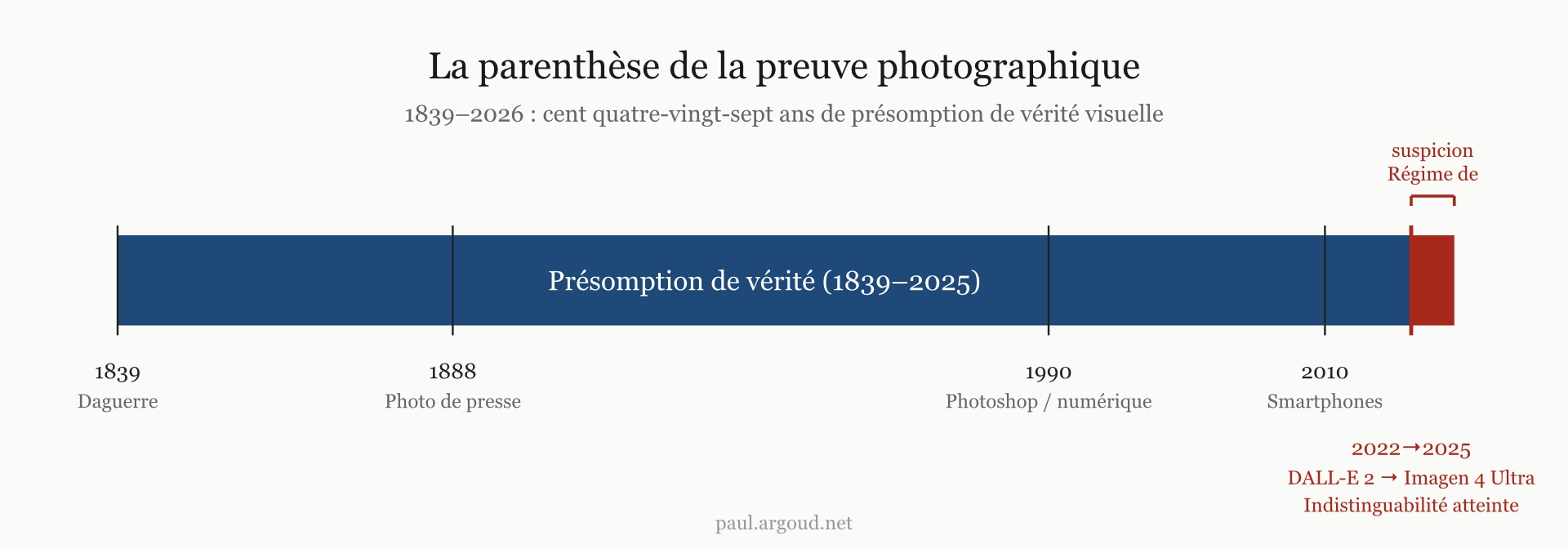
Photography as an institution of proof and as an industrial profession lasted from Daguerre’s invention in 1839 to about 2025. It’s a remarkably brief period on the scale of media history: a hundred and eighty years during which a technology for capturing the real enjoyed a unique epistemic status, the presumption of truth.
No other representation technology had enjoyed this status with such robustness. Painting was clearly an interpretation. Drawing, a construction. Oral testimony, a memorial reconstruction. Photography alone enjoyed the argument of the imprint: the light reflected by the real had imprinted its trace on a medium, and this trace had an evidentiary value the other modes of representation didn’t have.
This status didn’t rest on a magical property of photography, it rested on the technical asymmetry between the difficulty of producing a convincing fake and the ease of producing an authentic image. This asymmetry vanished in under five years.
What takes its place isn’t a better or worse visual regime, it’s a different regime, closer to what existed before 1839: a regime where every image is presumed interpretation, where the author’s signature and the traceability of the production chain become the only guarantors of truthfulness, where embodied human testimony recovers a premium that photography had provisionally suppressed.
Visual modernity was a hundred-and-eighty-year parenthesis. It’s over. What we do now is learn to read images the way our great-great-grandparents read engravings: with a fundamental suspicion, tempered by the trust granted to the source rather than to the content.
The pixel is a commodity. Trust stays rare. It’s the one invariant that holds.