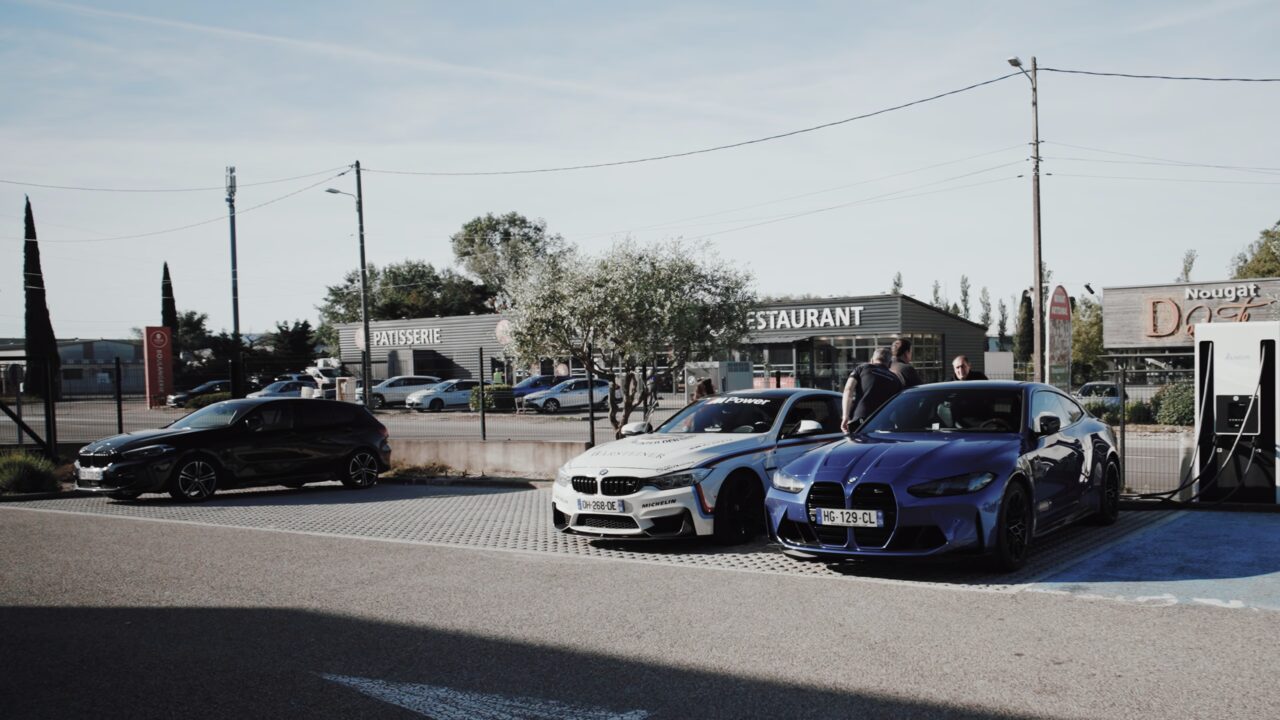
The Asphalt Symphony
There are passions that don’t merely occupy the mind. They colonize it. They dictate a way of inhabiting the world, of looking at a road, of listening to an engine idle on a winter morning. For me, this obsession has a name, the automobile, and it has never stopped growing.
I can devour the asphalt for hours on end, for entire days, without ever feeling the weariness of travel. No matter the hour: whether a blazing sun makes the tarmac shimmer or night wraps it in inky silence. No matter the weather: under driving rain, in wind that tries to push me off course, beneath the first snowflakes dancing in the headlight beams. The moment the engine wakes, the world fades away. All that remains is the line, and the precise gesture that draws it.
The Cockpit, an Extension of the Body
It all begins with a ritual. Being strapped in, adjusted, motionless at the heart of the movement to come. The harness bites into the chest, the bucket seat hugs every vertebra, and suddenly man and machine cease to be two. In this millimeter-perfect space, nothing is left to chance: every control falls under the hand before you’ve even reached for it. You don’t drive with slackness; you don’t caress a steering wheel the way you’d stroke a horse’s neck. You steer with surgical precision, a quiet firmness. The physical boundary between flesh and metal dissolves. The car becomes an extension of the body, a graft of steel onto a nervous system.
A Sensory Symphony
Driving is an awakening. Every sense ignites at once, in a saturation you seek out with an almost suspect greed. First come the smells: that raw scent of burned fuel, mingled with the heady fumes of rubber giving up its sap to the tar. Then comes the music, not the kind that pours from the speakers, but the inimitable song of brake discs heated red, crackling and screaming with every massive deceleration. A score no one ever wrote and yet that plays again, identical and different, with every turn of the wheel.
And then this mad, ceaseless flood of information streaming back without interruption. The chassis extends the spine and recounts every transfer of mass. The seat whispers the subtleties of the surface, the coarseness of a tread, the imperceptible bump no passenger will ever feel. The steering wheel dictates the exact grip, the degree of trust you can place in the front end, and the honesty, or the betrayal, of the asphalt.
The eyes, for their part, never linger. They are already cast toward the next corner while the car negotiates the present. At these speeds, the brain runs on two timescales at once: processing the flow in the instant, deciding within a thousandth of a second, sometimes by cold geometry, sometimes by pure instinct. Joining gesture to thought until the two merge: a methodical choreography, flawless, without a moment of dead time.
Hit the brakes hard to settle the car. Meter the load transfer to set the front end. Feel the grip at the very edge of breakaway, that invisible point of balance where everything can tip. And sometimes (this is where the finesse hides), accept sacrificing one corner, losing a fraction of it, the better to explode out of the next. The beauty of driving lies in that very calculation: give up here to gain there. The gesture that seems held back and that, in truth, is preparing the release.
At the Heart of the Beast: The Goldsmithing of Fire
For none of this would exist, none of it could exist, none of it could excite, without that piece of fine craftsmanship crouched beneath the hood. The internal combustion engine: this is what I have always known, what cradled my first childhood thrills as I leaned over an open hood, and what continues, decades later, to wring from me shivers nothing else can reproduce. Pistons, connecting rods, crankshaft, camshafts, valves: a ballet of metal machined to the micron, orchestrated by thousands of controlled explosions every minute. A century and a half of mechanical genius, accumulated, refined, chiseled to the point of enchantment. Every engine bears a signature, a temperament, a grain. You recognize an inline-six from Munich by ear the way you recognize an old friend’s voice over the phone. There is, beneath this innocuous-looking sheet metal, a raw beauty, a poetry of steel and fire, something the apostles of “clean mobility” never wanted to hear, and that they will never forgive.
And in the end, the formula hardly matters. There is the naturally aspirated engine, howling, climbing through the revs the way one climbs a marble staircase, each step higher, more crystalline, up to that red zone where the machinery begins to sing like a tenor at the summit of his score. An almost mystical linearity, without surprise and without deceit: every press of the throttle finds its answer, immediate, faithful, honest. And then there is the forced-induction engine, muffled and menacing at low revs, dormant and merely sensed, until the moment the surge arrives, brutal, and the car stops moving forward and leaps instead. The horizon rushes in, your breath catches, the laughter rises on its own. One reasons, the other roars. One seduces with the purity of its climb, the other terrifies you with its violence. But what matters the still, so long as we have the intoxication.
The Perfect Score
What unspeakable joy it is to drive a machine you can rely on blindly. Lap after lap, braking after braking, acceleration after acceleration, the machine answers. It takes the punishment, it asks for more, it never falters. It is no longer a tool: it is a complicity.
This symbiosis reminds me of a musician and his instrument. The virtuoso rehearses, refines, searches for the right note, until the day technique fades and gives way to something else, a nameless emotion that belongs to him alone. To be in harmony with a sports car on a winding road or a technical circuit is exactly that: to perform a complex score, here, now, at this precise point of the world, better than anyone else could at that instant. A brief communion, perfect, irreplaceable. And one that, by the very next lap, you’ll already have begun to chase again.
Perhaps that is why, at a time when we’re promised cars that drive themselves, when getting from place to place is confused with driving, I keep placing both hands on a steering wheel. Because there is, in the act of driving, something no algorithm will ever be able to delegate: the pleasure of being alive, here, in the exact coincidence of body, machine, and road.
Meanwhile, in the Garage
And then, suddenly, I lift my head from the keyboard.
The study is quiet. Outside, night is falling over the valley. Somewhere in the house, a clock counts off its peaceful seconds. Everything is in order, everything in its place. And it is precisely this calm that betrays me. For a few meters from here, behind a closed door, in the warm dimness of a garage that still smells of oil and cold rubber, she is there. Motionless. Patient. Hood lowered over her six sleeping cylinders, rubber gone cold, calipers at rest, the parking brake clenched tight against the night.
God, how I miss her, right now, at this exact second when I’m writing these lines about her instead of driving her. I miss her the way one misses a phantom limb, the way one misses a familiar voice in a house that’s grown too silent. I know by heart the exact position of the starter under my thumb, the precise resistance of the brake pedal at the first press, the particular grain of her thick-rimmed leather wheel beneath my palms. I know the precise second the turbo wakes in third, the exact timbre she takes on at 5,500 rpm, the way she sets onto her suspension when you attack a fast right-hander at full load.
All of this sleeps a few steps away. All of this is waiting for me.
I write a few more words, out of discipline, out of honesty with this piece. Then I’ll close this keyboard, grab a key off the hook, push open the garage door, and rejoin the one companion with whom I’ve never needed to speak. The road outside is dry. The night will be long.
I’ve waited long enough. So has my BMW M.