Plex, or the Methodical Betrayal of a Community
How, in eighteen months, a beloved media server turned into a product hostile to its own users, and why I switched to Jellyfin without a shred of regret.
This morning, May 19, 2026, an email from Plex landed in my inbox, honeyed in tone and glacial in content: the Lifetime Pass will jump from $249.99 to $749.99 on July 1, 2026. A clean tripling of the price. By way of justification, a sentence worthy of a Newspeak seminar: Plex is keeping the option available « at a price that reflects the real, ongoing value of the software ». Translation: we sold it to you for a pittance, that was a mistake, and now we’re correcting it. Except, no. That was precisely the promise. And it’s that promise, like so many others, that has just been unilaterally revised upward.
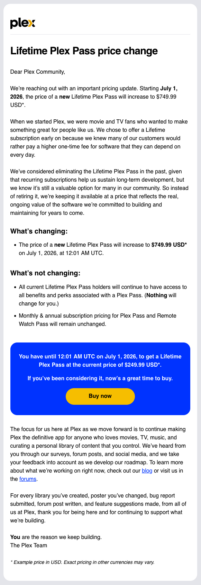
This episode is the perfectly logical culmination of a trajectory that began a little over a year ago. Let’s take a quick look back at what Plex has become, and why I already jumped ship.
April 29, 2025: the day Plex disowned its own DNA
For sixteen years, since 2009, Plex had one killer selling point: set up your server at home and access it from anywhere, for free. That was the thing that made Plex a media server rather than yet another local player. The continuity between your couch, the subway, and a hotel room: there’s the real value, to borrow their own words.
On April 29, 2025, Plex announced that this feature (the feature) would move behind a paywall. Take your pick:
- either the server admin takes out a Plex Pass (~$7/month);
- or each invited user takes out a Remote Watch Pass (~$2/month).
The rollout is calibrated to boil the frog gently: mobile apps first, then Roku in late 2025, then smart TVs and consoles in 2026. Just enough time to get used to it, to grumble in stages, and eventually to reach for the credit card. It’s the textbook playbook of enshittification, a term the American Dialect Society crowned word of the year in 2024, and one I find cruelly apt for describing what’s happening here. The mechanism is by now documented elsewhere: Anthropic ran the very same playbook in 2026 with its promises of “unlimited” AI, and this is neither the first case nor the last.
Notice the mechanism: what was the product’s founding argument becomes its premium argument. They gave you free coffee for fifteen years, you got used to it, and now they’re charging for the cup. Going cold turkey is hard: your films, your series, your hard drives, your indexed library, it’s all already there, inside Plex. Moving costs time. They know it. The entire strategy rests on precisely that friction. It’s, give or take a scale factor, the exact same logic as BMW charging a subscription for heated seats: lock in usage through dependency, then monetize the unlocking.
Three hikes, one and the same move
A little price timeline, for those who enjoy watching the numbers move:
| Plan | Before Apr 29, 2025 | After Apr 29, 2025 | As of July 1, 2026 |
|---|---|---|---|
| Plex Pass (monthly) | ~$4.99 | $6.99 | $6.99 |
| Plex Pass (annual) | $39.99 | $69.99 | $69.99 |
| Plex Pass Lifetime | $119.99 | $249.99 | $749.99 |
First hike in over ten years, they say. True. What they conveniently forget to mention is that it comes bundled with the removal of a historically free feature, and that it’s followed fourteen months later by a second hike, on the Lifetime, to the tune of 200%. Lifetime. The word itself takes on a strange flavor: for life, but at $750, and with what guarantee that they won’t dream up a higher tier two years from now, carefully walled off from the “premium” new features?
This morning’s email, for that matter, pulls off a delicious bit of semantic sleight of hand. Plex had, apparently, considered scrapping the Lifetime because “recurring subscriptions enable long-term development.” But they’re generously keeping it, at $750. Read between the lines: we could have taken this option away from you, so be grateful we didn’t. It’s pure, unabashed anti-patron messaging, owned without a blush.
The “New Plex Experience”: regression by design
Alongside the forced monetization, 2025 was the year of the great UX overhaul, ironically christened the New Plex Experience. The watchword was modernity. The result looks more like what you’d expect from a product team that no longer really cares about the people who actually use the software:
- more confusing navigation, an information hierarchy reshuffled with no tangible improvement;
- useful features gone: Picture-in-Picture, keyboard support, Watch Together across several platforms;
- forced landscape mode in some mobile apps, because why offer a choice;
- basic information gone: a video’s runtime, for instance, downgraded to a nice to have;
- persistent transcoding bugs, increased sluggishness on hardware that’s perfectly capable;
- forums and social media flooded with negative feedback… ignored, or dispatched with the classic “we hear your feedback” that changes absolutely nothing.
The “you can’t please everyone” line doesn’t hold up. This isn’t a debate over the color of a button; these are functional regressions documented en masse, and forced through despite the opposition of paying users.
The Netflix-ification
All of this plays out against the backdrop of an obvious strategic pivot. Plex no longer wants to be your media server. Plex wants to be your default entertainment app, with your server demoted to a tab buried in an interface stacked with:
- Plex Discover: aggregated recommendations from third-party services you don’t even own;
- Plex Watch Free: their AVOD service (free, ad-supported), pushed right into your personal library interface;
- ad banners and other nudges to consume Plex content, inside the very app you use to play your own files.
The shift is explicit: your server, your storage, your electricity, your bandwidth… become a retention hook for a product that sells you something else entirely. It’s the perfect inversion of value. And it’s consistent with the $40 million Series C round closed in 2024: the valuation had to be justified, and the only way to do that was to convert a community of self-hosters into users who are “monetizable” in the advertising and SaaS sense of the word.
It’s worth noting, for a chuckle, that Plex describes itself on Crunchbase as a streaming service. Not a media server. Not a tool for your own media. A streaming service. It’s now set in stone. The rest is just the transition.
The exit: Jellyfin, Cloudflare Tunnel, Manet, Infuse
I stopped expecting anything from Plex in early 2025, the moment the remote-access paywall was first rumored. I migrated to Jellyfin, and after more than a year of daily use, here’s the honest verdict.
The only real sticking point: remote access. Where Plex had done the heavy lifting with its hosted relay, Jellyfin leaves it to the server owner to sort things out. I went with a Cloudflare Tunnel (cloudflared) that exposes my Jellyfin through a subdomain, without opening a single port on the router, with managed TLS and zero trust rules I can configure as needed. Setting it up takes a solid evening of reading and testing for a reasonably resourceful techie. Once it’s in place, it just stays put. And financially, it costs nothing beyond the domain name I’d have paid for anyway.
A small caveat in the interest of intellectual honesty, because the fine print matters: Section 4.2 of Cloudflare’s Self-Serve Subscription Agreement (formerly Section 2.8) explicitly prohibits serving large volumes of non-HTML content from the free plan, and names video and audio files specifically as problematic when they consume a “disproportionate” share of bandwidth. In practice, the tunnel isn’t a CDN, plenty of self-hosters serve their media through cloudflared without trouble, and strictly personal, reasonable use (my case) doesn’t seem to draw their attention. But let’s be clear: if you spin up a Jellyfin for twenty concurrent users and stream 4K HDR films through it all evening long, Cloudflare is well within its rights to turn off the tap. For sovereignty purists, or for any use beyond the family circle, a VPS at a European host with a homemade WireGuard remains the more defensible setup.
My current stack:
- Server: Jellyfin on my Synology NAS in SHR, clean indexing, hardware transcoding, hand-picked plugins, zero telemetry;
- iOS audio: Manet, a refined native client, built by and for users;
- Video (iOS / tvOS): Infuse, the Rolls-Royce of media players, Jellyfin-compatible, gorgeous metadata, on-demand transcoding. Let’s be honest: Infuse is paid too (annual subscription or lifetime license). But unlike Plex, it sells you no ads, no in-house streaming service, no twisted promises about what the app is: it’s a player, it stays a player, and it does its job remarkably well.
No ads. No third-party services shoved into my feed. No product team quietly testing how to squeeze a few more dollars out of me. And an open source project, under the GPL license, whose code I can read for myself if the urge ever strikes.
The real question: who owns your library?
What’s at stake with Plex isn’t a matter of price. $750, at a push, is defensible for anyone who wants a turnkey solution, support included, and who enjoys the ecosystem. That’s not the debate. The debate is the asymmetry. Plex spent sixteen years building a community’s trust by swearing it was different from the big platforms, that it respected your server, your content, your control. And it converted that trust into a monetization lever the moment the financiers needed numbers.
The case is symptomatic of a broader trend: in recent years, the personal-library ecosystem has been methodically ground down, between tracker shutdowns, the crackdown on collection-building tools, and the software offensive against independent media servers. At every link in the chain, the user is reminded that their library doesn’t really belong to them, or at least not without recurring fees. Plex is just one more link.
It’s the same pattern as VMware bought out by Broadcom. The same as Unity and its runtime fee. The same as Reddit shutting off its API. The same as Twitter / X. The same as a hundred others. A platform builds dependency during the adoption phase; then, once critical mass is reached, exploits that dependency during the extraction phase. That’s what Cory Doctorow calls enshittification, and it has become the dominant business model of consumer software.
The only rational response, in my humble opinion, is to reinternalize. As long as technical sovereignty remains within reach (and with Jellyfin, it is), there’s no reason to keep betting on the good faith of a company that just tripled its prices while barely admitting it’s because it can. It’s the same move I described regarding sovereign AI and local open source in 2026: every time a critical dependency turns into a tool of capture, the only defensive response is to bring it back under your own control.
Plex, it was a good fifteen years. But at $750 a promise, and given what they’re doing with it, no thanks. My media will stay home, accessible over my own rails, with a client I can swap out tomorrow morning if Jellyfin ever goes bad in turn.
That, exactly, is the definition of software freedom.