Fifty cents to pee, and that doesn’t strike me as trivial
A few weeks ago, I stopped at the Berchem Ouest service area, on the A3 in Luxembourg, that highway behemoth that boasts of being Europe’s largest service station by revenue. 25,000 customers a day in high season, 260 million liters of fuel sold each year. A village at the edge of the highway, with restaurants, a tobacco shop, a supermarket. A place that handles millions. I stop there at least once a year on my way to go tear around the Nordschleife with friends, which tells you how well I know the place.
And to use the toilets: 50 cents.
I expected it. For years now this practice has been spreading, creeping, normalized, across highway service areas, train stations, certain shopping malls. But this time, something crystallized. A simple thought, almost childlike in its obviousness: I’m being made to pay to satisfy a physiological need I didn’t choose to have, in a commercial venue that turns colossal profits, after I’ve already spent money here. That thought, once clearly formulated, is hard to dismiss.
The cynicism of the rebate token, and its justifications
First, we have to do the system justice, and acknowledge that the debate isn’t as simple as it looks. The operators aren’t entirely lying when they invoke the costs: intensive cleaning, maintenance, surveillance, and above all the very real phenomenon of free toilets becoming spots for squatting, dealing or massive vandalism the moment there’s no longer a filter. It isn’t a figment of the imagination: anyone who frequented certain French train stations in the 1990s remembers it.
The rebate-token system, which the Germans perfected with Sanifair on their highways, answers precisely this logic: you pay to enter, but you get the entire sum back as a purchase voucher if you buy something. In theory, the regular customer isn’t penalized. The model has a certain coherence.
In practice, it remains deeply cynical. The rebate voucher is useless if you don’t want to buy anything, if you’re just passing through, if you’re a child, an elderly person, a pregnant woman with urgent needs. You did indeed pay 50 cents to pee, and the logic of the system consists precisely of conditioning access to a biological function on a commercial act. Acknowledging that the cost constraint exists doesn’t make this equation any more acceptable.
The bureaucracy of stainless steel
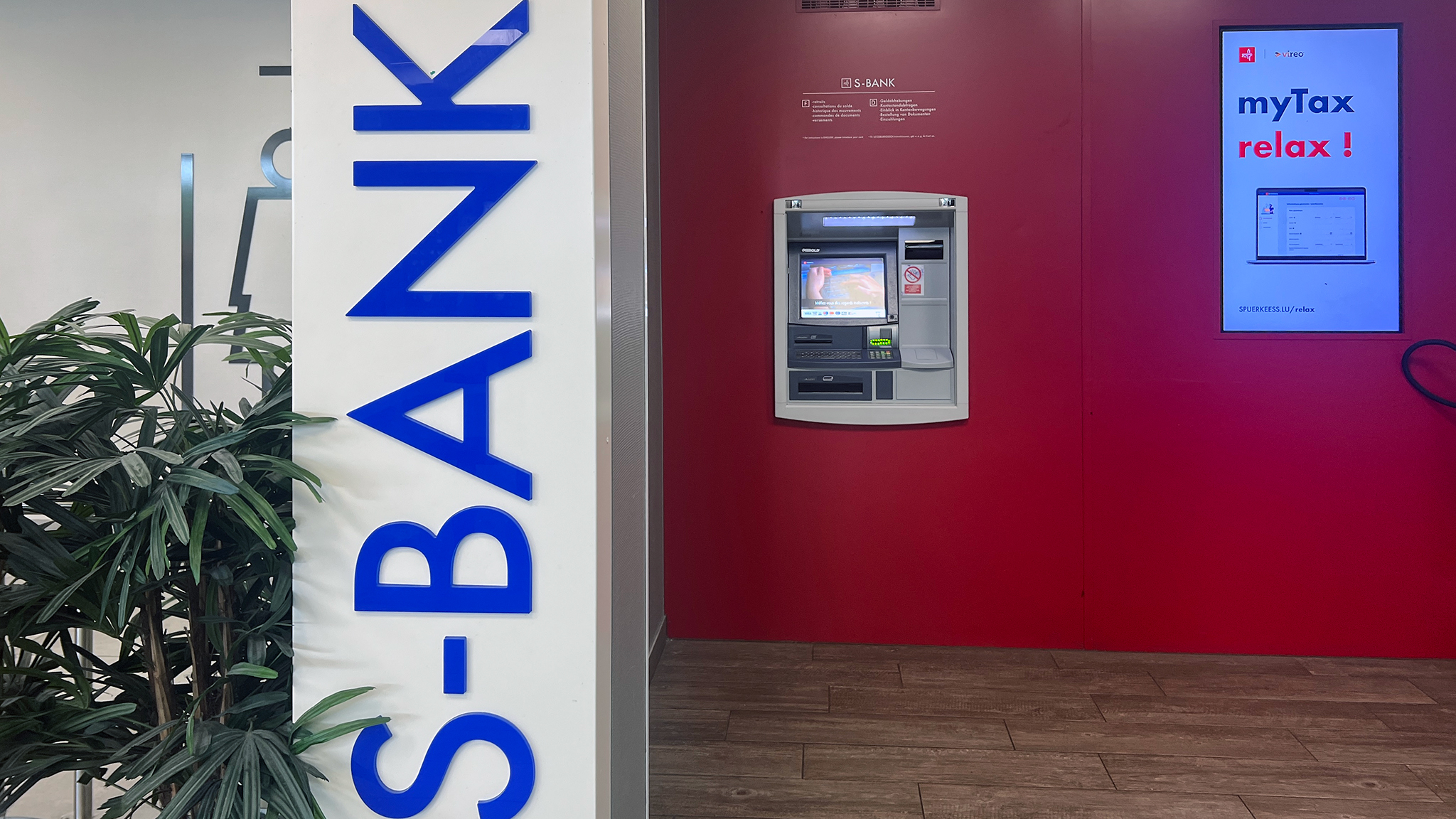
What strikes you more at Berchem is the apparatus itself. The photos I took on site speak for themselves.
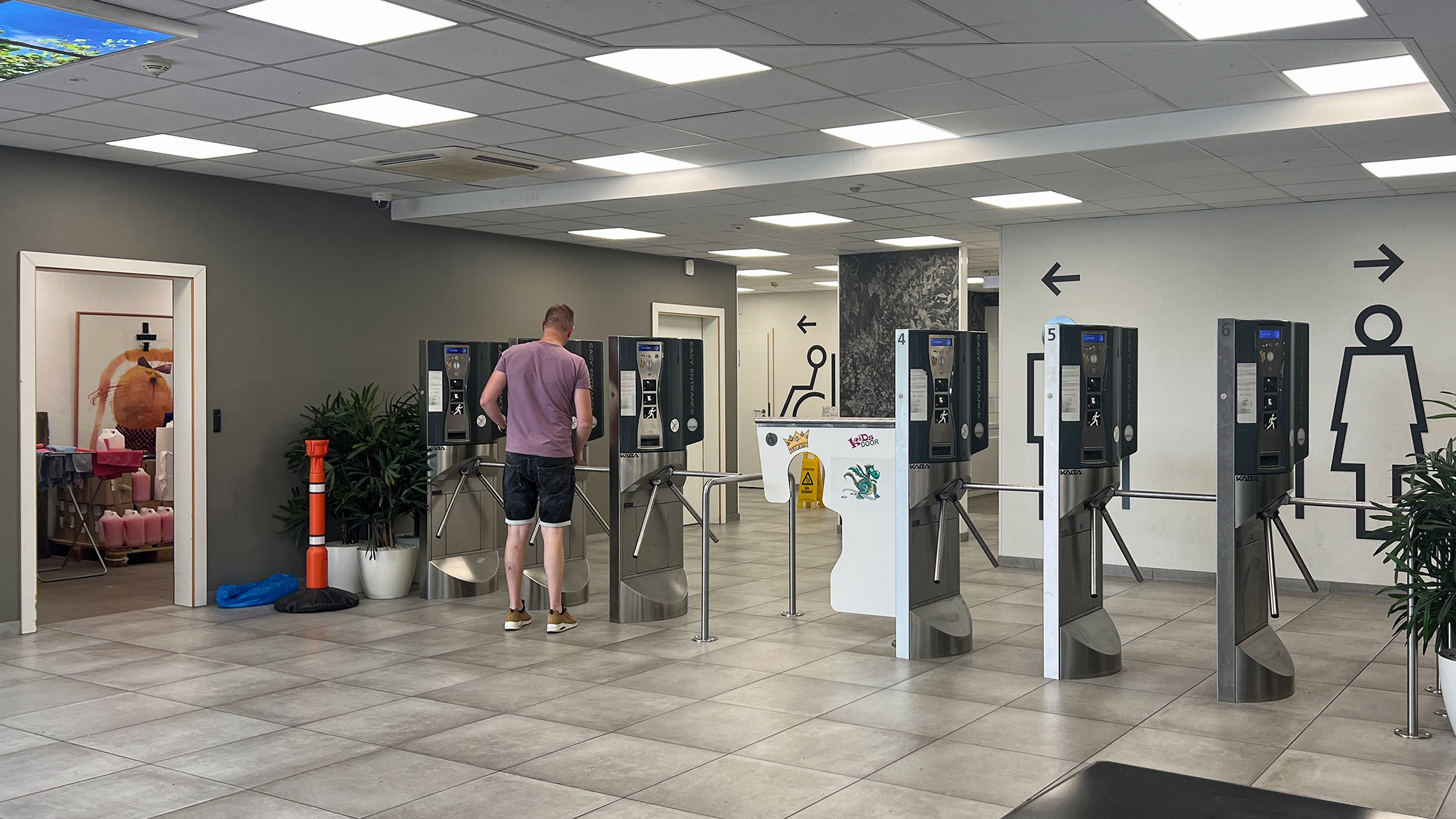
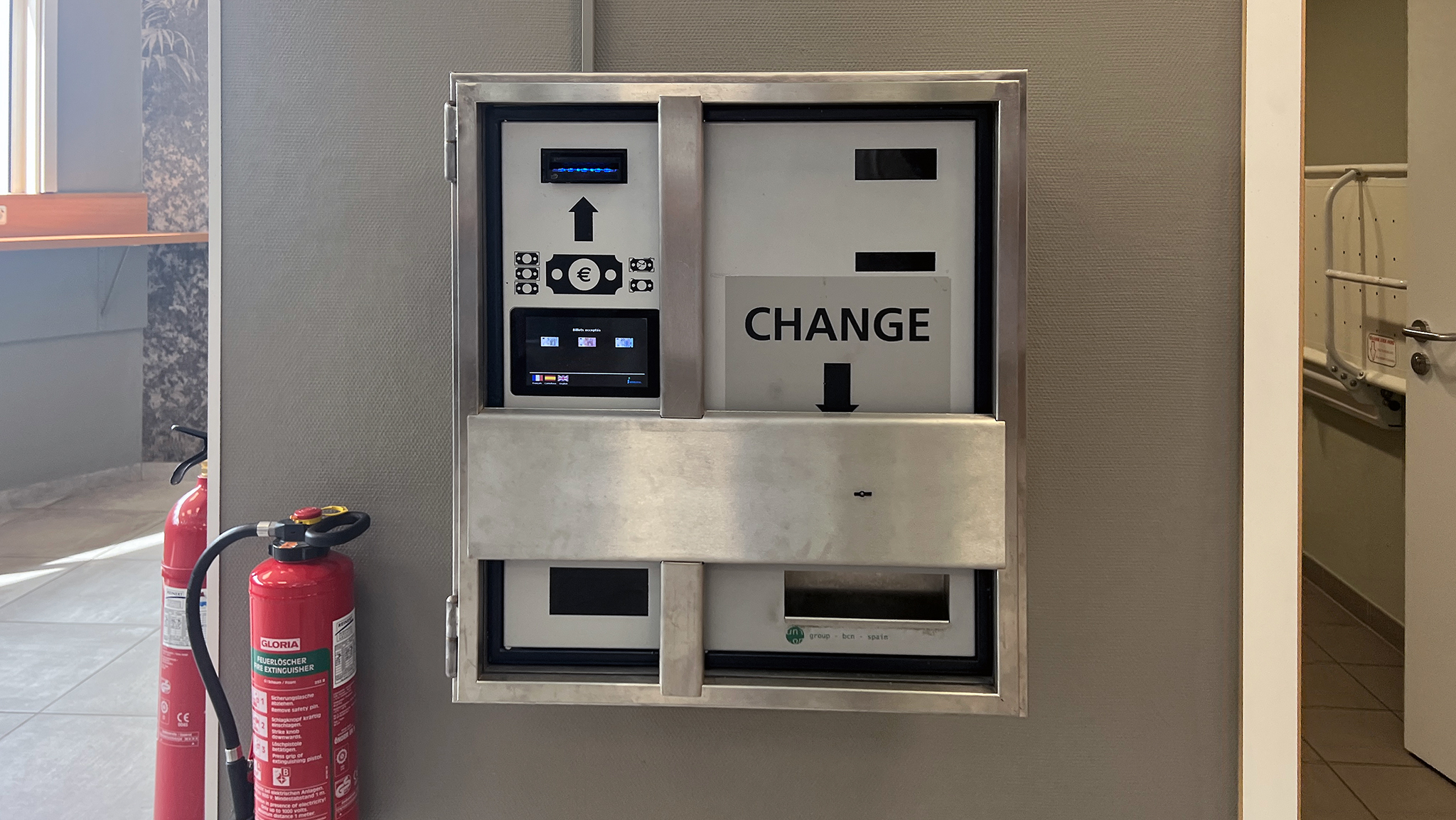
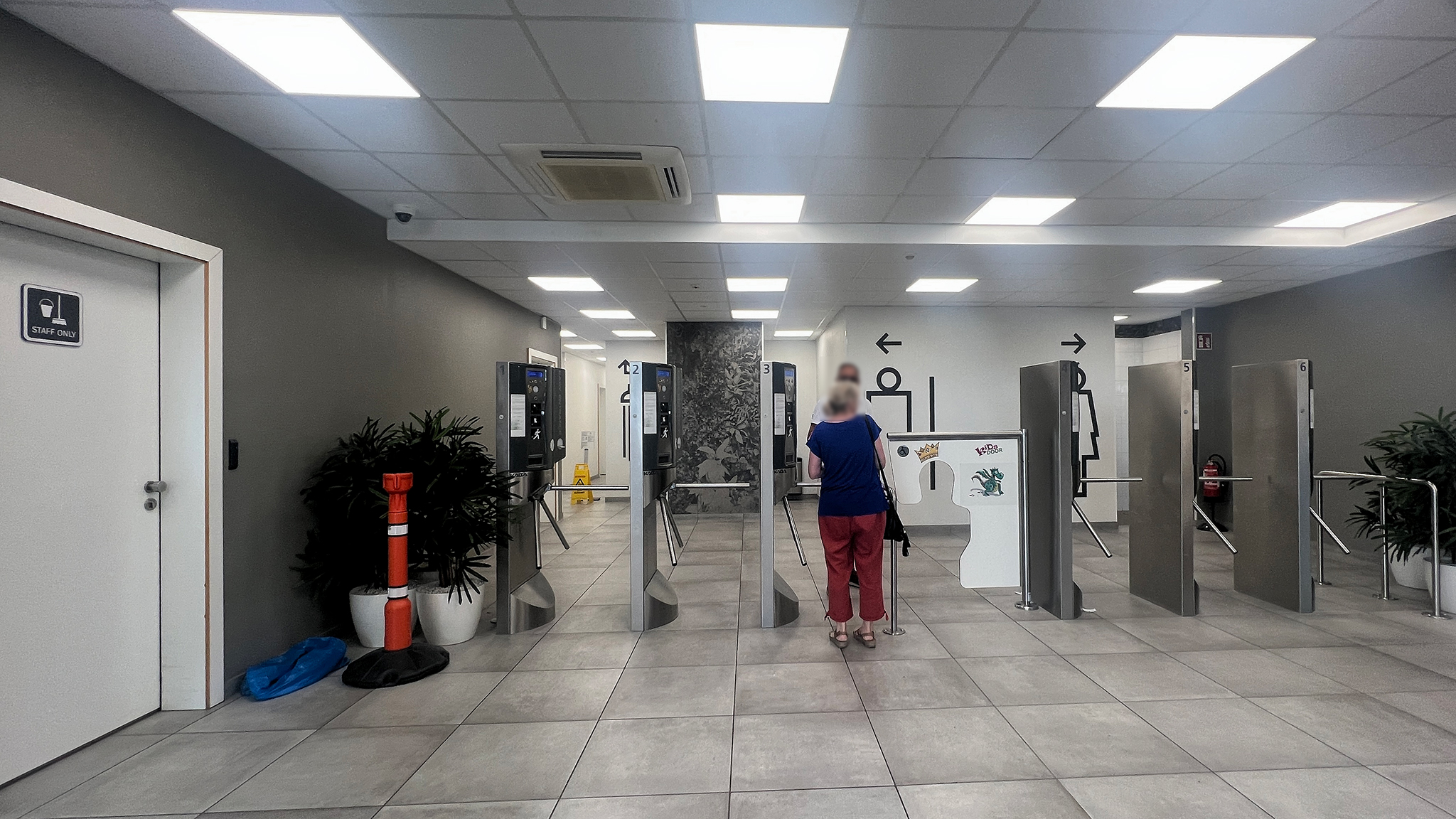
A clean hall, well lit, almost tidy: a row of chrome-plated stainless-steel turnstiles, each fitted with its own touchscreen payment terminal. But before you get there, you have to go through the change machine: a hefty brushed-steel CHANGE cabinet bolted to the wall, which accepts your bills and gives you back coins. Because you need coins to feed the terminal, which will trigger the turnstile, which will grant you access. A machine to prepare the money, a machine to receive it, a turnstile to filter: three industrial pieces of equipment in series for an act that nature provided for with no hardware.
And what if you have neither coins nor a bill? In a corner of the hall sits an S-Bank ATM. You can withdraw €20 (with any fees if your card isn’t on the network) to get the 50-cent coin that serves as your open-sesame. Banking infrastructure mobilized as a last resort for a natural need. The situation borders on the absurd.
The irony is twofold in a world that wants to be ever more cashless: if the change machine is broken, if your card is contactless but the terminal only accepts coins, your biological need becomes a source of logistical anguish. The turnstile doesn’t negotiate.
You can legitimately wonder what the carbon and financial cost of this permanent infrastructure is (screens on 24/7, motorized turnstiles, change machines on standby) relative to the 50 cents collected per entry. We’re told about carbon footprints and CSR throughout annual reports. Frugality clearly has its blind spots.
Berchem: the paradox of an exceptional site
The Berchem service area posts the highest revenue in Europe among service stations. Its rent is structural: millions of French cross-border travelers who come to fill up at Luxembourg prices, buy their tax-free cigarettes, stop to eat. The flow is captive, guaranteed, permanent.
In this precise context (and this is what sets Berchem apart from an ordinary service area), charging for the toilets is more a choice to monetize than an economic necessity. That doesn’t mean it should be generalized: at a low-traffic service area, at a small provincial station, the calculation is different. But here, the cost argument doesn’t hold up to scrutiny. Worth noting in passing is that the showers are made available free of charge to truckers, a sign that the choice to charge or not is indeed a choice, not a constraint.
A problem of dignity, not (only) of rights
The right to sanitation is recognized by the United Nations, but we have to be honest about what that covers: this right mainly targets access in developing countries and public spaces managed by local authorities. In a shopping mall or a private service station, we’re more in the logic of customer service than of a fundamental right in the strict sense. Brandishing UN resolutions against a Luxembourg highway service area is stretching the framework a bit.
What’s at stake here is more prosaic, and more universal: the question of whether a high-traffic private venue, which draws its profitability from the passage of travelers, can decently condition access to a physiological need on the payment of a sum. For people with chronic bowel diseases, for seniors, for young children, it isn’t a question of comfort. It’s a question of practical, everyday dignity, the kind that isn’t the subject of grand declarations but that is lived, badly, in front of a turnstile.
France, let’s recall, imposes on municipalities no regulatory obligation to provide public toilets. This void is the breeding ground in which the paid toilet thrives.
Japan, a partial but instructive counterexample
Japan offers free public toilets, clean, maintained and often remarkably advanced technologically. It’s a fact regularly cited, and it’s true. But the direct comparison has its limits: the Japanese culture of cleanliness and collective respect is profoundly different, vandalism almost nonexistent, the high level of civic-mindedness constitutive of social life. Comparing the toilets of Tokyo with a highway service area frequented by thousands of truckers and cross-border travelers would be to ignore behavioral realities that can’t be decreed.
The Japanese example remains instructive all the same, not as a model to copy feature for feature, but as a demonstration that free access and cleanliness aren’t incompatible terms. The question is who bears the cost: the traveler, individually, at the moment of need, or the operator, collectively, as an integral part of its service.
What this practice reveals
Fundamentally, the debate over paid toilets isn’t a debate about hygiene. It’s a debate about what a commercial operator decides to offer or to charge those who trust it by stopping at its premises. About what we collectively agree to consider a minimal service owed to the traveler, and what we let become an additional revenue line.
We agree to pay because we have no choice. Because we’re on a highway, because we’re in a hurry, because 50 cents seems trivial on the scale of a trip. It’s precisely on this resignation that the model thrives.
At Berchem, with its millions of annual visits and its record revenue, we’re a long way from the small provincial service area struggling to make ends meet. The choice to charge is there, owned, organized, industrialized. You can find that reasonable. I find it indecent.