Why building a crypto trading not doesn’t pay off
A crypto trading bot is the perfect mirage for a developer: it promises to turn a technical skill into passive income. That is exactly what should set off the alarm.
There is a certain kind of project that instantly captivates a developer’s mind, and the crypto trading bot is its purest form. The idea checks every box of the fantasy: an autonomous system, running around the clock on a server you administer yourself, making money while you sleep. It weds two powerful desires, technical mastery and financial independence. That is precisely why it deserves suspicion. Whenever a project combines engineering prowess with the promise of wealth, the odds are high that the seduction of the story is hiding the absence of any real economic foundation.
I wanted to take this idea seriously, not to validate it, but to put it through an honest interrogation. Here is why, on examination, coding a crypto trading bot has no financial merit, and why that conclusion turns out to be more useful than the project itself.
The Decorrelation Story Is Dead, and It Dies at the Worst Possible Moment
The most common justification for crypto exposure comes down to a single word: decorrelation. The idea is to add an asset to an equity portfolio that moves independently, smoothing out overall performance. That used to be true. It no longer is.
The recent figures leave little room for doubt. In the first quarter of 2026, the 30-day rolling correlation between Bitcoin and the S&P 500 climbed to 0.74, its highest reading of the year, and on certain intraday windows the coefficient of determination between the two assets brushed 0.94. In other words, over those stretches, Bitcoin and U.S. equities moved almost as a single asset. The structural cause is well understood: the arrival of Bitcoin ETFs in 2024 and the wave of institutional adoption have welded crypto to the macroeconomic cycle. Bitcoin has no central bank of its own, so it borrows the Federal Reserve’s. Same liquidity flows, same investor base, same reactions to rate decisions.
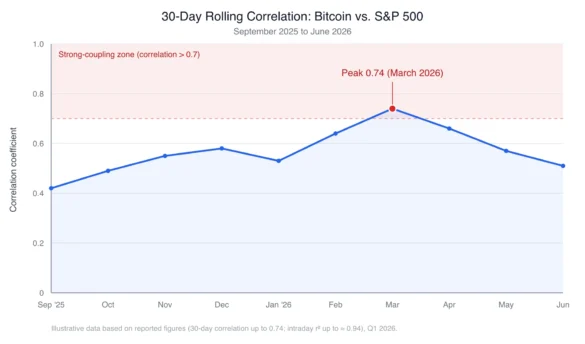
But the real problem is not the level, it is the timing. The crypto-equity correlation rises during periods of stress, when everyone is fleeing risk, and recedes during periods of euphoria. Decorrelation is therefore present exactly when you do not need it, in a bull market, and evaporates precisely when you would, in a crash. This is the perfect opposite of what you want from a diversifying asset. An insurance policy that only works in fair weather is not insurance. Anyone who buys crypto to protect an equity portfolio is therefore building a decision on a false premise.
One qualification is in order, in the interest of honesty: this correlation is never fixed. It fluctuates, and 2026 itself saw, depending on the observation window, phases of decorrelation and even negative correlation, with Bitcoin occasionally breaking away from the equity cycle on catalysts of its own. The point about behavior under stress still holds; that is the moment that matters most, and it is exactly when the correlation snaps shut. Still, it must be acknowledged that Bitcoin retains a high beta and a genuine upside asymmetry, an outsized gain potential during its favorable cycles. It is that asymmetry, not decorrelation, that can justify a small allocation for certain profiles, as we will see further on with the question of sizing.
The Illusion of an Edge Against the Machines
Suppose we set the decorrelation argument aside. That leaves the bot’s own promise: beating the market through an algorithm. Here the question to ask before writing a single line of code is blunt: do I have a genuine hypothesis of an advantage, or am I building an infrastructure in search of a reason to exist?
Nearly all amateur crypto bots rest on momentum or mean-reversion strategies driven by the usual technical indicators: moving-average crossovers, RSI, Bollinger bands. These strategies share a common fate. They shine in backtests, because the parameters have been unwittingly overfit to past data, then they get devoured by fees and noise the moment they go live. The crypto market is especially hostile to this kind of illusion: open around the clock, dominated by colocated algorithmic firms and liquidation bots, shot through with violent regime shifts. On the terrain of latency and sophistication, an individual with a Python script on a home server beats no one. The very idea of winning a speed race against players who do this for a living, with vastly greater resources, is denial.
A durable edge in trading is not born of a clever indicator setting. It is born of information, a structure, or a constraint that others do not have. The individual who thinks he has found one because his backtest looks flattering is mistaking the luck of an overfit for the discovery of an edge.
Let us be precise about the scope of that claim. It targets the common case, the amateur developer with a script on a VPS, and in that case it is true with very few exceptions. Real advantages do exist, but they rest on a rare informational or structural edge: on-chain arbitrage, MEV capture, sophisticated market making with colocation or privileged access to liquidity. These niches do sometimes generate alpha, but they demand sharp expertise, heavy infrastructure, and a position the average individual does not have and never will. The rule therefore stands: unless you hold a truly uncommon structural or informational edge, you do not have one.
Paper Trading Lies, and It Always Lies Upward
Faced with these objections, the reasonable response seems to be: I won’t risk real money, I’ll do paper trading, real-time simulation. That is more prudent, certainly. But it introduces an even more insidious trap, because it flatters.
A naive simulator fills you perfectly. You get the price on the screen, instantly, without moving the order book, without latency, without anyone on the other side watching your flow arrive. In real conditions, on the same signals, you lose on every entry and every exit. Slippage, fees, the market depth that collapses the moment your order is a little large: none of these frictions exist in a lazy simulation. One point deserves emphasis, because it is fatal to high-frequency strategies: the fee structure of crypto exchanges heavily penalizes the bot that hits the book to get in or out quickly. Every market order pays the taker fee, which is higher than the maker fee reserved for those who supply liquidity. A strategy that multiplies rapid round trips therefore stacks up these taker fees at a pace that instantly eats away any theoretical alpha. The higher the frequency, the larger the share of potential gain the fees consume, until the whole thing tips into negative territory. The naive paper trader, meanwhile, blithely ignores this bleed and presents you with a performance curve that will never exist. The result: a strategy that shows a 30 percent gain on paper can easily produce a 10 percent loss in reality. The gap is not random noise; it is structural, and it always runs in the same direction. Paper trading lies to you, and it lies upward.
The heart of an honest bot, then, is not the strategy, it is the realism of the execution engine: a deliberately pessimistic model of slippage and fees, fed by the real order book over a websocket rather than by a simple price reading. Most amateur projects skip this step, which is tedious and unrewarding. That is exactly why they blow up at the moment of going live.
The Truth About Sizing: You Reason in Risk, Not Capital
Suppose we accept a small crypto sleeve anyway, no longer to decorrelate but to capture the asymmetry of its returns, that potential for violent upside that equities do not offer. The question becomes: how much weight?
This is where the costliest mistake is made. Crypto carries a daily volatility three to five times that of equities. When stocks fall 2 percent, Bitcoin falls 6 to 10 percent. That is not diversification, it is amplification. The direct consequence: a sleeve worth 10 percent of capital in crypto does not account for 10 percent of the portfolio’s risk, it accounts for 30 to 40 percent. Your so-called satellite sleeve quietly becomes the primary engine of your total volatility. You think you hold a touch of the exotic; you actually hold a directional bet in disguise.
For a crypto exposure to contribute reasonably to overall risk, say 5 to 8 percent of it, a level at which it can lift returns without steering the ship, the corresponding weight in capital drops to 1 or 3 percent. Beyond 5 percent of capital, you are no longer making an allocation, you are placing a bet on Bitcoin, and you have to own it as such.
And it is precisely this finding that seals the bot’s fate. Building a real-time trading infrastructure, with persistent state management, slippage modeling, websocket feeds, monitoring, and failure recovery, all to steer 2 percent of your net worth, is pure overengineering. The development effort is wildly out of proportion to the financial stake. You mobilize weeks of sophisticated engineering in the service of an amount that, in the best case, will move overall performance by a few tenths of a point.
The Real Distinction: A Hobby Is Not an Investment
At this point the financial conclusion is plain: coding a crypto trading bot does not pay off. But that clarity reveals another, more fruitful one. We have been conflating two motivations that need to be separated.
If the question is “is this financially worthwhile?”, the answer is no, and the analysis above is enough to prove it. But if the question is “do I want to build a clean, asynchronous, robust real-time system for the technical pleasure of it and to learn a demanding domain?”, then the answer is entirely different, and perfectly legitimate. A paper trading bot is an excellent engineering playground. It has real value, but that value is educational and recreational, not financial. The mistake, the only true mistake, is to dress up a technical project as an investment decision, or conversely to deny yourself a fine learning project on the grounds that it will not make you rich. These are two distinct registers. To confuse them is to lie to yourself about your own intentions.
And for anyone genuinely seeking to serve their wealth, the advantage is never in some new exotic bet. It is in the tooling of what you already do well. Automating not speculative execution but discipline: that is the whole point of automated dollar-cost averaging, investing a fixed amount at regular intervals, which removes emotion and market timing from the equation. The same goes for smart rebalancing by API, a system that computes the gaps to a target ETF allocation, detects the rebalancing thresholds, and triggers or flags the corrective order when a position drifts too far. That is genuinely useful automation: less glamorous than a grid-trading bot that promises to capture every oscillation, but viable for your wealth because it serves a strategy that makes sense, instead of chasing an edge that does not exist. You capture this way 100 percent of the value of an automated system, with a fraction of its risk, in the service of capital that actually matters. It is less spectacular than an autonomous crypto bot. It is far more rational.
The lesson goes beyond finance. It holds for any story that weds technical seduction to the promise of easy money: the first lucid question is not “how do I build it?”, but “why should it work when so many others, far better equipped, fail?”. Killing a bad idea before writing the first line of code is not a surrender. It is the most profitable form of engineering there is.