Claude Managed Agents: Anthropic’s infrastructure is more honest than it looks
A few weeks ago, Anthropic restricted the use of Claude on the Max plans for intensive agent workflows. Developers who were running automated pipelines all day long found themselves locked out. The official reason: these uses generated costs out of all proportion to what they were paying. A subscriber at $200/month could consume the equivalent of several thousand dollars of compute: I wrote about it at the time.
Then, in the same breath, Anthropic launched Claude Managed Agents.
An agent infrastructure service, hosted by Anthropic, billed by the token and by the session hour. The sequence is clear: you close off the unmetered access, you open the paid service. Is it dishonest? No. Is it a calculated move? Obviously.
But that’s not where the interesting question lies.
What the product really is
In concrete terms, Managed Agents lets you define an agent (the model, the instructions, the tools), pair it with a preconfigured cloud environment, and launch sessions that run autonomously for several hours. The agent can execute shell commands, read and write files, browse the web, interact with external services via MCP; which plays the role of tool provider here, where Managed Agents is the factory that runs them. Everything is persisted server-side. You log off, you find the session intact.
A few features are still in restricted access: multi-agents (an agent that orchestrates other agents in parallel, along the lines of what I’d explored in Society of Minds), persistent memory across sessions, and a self-evaluation mode where the agent corrects itself and retries until satisfied. That three of the most structuring features are still in limited preview tells you one thing: the product is in public beta, not a final release. Anthropic is still actively iterating on the most complex use cases. On their internal benchmarks, Anthropic claims up to ten points of improvement in success rate compared to a classic prompting loop. Notion, Sentry, Asana, Rakuten are already running it in production.
The problem it solves is real. All the plumbing required to run an agent in production (secure sandboxing, state management, error recovery, credentialing, traceability) represents weeks of infrastructure work before you deliver anything to a user. Managed Agents absorbs all of that. This is exactly the subject I opened up here: the shift from an AI that answers to an AI that acts imposes an infrastructure complexity that most teams underestimate.
What the word “managed” reveals
In the engineering post that accompanies the launch, Anthropic’s teams make a confession that deserves to be read carefully. They explain that harnesses (the logic layers that drive the agents) encode assumptions about what the model can’t yet do on its own. And that these assumptions become obsolete as the models improve. They give an example: a context-reset mechanism developed for Sonnet 4.5 turned out to be useless with Opus 4.5, which no longer suffered from the same behavior.
It’s a remarkable admission. Anthropic is saying: we’re building abstractions we know to be transitory. And in the same breath, they launch a managed service built on those abstractions.
Managed Agents’ architecture is smart precisely because it anticipates this problem. By decoupling the brain (the model and its harness) from the hands (the sandboxes and execution tools) and from the memory (the session log), they give themselves the ability to evolve each layer independently. When the model is capable of more, they change the harness without touching your agent configuration. When the sandbox infrastructure changes, you know nothing about it. It’s the same logic I analyzed around prompt caching and CAG: Anthropic stacks layers of abstraction on layers of abstraction, and each additional layer moves you a little further from the actual mechanism.
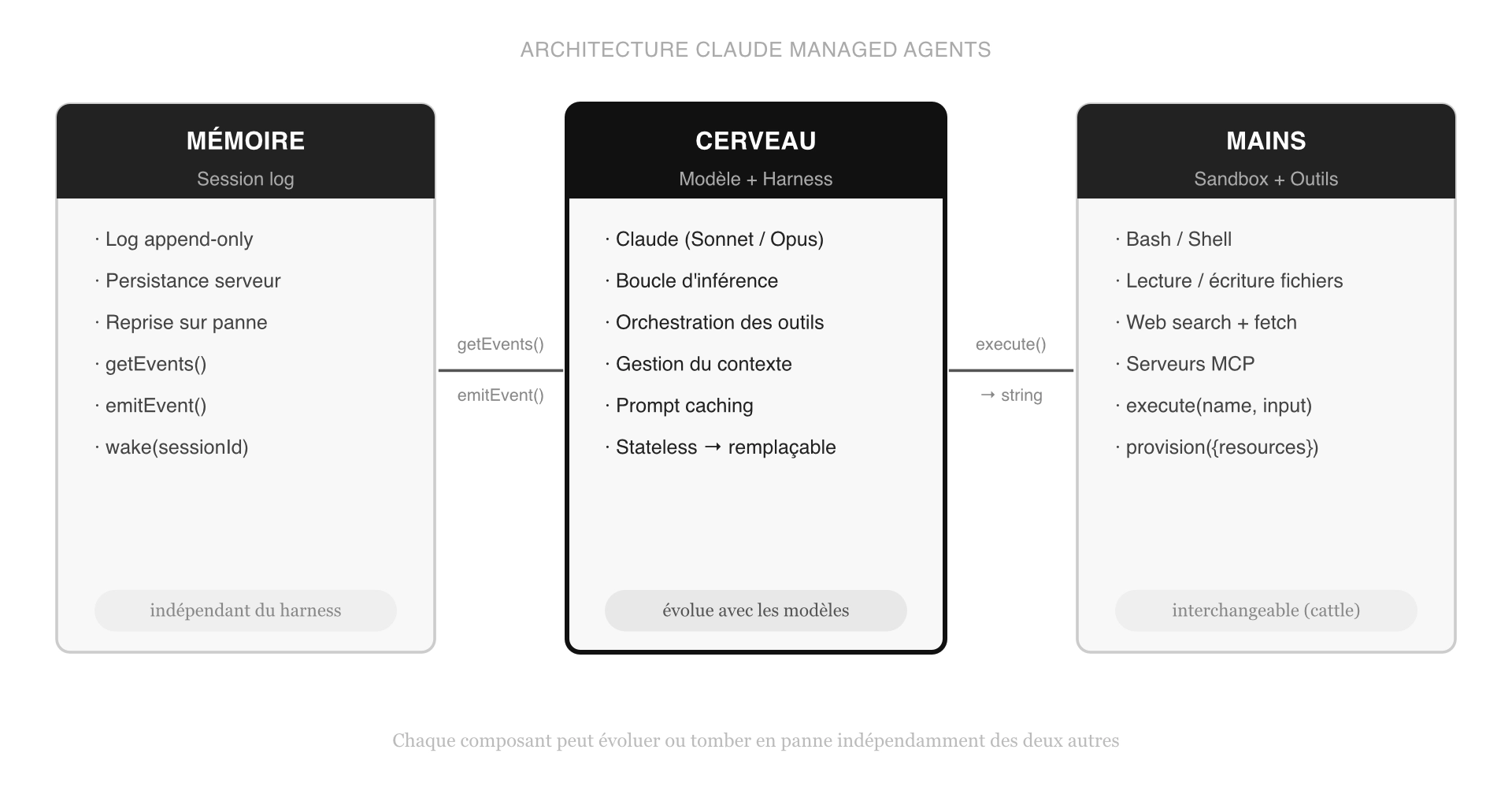
It’s clean, it’s well thought out. But it’s also exactly what needs to be analyzed coldly.
The debt you don’t see piling up
I’ve lived this from the inside. On a client project, I’d delegated too much to the AI, too fast, without really understanding what was happening in the loop. It worked. The results were there. Until the day something went off the rails, and that’s when I realized I was unable to diagnose it. I didn’t know why the agent was doing what it was doing. I didn’t have my hands in it. I had to start over from scratch.
This isn’t an isolated anecdote. It’s a pattern I’d already identified in another register: the AI that zombifies brains doesn’t do it abruptly: it does it through gradual comfort, through delegation that accumulates, through understanding that atrophies for lack of being exercised.
This is exactly the risk that Managed Agents industrializes on a large scale.
The service is designed so that you don’t have to understand what’s happening underneath. That’s its value promise. You define objectives, you observe results, you intervene only to correct the trajectory. Let’s be honest: Managed Agents’ architecture is probably more inspectable than many cobbled-together homemade implementations. The session log is append-only, every tool call is traced, the console exposes the full set of the agent’s decisions. It’s not a sealed black box. But it’s a high-level understanding; you see what, not why. And that’s precisely where the risk sits. When the agent goes off the rails (and it will), your ability to step in depends directly on the understanding of the underlying system you’ll have built. If all you’ve done is configure parameters in a console, the session log will tell you what happened, not how to fix it.
This isn’t an indictment of the service. It’s an observation about what “automating” really means.
What it changes for you, depending on where you stand
If you’re building a product and you want to move fast to production, Managed Agents is probably the shortest path. The pricing is transparent: tokens at the standard API rate plus $0.08 per hour of active session, only during actual runtime and not at rest, plus $10 per 1,000 web searches. This model is very competitive for bursty usage (an agent that works for two hours then stops) but can get expensive if you’re picturing agents running continuously. The question “how many real session hours per month?” is worth asking before you sign.
Quick calculation. An agent that runs 4 hours a day for 20 working days: 4 × 20 × 0.08 = $6.40 in session fees, tokens aside. Add a modest consumption of 500,000 Sonnet tokens a month at $3/million on input: about $1.50. Total: less than $10 for the month. That’s negligible for a targeted business use. On the other hand, an agent permanently idling (24/7, 30 days) would come to $57.60 in session fees alone, before a single token.
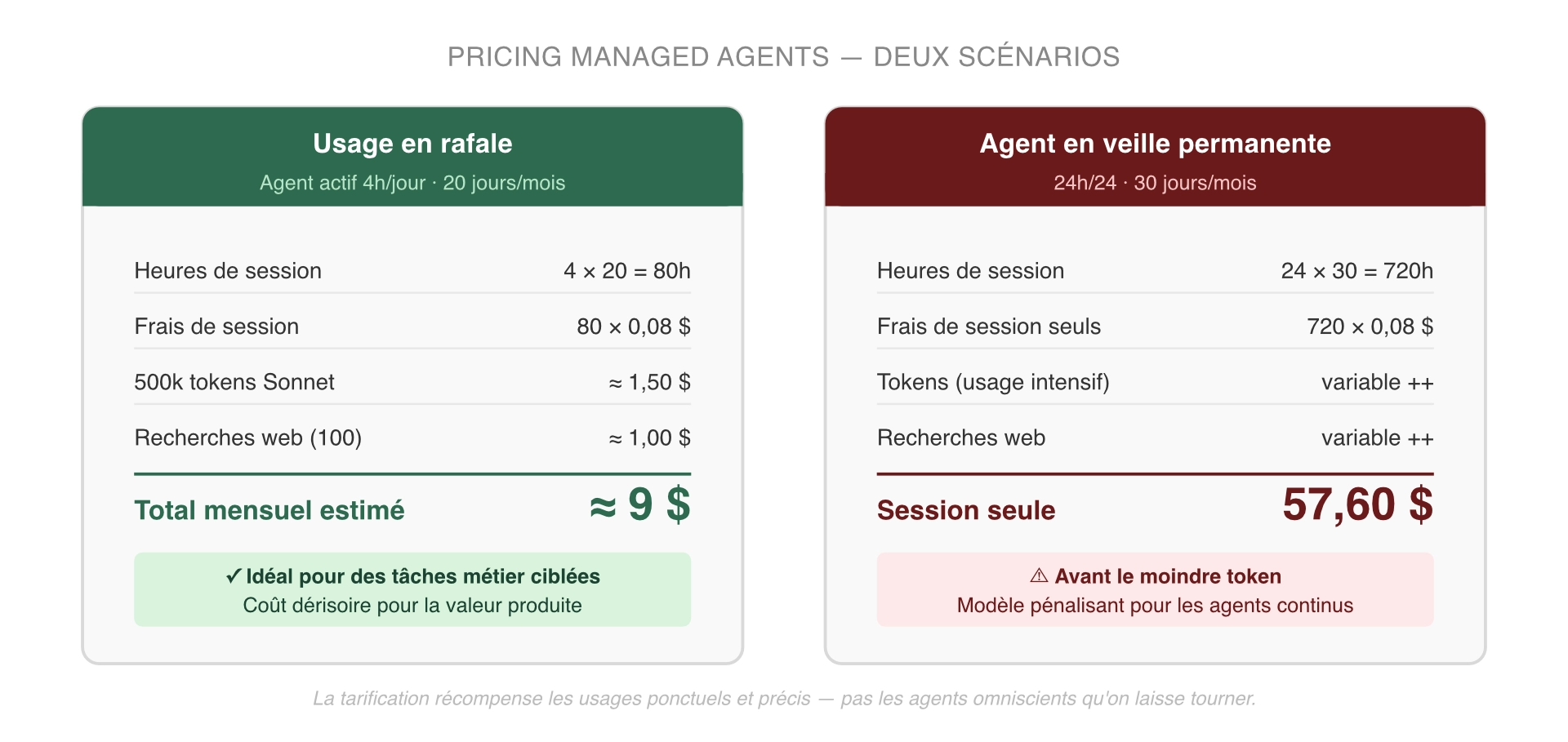
The pricing rewards occasional, precise usage, not omniscient agents you leave running.
Rakuten deploys one agent per department in a week. Sentry goes from diagnosing a bug to the fix pull request in a single flow. These are real gains.
If you’re a developer and you’re building to learn, to understand, to master, go through the fundamentals first. Build your own agent loop. Understand what a harness does. Wrestle with context management, with tool errors, with failure recovery. Claude Code hooks, skills, WebMCP: all of them interfaces that give you access to the mechanism before the abstraction hides it from you. This isn’t masochism, it’s foundational skill.
And if you care about sovereignty (data, costs, vendor lock-in), the question I raised about local, open-source AI regains all its relevance here. Managed Agents is Anthropic infrastructure, in Anthropic data centers, with Anthropic billing. It’s a coherent choice for many uses. But it’s a choice, not a foregone conclusion.
The real distinction isn’t between those who use Managed Agents and those who don’t. It’s between those who know what they’re delegating and those who delegate what they don’t understand.
Automating what you don’t understand isn’t automating. It’s outsourcing your incompetence with a better service contract.